


![Everything You Need to Know About the IB Extended Essay [2027 GUIDE]](https://cdn.prod.website-files.com/66c84025dfaab9d8f83e6106/6ac43a72f5c40fb6309d23f0_6ac43a6f26400389f47df62b_Everything%2520You%2520Need%2520to%2520Know%2520About%2520the%2520IB%2520Extended%2520Essay%2520%255B2027%2520GUIDE%255D.webp)
The Extended Essay (EE) is one of the three parts of the IB Diploma Programme core, alongside Theory of Knowledge and CAS. It is a 4,000-word research essay on a topic you choose, and for many students it is the first real piece of independent academic research they have ever done.
The IB has published a new Extended Essay guide for students first assessed in 2027. That means students sitting their final exams in May 2027 or later (normally those who started the Diploma in 2025 or later) follow new rules. The new guide brings in a new interdisciplinary pathway, new assessment criteria, a new mark total and a new way of assessing reflection.
This guide explains how the new EE works and exactly what has changed from the old one. All the facts come from the IB's Extended essay guide (first assessment 2027, updated November 2025), written in our own words.
Key Takeaways
- The EE is a compulsory, externally assessed research essay of up to 4,000 words, plus a reflective statement of up to 500 words. It takes about 40 hours of work.
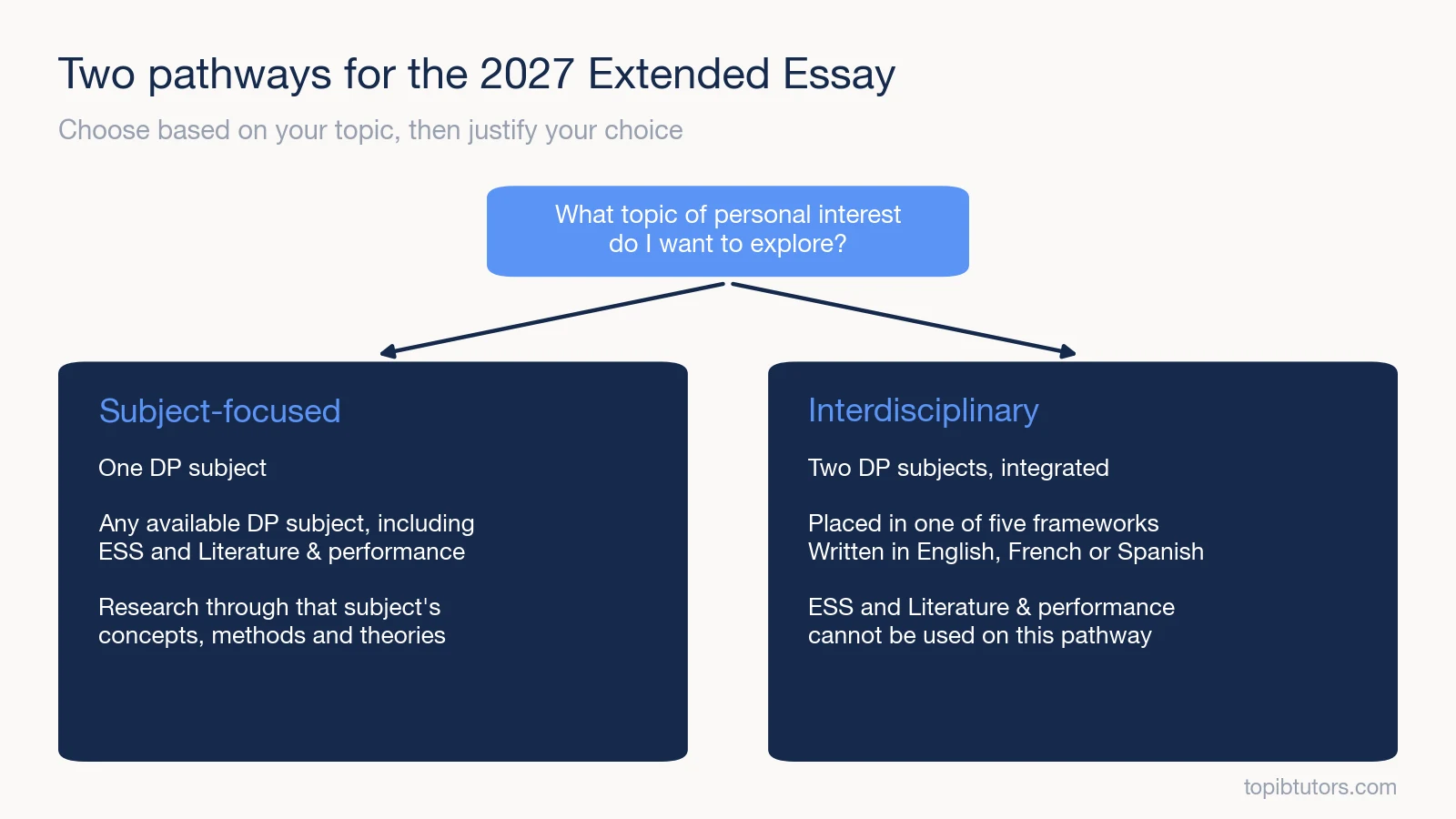
- From 2027 you choose one of two pathways: subject-focused (one DP subject) or interdisciplinary (two DP subjects, placed in one of five frameworks). The interdisciplinary pathway replaces the old World Studies EE.
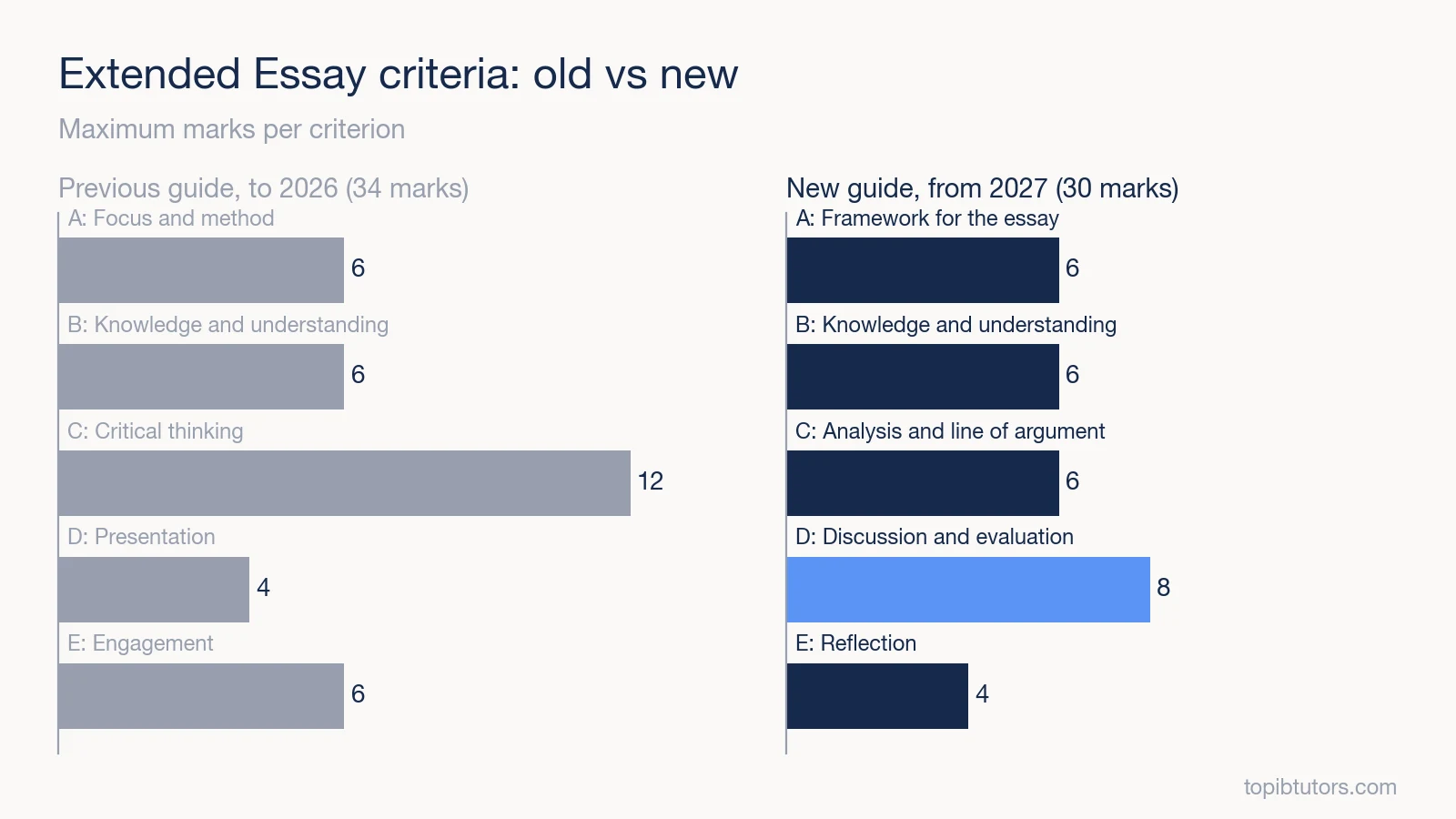
- The essay is marked out of 30 (down from 34) against five new criteria: framework, knowledge and understanding, analysis and line of argument, discussion and evaluation, and reflection.
- You attend three compulsory reflection sessions with your supervisor, ending in a short viva voce interview, then write your reflective statement.
- The EE is graded A to E and combines with your TOK grade for up to 3 bonus points. An E is a failing condition.
What Is the IB Extended Essay?
The Extended Essay is an in-depth study of a focused topic of your own choice. You write a research question, investigate it using methods suited to your subject (or subjects), and present your findings as a formal academic essay. A supervisor, a teacher at your school, guides you throughout.
Here are the basics:
| Feature | Details |
|---|---|
| Length | Up to 4,000 words for the essay, plus a reflective statement of up to 500 words |
| Time | About 40 hours of your own work |
| Supervision | Three to five hours with your supervisor, including three compulsory reflection sessions |
| Assessment | Marked by IB examiners (external assessment) out of 30, then graded A to E |
| Diploma requirement | Compulsory for all Diploma students You need at least a D to be awarded the diploma |
| Bonus points | Combined with your TOK grade for up to 3 points towards your total of 45 |
The IB's stated aims for the EE are for you to experience the excitement of exploring ideas, carry out research driven by your own interests, build skills in research, thinking, self-management and communication, and reflect on what you learned along the way.
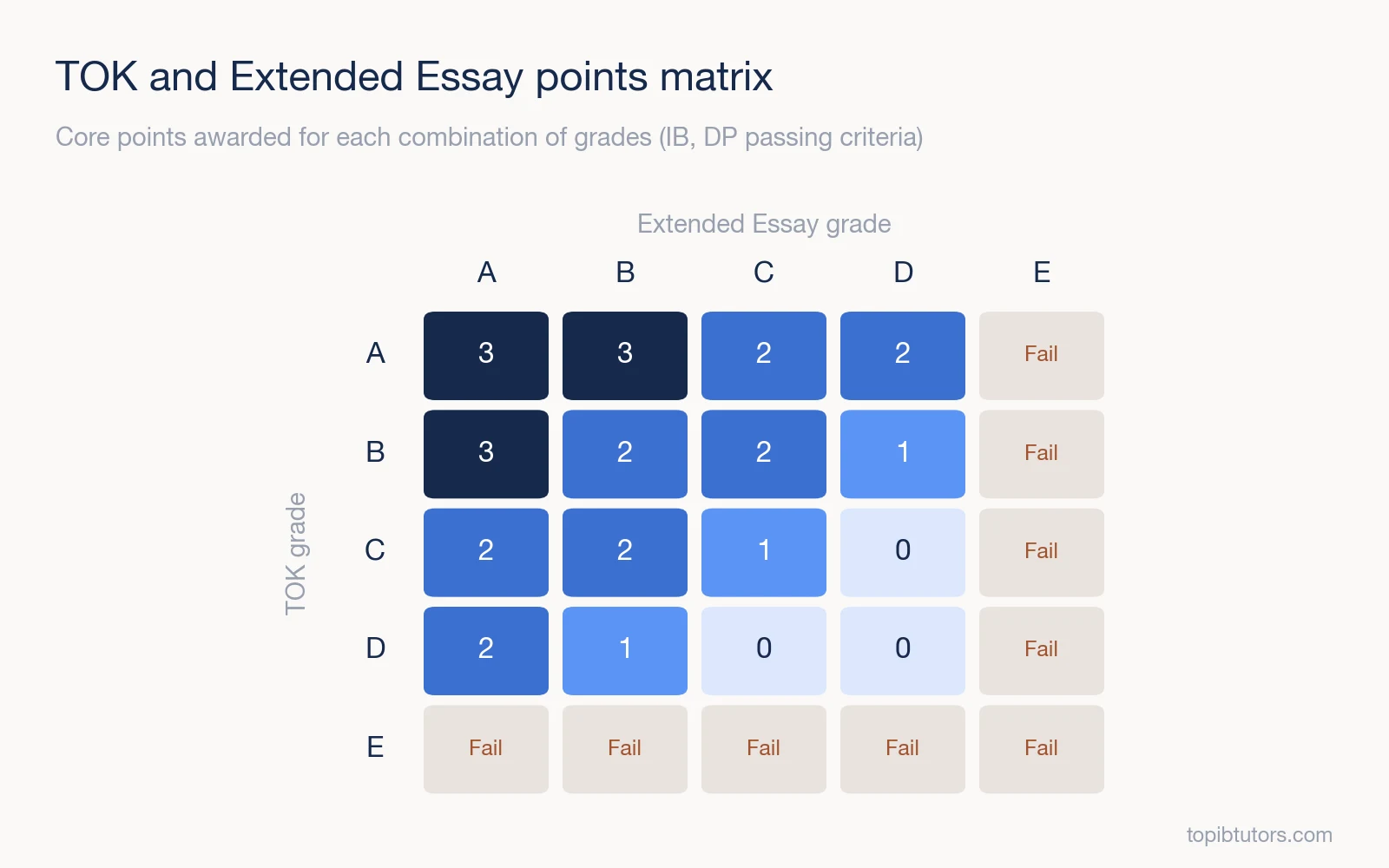
The EE and TOK grades together decide your core points, as the matrix above shows. For a full explanation, see our guide to how your IB score is calculated.
What Has Changed? The Old EE vs the New EE
If you have older siblings, friends or tutors who did the EE before 2027, a lot of their advice still applies: it is still a 4,000-word research essay with a supervisor and a viva voce. But several important things have changed.
| Old EE (assessed up to 2026) | New EE (first assessment 2027) | |
|---|---|---|
| Pathways | An essay in one DP subject, or a World Studies EE across two subjects | Subject-focused (one subject) or interdisciplinary (two subjects) |
| Interdisciplinary structure | World Studies: an issue of global importance in one of six themes | Topic placed in one of five frameworks It no longer has to be a global issue |
| Assessment criteria | A: Focus and method B: Knowledge and understanding C: Critical thinking D: Presentation E: Engagement | A: Framework for the essay B: Knowledge and understanding C: Analysis and line of argument D: Discussion and evaluation E: Reflection |
| Total marks | 34 | 30 |
| Biggest criterion | C: Critical thinking (12 marks) | D: Discussion and evaluation (8 marks) |
| Reflection | Three written reflections across the process, up to 500 words in total, marked under Engagement (6 marks) | Three reflection sessions, then one 500-word reflective statement written at the end, marked under Reflection (4 marks) |
| Reflection form | Reflections on planning and progress form (RPPF) | Reflection and progress form (RPF) |
| Unchanged | 4,000 words, about 40 hours, a school supervisor, a final viva voce, one draft read by your supervisor, graded A to E | Same |
What do these changes mean in practice?
- Analysis and argument now carry most of the marks. Criteria C and D together are worth 14 of the 30 marks. A clear, sustained line of argument that links your research question, findings and conclusion is essential.
- Evaluation is spread through the essay. The IB says it does not want a separate "evaluation" section at the end. You should weigh up your sources and methods throughout.
- Reflection is one focused piece of writing. Instead of three short reflections, you write one statement at the end. It should evaluate what the EE taught you and how you will use those skills elsewhere, with specific examples.
- Presentation is no longer its own criterion. Structure now sits inside Criterion A, alongside your research question and methods.
- Interdisciplinary essays are more flexible. You no longer need an issue of global significance. You do need to integrate two subjects and justify why that helps answer your question.
Choosing Your Pathway
Every new EE starts the same way: with a topic you are genuinely curious about. You then decide whether it is best explored through one subject or two.
The Subject-Focused Pathway
You research your topic using the knowledge, concepts, theories, perspectives and methods of one DP subject. This is the right choice when your idea sits clearly inside one discipline, for example a close reading of a novel in English, or a laboratory experiment in Chemistry.
The IB strongly recommends that you already study the subject in the DP, so that you have enough subject knowledge to do rigorous research. You must choose from the list of subjects available for your exam session. Two subjects are classed as "cross-disciplinary", Environmental Systems and Societies and Literature and performance, and these can only be used on the subject-focused pathway.
The Interdisciplinary Pathway
You integrate the knowledge, concepts, theories, perspectives or methods of two DP subjects to answer a question that one subject alone could not answer as well. For example, you might combine physics and sports science to study how a cricket ball spins, or psychology and visual arts to study how an artist's perception shapes abstract paintings.
Key rules and points:
- Integration grows as you go. You don't need a fully integrated plan from day one. Start by applying ideas from both subjects; by the conclusion, the reader should see how combining them gave you a deeper answer.
- The balance doesn't need to be 50/50. One subject can carry more weight, as long as integrating the two clearly helps you answer the research question.
- Study at least one of the two subjects. The IB strongly recommends this to keep your research rigorous.
- Language of submission. For now, interdisciplinary essays must be written in English, French or Spanish.
- ESS and Literature and performance cannot be combined with another subject.
The Five Interdisciplinary Frameworks
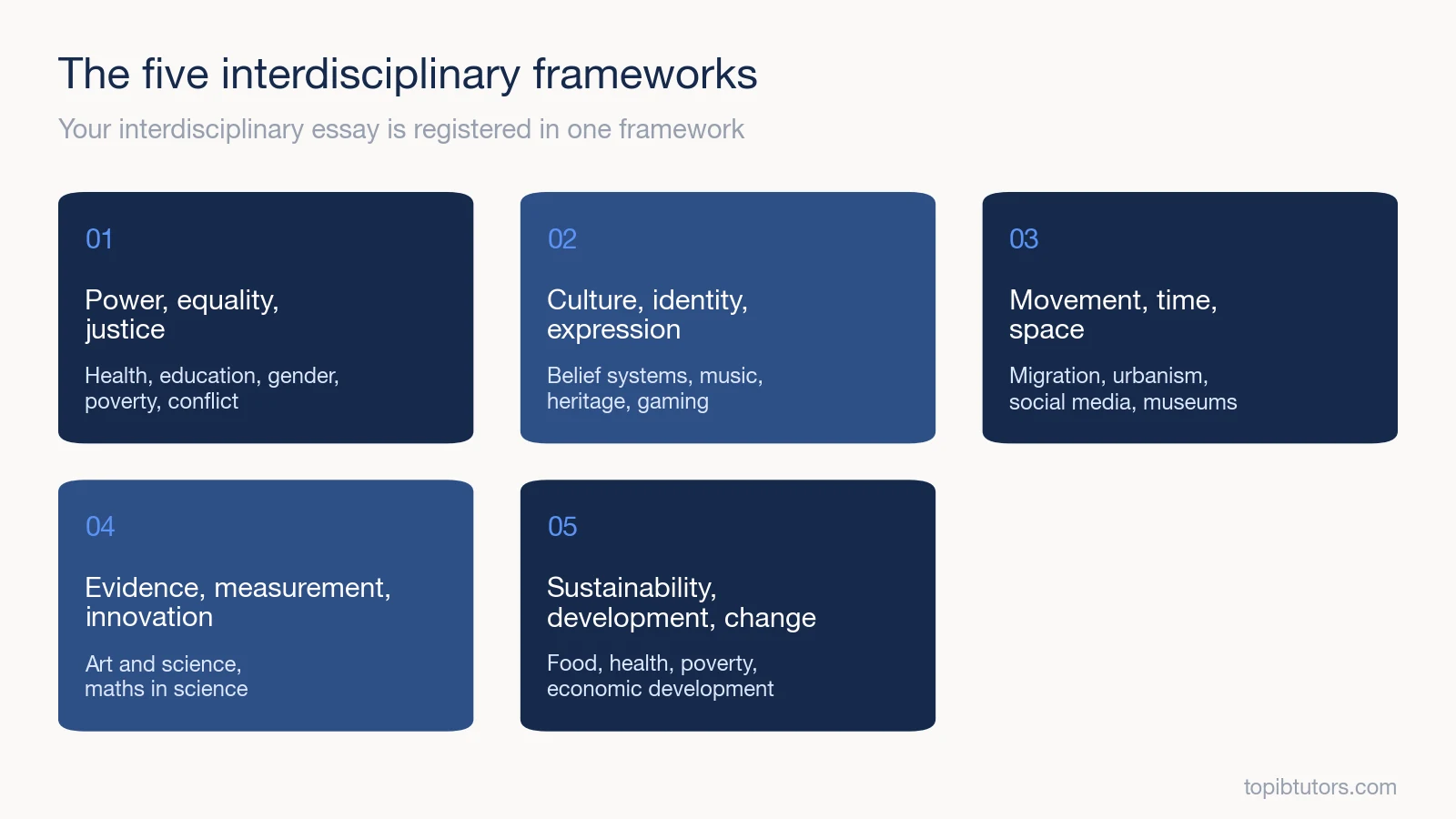
When you register an interdisciplinary essay, you place it in one of five frameworks. The framework helps you shape your idea and helps the IB organise marking. It is not directly assessed, and your topic only needs to connect with one of the words in the framework, not all three.
The Assessment Criteria
The same five criteria apply to every essay, whether subject-focused or interdisciplinary, and examiners apply them in the context of your subject or subjects. Criteria A to D are applied to the essay as a whole. Criterion E is applied only to your reflective statement.
| Criterion | What it looks at | Marks |
|---|---|---|
| A: Framework for the essay | Whether your research question is relevant, clear and focused Whether your research methods suit the question and are explained and applied well And whether your structure helps communicate your research | 6 |
| B: Knowledge and understanding | How well you use relevant research materials to build knowledge of the topic, and how accurately you use the subject's terminology and concepts | 6 |
| C: Analysis and line of argument | Whether you analyse (rather than describe) and produce relevant findings, and whether a clear argument links your question, findings and conclusions | 6 |
| D: Discussion and evaluation | How balanced your discussion of the significance of your findings is, how well it is supported by evidence, and how well you evaluate the strengths and limitations of your essay | 8 |
| E: Reflection | Whether your reflective statement evaluates the EE experience with specific examples, and shows your growth and how you can transfer what you learned | 4 |
| Total | 30 |
Examiners use a "best fit" approach and mark positively: they look for what you have done well rather than hunting for mistakes. The IB also notes that the top marks do not require a perfect essay.
Writing a Strong Research Question
Your research question drives everything else, so it is worth spending time on it. The IB's advice comes down to a few clear points:
- Make it an actual question, not a statement or a hypothesis.
- Keep it focused. You need to be able to answer it properly in 4,000 words. Broad topics almost always lead to descriptive essays.
- Ask one question, not two. Avoid "double-barrelled" questions.
- Use wording that invites analysis, such as "to what extent", "how significant" or "how effective".
- Avoid obvious answers. The answer shouldn't be clear from the question itself.
- Check your sources early. If there isn't enough good material, adjust the question or change topic. The IB is clear that changing direction is completely acceptable.
Here are two examples of the difference this makes:
| Too broad or descriptive | Better focused |
|---|---|
| What is climate change doing to coral reefs? | To what extent did the 2024 bleaching event change coral cover at one named reef site, compared with the previous decade? |
| How does a novelist use symbolism? | How does the recurring image of the sea shape the presentation of grief in one named novel? |
Reflection: Sessions, the RRS and the Reflective Statement
Reflection is now a much more defined part of the EE.
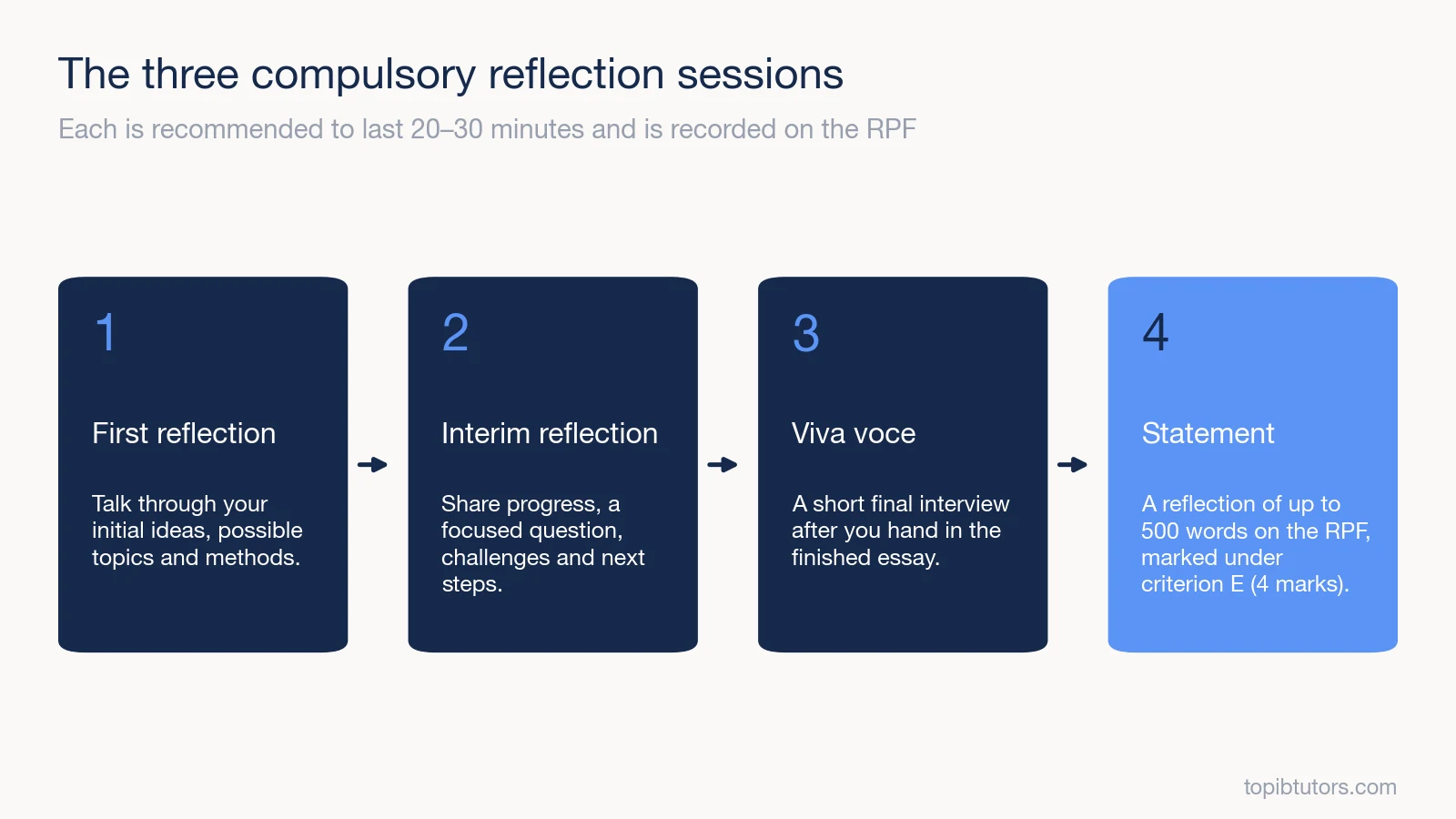
- Three compulsory reflection sessions. These are the first reflection (your initial ideas), the interim reflection (progress, your research question and any challenges) and the final reflection, the viva voce. The viva voce is a short interview, held after you hand in your finished essay, that celebrates the work and checks it is your own. Your attendance at all three is recorded on the reflection and progress form (RPF).
- Check-ins are different. Shorter catch-ups with your supervisor between sessions are encouraged, but they aren't recorded on the RPF.
- The researcher's reflection space (RRS). This is a journal, physical or digital, where you record ideas, reading notes, decisions and questions. It isn't submitted, but the IB strongly recommends keeping one because it makes the reflective statement much easier to write.
- The reflective statement. You write up to 500 words at the end of the process, on the RPF. Examiners don't read beyond 500 words. The RPF must be written in the same language as your essay. A blank, missing or wrong-language RPF scores zero for Criterion E.
A strong statement goes beyond describing what happened. It evaluates the experience with specific examples, explains how your thinking changed, and shows how you will use the skills you developed in future study or work.
Word Count, Structure and Formatting
The upper limit is 4,000 words. Examiners are told not to read anything beyond the limit, so going over hurts your marks across every criterion.
| Counts towards the 4,000 words | Does not count |
|---|---|
| Introduction, main body and conclusion | Contents page and headers |
| Quotations | Maps, charts, diagrams and annotated illustrations |
| Footnotes or endnotes that are not references | Tables |
| Equations, formulas and calculations | |
| Citations and references, and the bibliography | |
| The reflection and progress form |
If you write in Chinese, Japanese or Korean, the IB uses conversions: up to 4,800 Chinese characters, up to 8,000 Japanese characters, and 4,000 words in Korean.
Your essay must include a title page, contents page, introduction, body, conclusion and reference list or bibliography. The title page shows your student code, your research question, your subject (or, for an interdisciplinary essay, both subjects and your framework) and your word count. The IB also asks for:
- Font size 12 with 1.5 line spacing
- Page numbers, starting after the contents page
- No names of you, your supervisor or your school anywhere in the file
- A file size under 10 MB
Important information belongs in the body of the essay, not in appendices or footnotes, because examiners don't have to read those.
The Rules You Need to Know
- Your supervisor reads one full draft. They give written feedback but may not edit it. The next version you hand in is your final essay, and it can't be changed after the viva voce.
- No "double-dipping". Your EE must not repeat material from another DP assessment, such as an internal assessment. If you reuse a resource, the essay needs a clearly different angle and focus.
- Using AI. Using AI to write your essay is academic misconduct. The IB does allow AI-generated material as a source, as long as you acknowledge it, cite it and check it against other sources.
- Cite as you write. Every source must be acknowledged in a consistent referencing style, and online sources need the date you accessed them. Examiners report essays that don't meet the minimum referencing requirements.
- External mentors. If you do research at a university or institute, you can have an external mentor, but your school supervisor still runs the reflection sessions and signs off the RPF.
- Ethics and safety. Research involving people, animals or fieldwork must follow the IB's ethical and experimentation guidelines.
A Few Subject-Specific Rules
The guide includes detailed advice for each subject group. A few rules catch students out:
- Psychology: your essay must use secondary sources only. Collecting primary data is not allowed.
- Social and cultural anthropology: your essay must be based on existing ethnographic material. Primary data can only supplement it.
- Language A: the essay must be written in the language it is registered in, and it can't be based on a text you studied in your Language and Literature course.
- Language B: all texts must originally be written or spoken in the target language, and you can't write it in a language you study as Language A.
- Visual arts: images are compulsory and must appear in the body of the essay.
- Sciences: your method must be detailed enough for someone else to repeat it, and any analysis of secondary data must be your own.
A Suggested Timeline
Schools set their own deadlines, but a typical plan over the two years of the Diploma looks like this:
| Stage | What you do |
|---|---|
| Start of DP year 1 | Brainstorm topics linked to subjects you enjoy Read the guide and the assessment criteria |
| First reflection session | Discuss possible topics, your pathway, sources and methods with your supervisor |
| Middle of DP year 1 | Do preliminary research, choose a focused research question and plan your method |
| End of DP year 1 | Collect data or carry out your main research Start writing |
| Interim reflection session | Share your progress, any challenges and your planned line of argument |
| Start of DP year 2 | Complete a full draft and receive your supervisor's written feedback |
| Final weeks | Revise, check your word count and referencing, submit the final essay |
| Viva voce, then reflective statement | Final interview, then write your 500-word reflection on the RPF |
Tips for a High-Scoring Extended Essay
1. Pick a topic you actually care about. You will spend about 40 hours on it. 2. Narrow your question early. Most low-scoring essays try to cover too much. 3. Read the criteria before you start, and use them as a checklist at every stage. 4. Build an argument, not a report. Each section should move your answer forward. 5. Evaluate as you go. Comment on how reliable your sources, data and methods are throughout, not just at the end. 6. Keep your RRS up to date. Your reflective statement will be far stronger with real examples to draw on. 7. Leave time to edit. Cutting a 5,000-word draft down to 4,000 words often improves the essay.
Common Mistakes to Avoid
- Writing a descriptive essay that summarises sources instead of analysing them
- A research question that is too broad, double-barrelled or has an obvious answer
- Going over the word limit, or putting key material in footnotes or appendices
- For interdisciplinary essays, treating the two subjects separately instead of integrating them
- A reflective statement that just tells the story of the process
Frequently Asked Questions
Which students follow the new Extended Essay guide?
Students first assessed in 2027, which normally means those taking their final exams in May 2027 or later. Students assessed in 2026 follow the previous guide.
Can I still do a World Studies Extended Essay?
No. From 2027 the World Studies EE is replaced by the interdisciplinary pathway, which combines two DP subjects within one of five frameworks.
How many marks is the new EE out of?
30 marks: 6 each for Criteria A, B and C, 8 for Criterion D, and 4 for Criterion E (reflection).
Do I have to study the subject I write my EE in?
It isn't a formal requirement, but the IB strongly recommends it. For an interdisciplinary essay, you should study at least one of the two subjects.
What happens if I get an E?
An E grade in the Extended Essay is a failing condition, so you would not be awarded the diploma, whatever your other scores.
How much help can my supervisor give?
Your supervisor guides, questions and supports you, attends your three reflection sessions and comments in writing on one full draft. They can't edit your work or give you information or data for the essay.
Can I use AI tools?
Only as a research aid that you acknowledge and cite, never to write any part of your essay. The IB treats AI-written work presented as your own as academic misconduct.
Get Support With Your Extended Essay
The Extended Essay is a big, independent project, and good guidance at the right moments makes a real difference. Our experienced tutors offer Extended Essay support: developing a focused research question, planning your method, structuring your argument and preparing for your viva voce, all within the IB's rules on authentic work. For the rest of the Diploma, see our guide to everything you need to know about the IB.


