


Japanese B is a language acquisition course (Group 2) in the IB Diploma Programme for students who already have some Japanese and want to become confident, independent users of the language, in speaking, listening, reading and writing.
Interest in Japanese has never been higher. According to the Japan Foundation's Survey on Japanese-Language Education Abroad 2024, more than 4 million people now study Japanese at institutions outside Japan, across 143 countries and regions. That is the highest number since the survey began. Japanese opens doors to study and work in Japan, and to one of the world's most influential cultures in technology, design, film, anime and literature.
This guide covers everything you need to know about the current Japanese B course, from choosing SL or HL to every part of the assessment. It also explains the updated Language B course, first assessed in 2029. The course facts come from the IB's Language B guide (first assessment 2020) and the IB's official subject briefs and updates, written in our own words.
Key Takeaways
- Japanese B is for students with some previous Japanese. Complete beginners take Japanese ab initio, and native speakers usually take Japanese A.
- It is offered at SL (150 hours) and HL (240 hours). HL students also study two literary works originally written in Japanese.
- The course is built around five themes: identities, experiences, human ingenuity, social organization and sharing the planet.
- Assessment: Paper 1 writing (25%), Paper 2 listening and reading (50%) and an individual oral (25%). In Japanese, Paper 1 length is measured in characters (字), not words.
- An updated Language B course starts with first assessment in 2029, but the IB has confirmed no changes to the assessment model.
Which IB Japanese Course Should You Take?
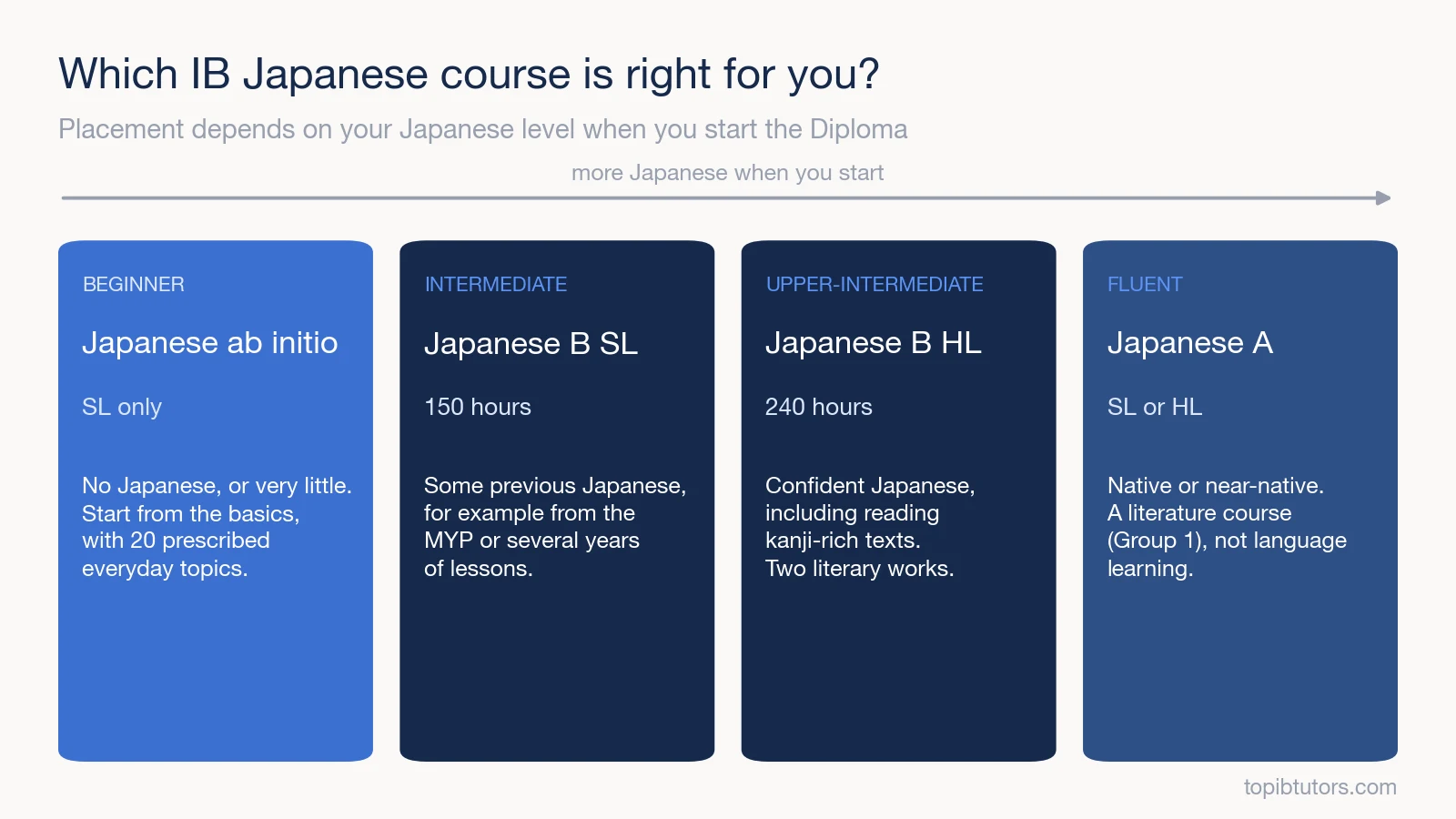
The IB offers Japanese in three different ways, and choosing the right one matters. Taking a course that is too easy or too hard for your current level is one of the most common mistakes students make with languages.
| Course | Who it is for | Levels |
|---|---|---|
| Japanese ab initio | Students with no previous Japanese, or very little | SL only |
| Japanese B | Students with some previous experience of Japanese | SL and HL |
| Japanese A (Literature, or Language and Literature) | Native or near-native speakers. A literature course in Group 1, not a language-learning course | SL and HL |
As a rough guide, if you can already read hiragana and katakana, know a few hundred kanji and can hold a simple conversation, Japanese B is likely to be right for you. If you're starting from zero, read our guide to IB Japanese ab initio. Your school will make the final decision, often using your MYP results or a placement test.
What Is the Difference Between Japanese B SL and HL?
At both levels, you learn to describe situations, tell stories, make comparisons, explain problems and give and support your opinions in Japanese. The differences are in depth, complexity and literature.
| Japanese B SL | Japanese B HL | |
|---|---|---|
| Teaching hours | 150 | 240 |
| Literature | Not required | Two literary works originally written in Japanese are required |
| Language expectations | Understand straightforward arguments Write and speak on topics of interest | Analyse arguments and literary texts Use a wider and more complex range of language, including more kanji and more formal registers |
| Paper 1 | 500–800 characters, 1 hour 15 minutes | 900–1,200 characters, 1 hour 30 minutes |
| Paper 2 listening | 45 minutes | 1 hour |
| Individual oral stimulus | A visual image | An extract from one of your literary works |
HL suits students who are already comfortable in Japanese, enjoy reading, and may want to study or work in Japan. SL is a strong choice if Japanese is a supporting language for you and you want to build solid, practical fluency.
The Five Themes
Every Language B course, including Japanese, is organised around five prescribed themes. All five must be covered equally. The IB also suggests recommended topics for each theme, but these are not prescribed, so your teacher can choose topics that suit the class and Japanese culture.
| Theme | What it explores | Recommended topics |
|---|---|---|
| Identities | The nature of the self and what it means to be human | Lifestyles Health and well-being Beliefs and values Subcultures Language and identity |
| Experiences | The events, experiences and journeys that shape our lives | Leisure activities Holidays and travel Life stories Rites of passage Customs and traditions Migration |
| Human ingenuity | How human creativity and innovation affect our world | Entertainment Artistic expressions Communication and media Technology Scientific innovation |
| Social organization | How groups of people organise themselves, or are organised | Social relationships Community Social engagement Education The working world Law and order |
| Sharing the planet | The challenges and opportunities facing individuals and communities in the modern world | The environment Human rights Peace and conflict Equality Globalization Ethics Urban and rural environment |
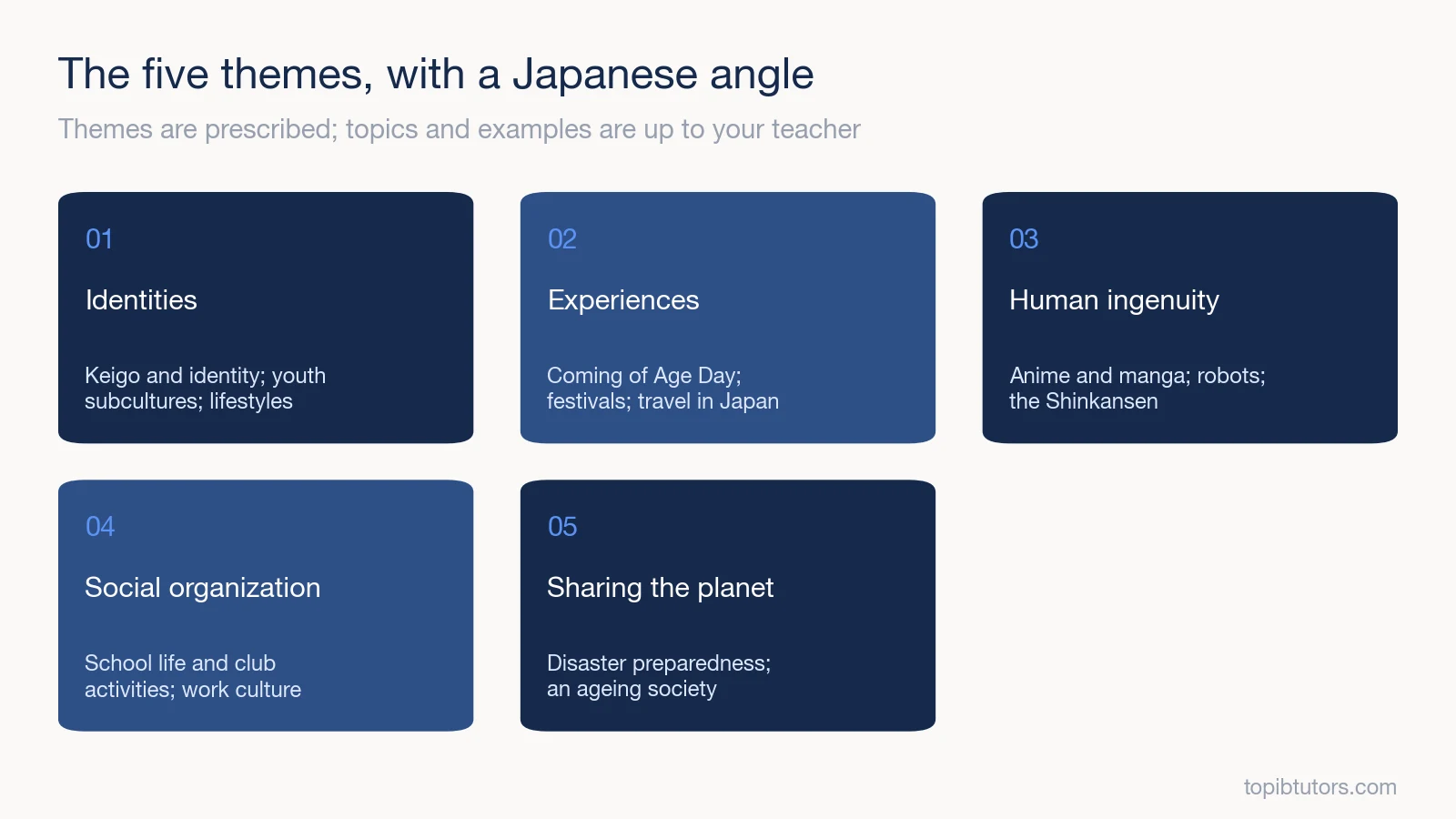
The best Japanese B students link every theme to specific features of Japanese society and culture. Think of how keigo (honorific language) reflects social relationships, Coming of Age Day (成人の日) as a rite of passage, school club activities (部活), disaster preparedness after major earthquakes, Japan's ageing society, or the global influence of anime and manga. Specific, well-chosen examples make your writing and your oral far more convincing.
Texts and Text Types
The course uses three broad categories of texts. You'll read and listen to them throughout the course, and you'll write some of them in Paper 1.
| Personal texts | Professional texts | Mass media texts |
|---|---|---|
Blog Diary Email Personal letter Social media posting | Blog Email Essay Formal letter Proposal Questionnaire Report Set of instructions Survey | Advertisement Article Blog Brochure Film Interview Leaflet News report Opinion column Podcast Poster Review Speech Travel guide Web page |
The course also develops your understanding of audience, context, purpose, meaning and variation. In Japanese these ideas matter even more than in many languages, because the level of politeness is built into the grammar. Choosing between plain form, です・ます form and keigo is a key part of writing for the right audience.
Assessment Overview
Standard Level (SL)
| Component | What it involves | Time | Weighting |
|---|---|---|---|
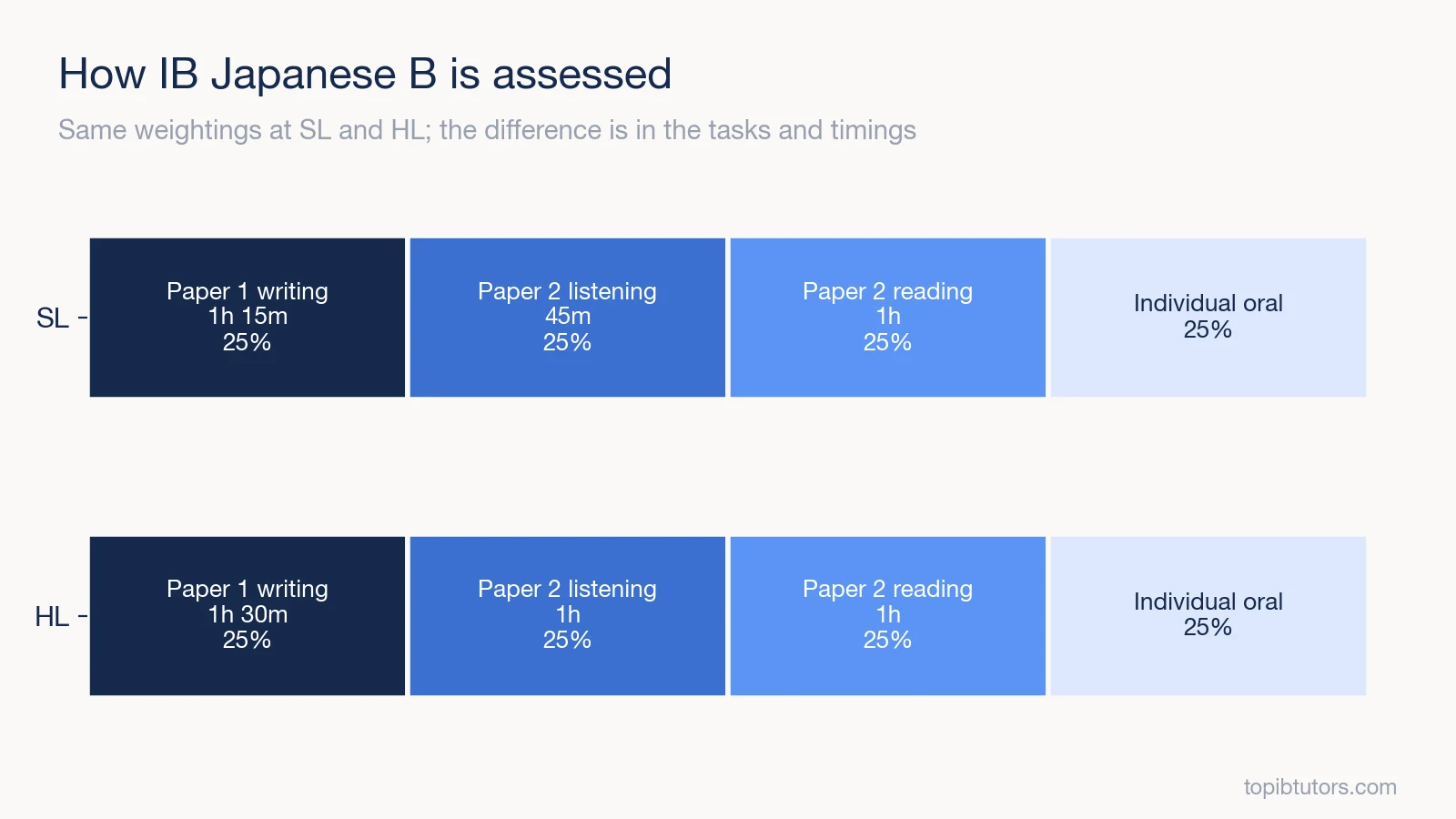
| Paper 1: writing (30 marks) | One writing task of 500–800 characters from a choice of three, each on a different theme. You choose the text type from the options given | 1h 15m | 25% |
| Paper 2: listening (25 marks) | Comprehension questions on three audio passages | 45m | 25% |
| Paper 2: reading (40 marks) | Comprehension questions on three written texts | 1h | 25% |
| Individual oral (30 marks) | A presentation on a visual stimulus, a follow-up discussion and a general conversation | 12–15 min, plus 15 min preparation | 25% |
Higher Level (HL)
| Component | What it involves | Time | Weighting |
|---|---|---|---|
| Paper 1: writing (30 marks) | One writing task of 900–1,200 characters from a choice of three, each on a different theme. The tasks demand more complex language and higher-order thinking | 1h 30m | 25% |
| Paper 2: listening (25 marks) | Comprehension questions on three audio passages | 1h | 25% |
| Paper 2: reading (40 marks) | Comprehension questions on three written texts | 1h | 25% |
| Individual oral (30 marks) | A presentation on an extract from one of your two literary works, a follow-up discussion and a general conversation | 12–15 min, plus 20 min preparation | 25% |
Dictionaries and reference materials are not allowed in Paper 1 or Paper 2.
A note on length: the IB guide gives Paper 1 lengths in words (250–400 at SL and 450–600 at HL) for languages that use them. For Japanese, length is counted in characters. The figures above are those used in IB World School course outlines for Japanese B, and they follow the same 2 characters-per-word ratio the IB uses for Extended Essays written in Japanese (8,000 characters instead of 4,000 words). Always check the exact range printed on your exam paper.
Paper 1: Writing
In Paper 1, you choose one of three tasks. Each task sets out a scenario with an audience, a context and a purpose, and offers a choice of text types. For example, you might be asked to write to a local council, for a school newspaper or for a blog. Your job is to choose the most appropriate text type and write it convincingly in Japanese.
Paper 1 is marked against three criteria:
| Criterion | What examiners look at | Marks |
|---|---|---|
| A: Language | How varied and appropriate your vocabulary is, how varied your grammar is, and how accurate your Japanese is | 12 |
| B: Message | How relevant your ideas are to the task, how well you develop them, and how clearly they are organised | 12 |
| C: Conceptual understanding | Whether you chose a suitable text type, used the right register and tone, and followed the conventions of that text type | 6 |
| Total | 30 |
One rule catches many students out. The IB notes that a response that ignores the context, purpose and audience can score zero for criteria B and C, even if the Japanese itself is excellent. Answer the task you were set, not the one you prepared for.
Japanese Text Type Conventions
The IB guide doesn't list conventions for each language, but examiners expect you to know them. Here are a few that matter in Japanese:
| Text type | Conventions to show |
|---|---|
| Formal letter (手紙) | An opening word such as 拝啓 and a matching closing word such as 敬具 A short seasonal greeting (時候の挨拶) The date (2026年10月6日) The recipient's name with 様 です・ます form or keigo throughout |
| Formal email (メール) | A subject line (件名) The recipient's name with 様 A polite opening such as お世話になっております A clear request A closing such as よろしくお願いいたします |
| Informal email or message | The friend's name with さん or ちゃん Plain or friendly です・ます form A casual sign-off such as じゃあ、またね |
| Article (記事) | A headline, a short lead, clear paragraphs, and usually だ・である style (or です・ます for a school newspaper) |
| Blog or diary (ブログ・日記) | A title and date, a personal tone, and a question or comment to readers in a blog |
| Speech (スピーチ) | A greeting (皆さん、こんにちは), self-introduction where appropriate, direct address to the audience, and a polite closing (ご清聴ありがとうございました) |
The most common mistake in Japanese Paper 1 is mixing styles: switching between です・ます form and plain form within one text. Choose one style that fits the text type and stay consistent (文体の統一).
Paper 2: Listening and Reading
Paper 2 tests your understanding of six authentic texts: three audio passages and three written texts, drawn from all five themes. It doesn't test factual knowledge of the topics, only your understanding of the Japanese. All questions are in Japanese, and all answers must be in Japanese.
Question types typically include multiple choice, true or false with justification, matching, gap-fills and short answers.
The audio can range from formal announcements and interviews to casual conversations between friends, so you need to recognise polite, plain and keigo forms by ear. Reading texts include kanji, so a strong reading vocabulary is essential.
How to prepare: - Listen to Japanese podcasts, news and dramas every week, including both formal and casual speech. - Read NHK News Web Easy (NHK NEWS WEB EASY), which presents real news in simpler Japanese with furigana. - When you practise past papers, look at why an answer is right. Many marks are lost by copying too much or too little from the text.
The Individual Oral
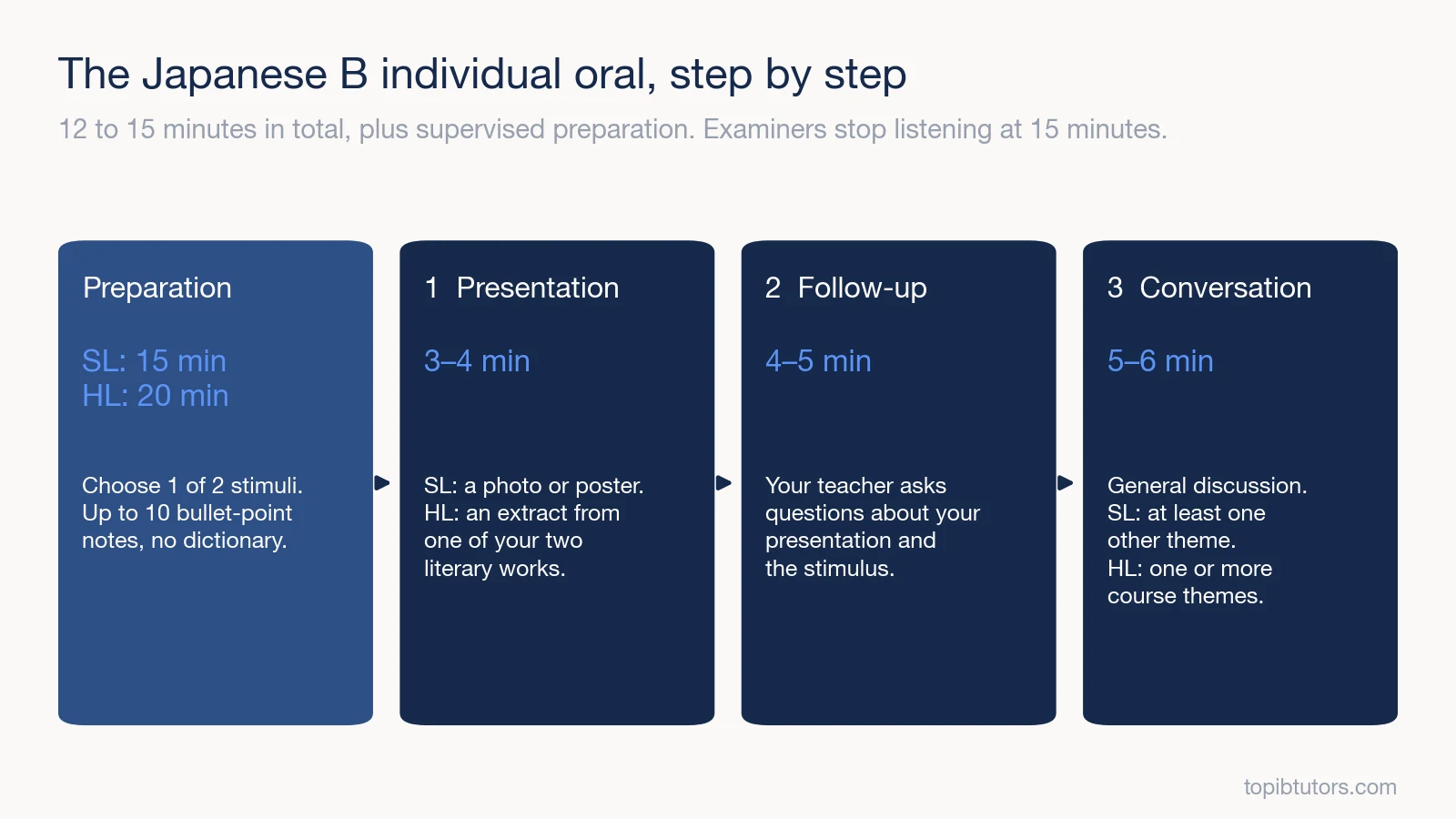
The individual oral is the internal assessment for Japanese B. It takes place in your final year, is conducted entirely in Japanese, and is marked by your teacher and moderated by the IB. It is audio recorded, and it cannot be rehearsed, although you can and should practise the format.
SL: The Visual Stimulus
You're shown two images, each linked to a different theme and labelled in Japanese. You haven't seen them before. You choose one and have 15 minutes to prepare, making up to 10 bullet-point notes. The images may be a photo, a poster, an illustration or an advertisement.
| Part | What happens | Time |
|---|---|---|
| 1: Presentation | You describe the image, link it to its theme and to Japanese culture, and give your opinions | 3–4 min |
| 2: Follow-up discussion | Your teacher asks questions about the theme and your presentation | 4–5 min |
| 3: General discussion | A conversation on at least one additional theme from the course | 5–6 min |
HL: The Literary Extract
You're shown two short extracts (the IB guide sets about 300 words for word-based languages), one from each of the literary works you studied. You choose one and have 20 minutes to prepare. In your presentation, you summarise the extract, briefly place it in the work as a whole, and give your opinions on its characters, events, ideas and themes. Most of your presentation must focus on the extract itself, not the whole book. The follow-up discussion explores the extract, and the general conversation uses one or more of the course themes as a starting point.
How the Oral Is Marked
| Criterion | What it looks at | Marks |
|---|---|---|
| A: Language | Vocabulary, grammar, accuracy, pronunciation and intonation | 12 |
| B1: Message (stimulus or extract) | How well your presentation engages with the image or extract and, at SL, links it to Japanese culture | 6 |
| B2: Message (conversation) | How relevant, developed and thorough your answers are | 6 |
| C: Interactive skills | How well you understand, keep the conversation going and contribute ideas of your own | 6 |
| Total | 30 |
Rules to Know
- Your notes are for reference only. Reading them aloud as a speech is not allowed.
- No phones, dictionaries or class notes in the preparation room.
- Pre-learned presentations on generic topics that don't focus on the actual image or extract will not score high marks.
- Examiners stop listening after 15 minutes.
HL Literature: The Two Literary Works
HL students must study two complete literary works originally written in Japanese. These can be prose fiction, non-fiction, poetry or drama. The IB is clear that works in translation and simplified "easy reader" versions don't count. It also says works should be linguistically accessible for language learners, so teachers tend to choose modern works rather than classical texts.
The aim is not literary criticism, which belongs in Japanese A. Instead, the works are a stimulus for discussion: you should understand their themes, plot and characters well enough to talk about them confidently in your oral.
Your teacher chooses the works. Examples of the kind of works schools might use include 『キッチン』 (Banana Yoshimoto), 『博士の愛した数式』 (Yoko Ogawa), 『コンビニ人間』 (Sayaka Murata) and short stories by Kenji Miyazawa. These are only examples; the IB doesn't prescribe any texts.
Tip: for each work, build a one-page Japanese summary of the plot, main characters, key themes and three or four memorable passages, with the kanji you need to discuss them. Practise talking about short extracts aloud, because that's exactly what the oral asks you to do.
Writing Your Extended Essay in Japanese
You can write your Extended Essay in Japanese B. Under the IB's guide for essays first assessed in 2027, a Language B essay can focus on one of three areas, or a combination of them:
| Area | What it involves | Example idea |
|---|---|---|
| Literary analysis | An aspect of a literary work or works originally written in Japanese | How the narrator's isolation is presented in a named contemporary Japanese novel |
| Language use | The development, structure or use of Japanese itself, linked to its cultural context or a specific text | How keigo is used in a named company's customer service materials |
| Culture | A sociocultural issue specific to Japan, studied through its effect on the language or through a concrete cultural artefact | What a named TV drama reveals about attitudes to work in Japan |
Key rules: - All texts must be originally written or spoken in Japanese. Translations aren't acceptable sources. - You can't write a Japanese B essay if you study Japanese A. - Cultural topics must be specific to Japanese culture. Broad issues that apply to many cultures, or global trends like emoji, aren't specific enough. - Most of your sources should be in Japanese, and your essay must use an academic register. - Length: the IB sets the limit for an Extended Essay written in Japanese at 8,000 characters instead of 4,000 words.
Note that interdisciplinary Extended Essays can currently only be written in English, French or Spanish, so a Japanese B essay will be subject-focused.
What Changes in 2029?
The IB has published an updated Language B course. It will be launched in February 2027 for first teaching in August 2027, with first assessment in May 2029. Students taking exams in 2027 and 2028 follow the current course described above.
The good news: according to the IB, there are no changes to the assessment model. Paper 1, Paper 2 and the individual oral all stay the same. What changes is mainly how the course is described and taught:
| Current course (first assessed 2020) | Updated course (first assessment 2029) | |
|---|---|---|
| Themes | Five prescribed themes | The same five themes |
| Paper 1 and Paper 2 | As described in this guide | No change |
| Individual oral | As described in this guide | Same format The wording of the top descriptors for criteria B2 and C is slightly revised for clarity |
| Course framing | Five concepts: audience, context, purpose, meaning and variation | Adds three lenses (cultures, communication and perspectives) and names three skill areas: sociolinguistic, linguistic and pragmatic |
| Teaching | Current guide and materials | A clearer guide, more emphasis on critical thinking, and new teacher support materials |
| HL literature | Two works originally written in Japanese | Same |
In short, if you start the Diploma in 2027 or later, everything in this guide about the exams will still apply.
Common Problems in IB Japanese
These are the errors our tutors see most often in Paper 1 and the oral. Fixing them is one of the fastest ways to move up a markband in Criterion A.
- は vs が: は marks the topic (what you're talking about); が marks the subject, especially new information or with words like 好き, 分かる and ある.
- に vs で: に for destination, time and existence (学校に行く, 公園に猫がいる); で for the place of an action and the means (図書館で勉強する, バスで行く).
- Mixing styles: keep to です・ます form or plain form within one text, unless you're quoting someone.
- Keigo: learn the most common honorific and humble verbs (いらっしゃる, おっしゃる, 申す, 参る, いただく). A few accurate keigo forms in a formal letter or speech show range.
- Transitive and intransitive pairs: 開ける / 開く, 始める / 始まる, 変える / 変わる. Using the wrong one is a very common error.
- Kanji and okurigana: write kanji you know accurately, with the right okurigana (the kana that follow the kanji, as in 食べる). Writing a word in hiragana is better than writing the wrong kanji.
- Counters: use the right counter for the object (三人, 三枚, 三本, 三匹).
- Connectors: go beyond そして and でも. Use しかし, それに, そのため, 一方で and つまり to organise your ideas.
Tips for Success in IB Japanese B
1. Study kanji in context. Learn new kanji as part of words and sentences linked to the five themes, not as isolated characters. 2. Build vocabulary by theme. Keep a list for each theme, with useful phrases and their readings. 3. Learn the text type conventions. Knowing them, including the right style and set phrases, is an easy way to secure marks in Criterion C. 4. Practise speaking without a script. Describe random photos aloud for three minutes, then answer questions about them. 5. Time your past papers. Writing 500–800 characters by hand in 1 hour 15 minutes takes practice. See why past papers are the ultimate tool for exam preparation. 6. Use command terms. Paper 2 questions use IB command terms. Our complete guide to IB command terms explains what each one asks for. 7. HL: know your two works inside out. Re-read key scenes and practise summarising extracts aloud.
Common Mistakes to Avoid
- Taking a level that doesn't match your starting Japanese
- Writing a generic, memorised Paper 1 answer that ignores the audience and purpose
- Mixing です・ます and plain form, or using the wrong level of politeness
- Writing well below or above the character range
- Reading notes aloud in the oral, or giving a pre-learned presentation
- Only listening to formal Japanese before Paper 2
Frequently Asked Questions
Is IB Japanese B hard?
It is demanding, mainly because of kanji and the different levels of politeness. If your Japanese matches the course level and you practise regularly, it is very manageable. The challenge is breadth: you need to write, speak, listen and read well.
How long is Paper 1 in Japanese B?
Length is counted in characters, not words. IB World School course outlines give 500–800 characters at SL and 900–1,200 at HL. Always check the range printed on your exam paper.
Can I use a dictionary in IB Japanese B exams?
No. Dictionaries and other reference materials aren't allowed in Paper 1 or Paper 2, or in the preparation room for the oral.
Is IB Japanese B the same as the JLPT?
No. IB Japanese B is part of the IB Diploma and is graded 1 to 7. The Japanese-Language Proficiency Test (JLPT) is a separate qualification run by the Japan Foundation and Japan Educational Exchanges and Services. Some students take both, and the skills overlap.
Can I take Japanese B if I have a Japanese-speaking parent?
It depends on your actual level. If you are fluent and literate in Japanese, your school will usually place you in Japanese A. If you speak Japanese at home but find reading and writing kanji difficult, Japanese B may be right. Your school decides.
What changes in IB Japanese B from 2029?
The updated course is first taught in August 2027 and first assessed in May 2029. The five themes and all the assessments stay the same. The main changes are a clearer guide, a stronger focus on critical thinking, and a new framing around cultures, communication and perspectives.
Get Support With IB Japanese B
Whether you need help with kanji, writing, Paper 2 practice or preparing for the oral, our experienced IB Japanese tutors can help, online wherever you are. To see how Japanese B fits into your diploma, read our guide to everything you need to know about the IB and how your IB score is calculated.


