


Ab initio is Latin for "from the beginning", and that is exactly what this course is. IB Mandarin ab initio is a language acquisition course (Group 2) for students who have never studied Mandarin, or have only had a very small amount of exposure to it. Over two years, it takes you from the basics to being able to communicate in everyday situations, in speaking, listening, reading and writing.
It's a popular choice for students who want a language with global reach, plan to study or work in a Chinese-speaking country, or simply want a challenge. According to figures from China's Foreign Ministry reported in 2024, more than 30 million people are learning Chinese worldwide.
This guide explains how Mandarin ab initio works, how it's assessed and how to do well. The facts come from the IB's official course information and subject briefs, written in our own words.
Key Takeaways
- Mandarin ab initio is for beginners. If you already have some Mandarin, you'll usually take Chinese B instead.
- It is offered at SL only, with 150 recommended teaching hours.
- The course covers five themes and 20 prescribed topics, all of which must be studied.
- You learn Chinese characters, with pinyin and the four tones to support pronunciation.
- Assessment: Paper 1 writing (25%), Paper 2 listening (25%) and reading (25%), and an individual oral (25%).
- An updated course starts in August 2027 (first exams May 2029), with no changes to the assessment.
Is Mandarin ab initio Right for You?
The IB designed ab initio for students with no prior experience of the target language, or very limited experience. It isn't a "shortcut" for students who already speak some Mandarin. Your school is responsible for placing you on the right course, and it will look at any Mandarin you have studied before, including in the MYP.
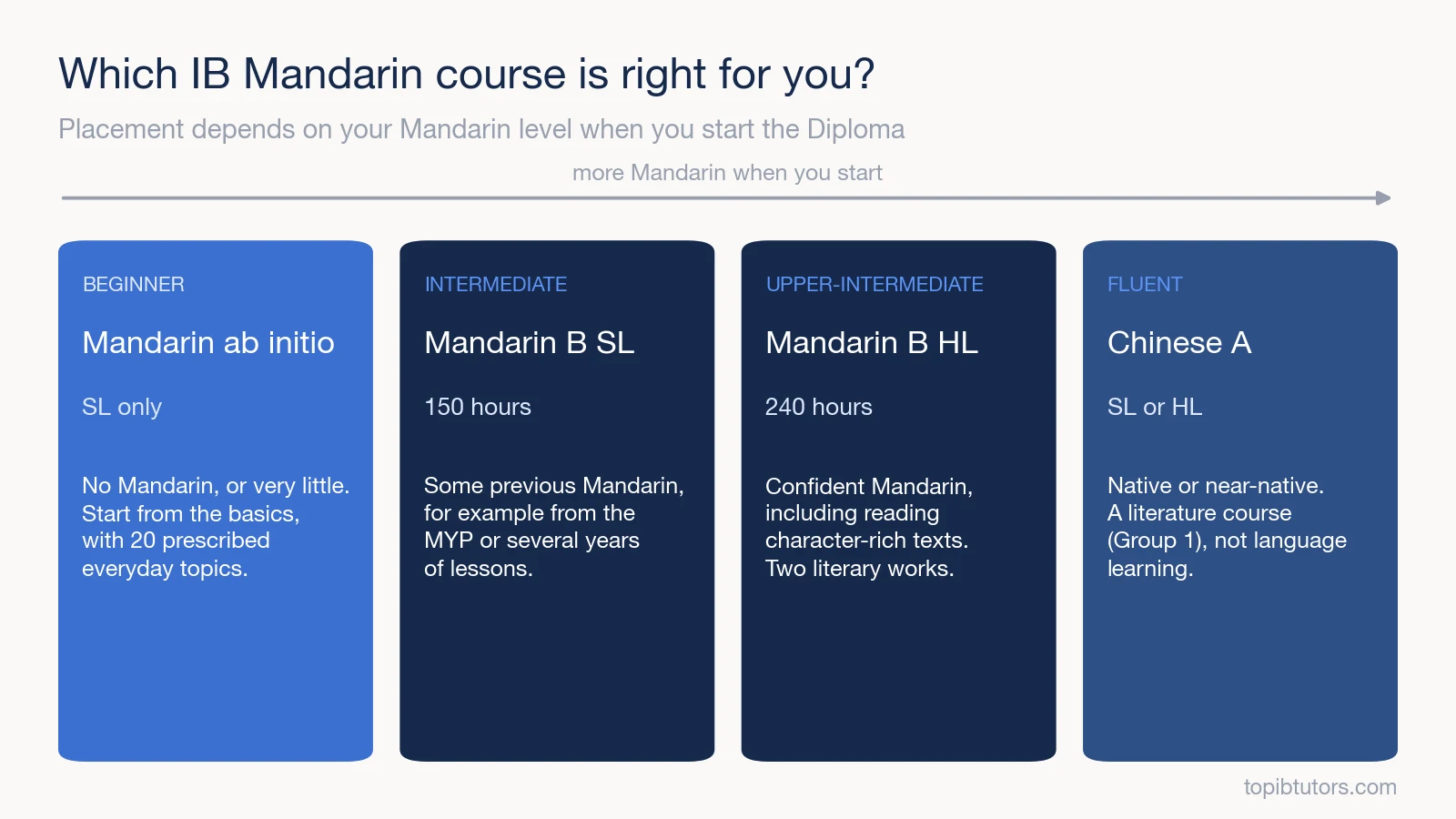
| Course | Who it is for | Levels |
|---|---|---|
| Mandarin ab initio | No previous Mandarin, or very little | SL only |
| Chinese B | Some previous experience of Mandarin | SL and HL |
| Chinese A | Native or near-native speakers (a Group 1 literature course) | SL and HL |
If you have studied Mandarin for a few years and can already hold a basic conversation, read our guide to IB Chinese B (Mandarin) instead.
Because ab initio is SL only, it counts as one of your standard level subjects. You'll need to take three (or four) other subjects at HL.
What You Learn
Mandarin ab initio develops your receptive skills (understanding what you hear and read), productive skills (speaking and writing) and interactive skills (taking part in conversations). From the very first lessons, you learn Mandarin through real-life contexts, not just grammar lists.
You also learn to think about audience, context, purpose, meaning and variation: how Mandarin changes depending on who you are talking to and why. For example, you'll learn when to use the respectful 您 instead of 你, and how a message to a friend differs from an email to a teacher.
Each language offered at ab initio also has a language-specific syllabus. It sets out the vocabulary and grammar students are expected to know. For Mandarin, this includes the characters students are expected to recognise and write, so your teacher will cover the core structures and characters you need for the exams.
Characters, Pinyin and Tones
Learning Mandarin means learning three things together:
| Element | What it is | Example |
|---|---|---|
| Characters (汉字) | The written language. Each character is a syllable with its own meaning | 学, 校, 学校 (school) |
| Pinyin | The romanised spelling used to learn pronunciation. It helps you learn, but exam texts are written in characters | Xuéxiào |
| Tones | Four main tones (plus a neutral tone) that change a word's meaning | Mā 妈 (mother), mǎ 马 (horse) |
IB Chinese exams are available in simplified and traditional characters. Your school will tell you which version you'll sit, and you should write consistently in one script.
The Five Themes and 20 Prescribed Topics
Unlike Chinese B, where topics are only suggestions, ab initio prescribes four topics for each of the five themes. All 20 must be covered over the two years. The IB explains this is because beginners need a structured learning environment.
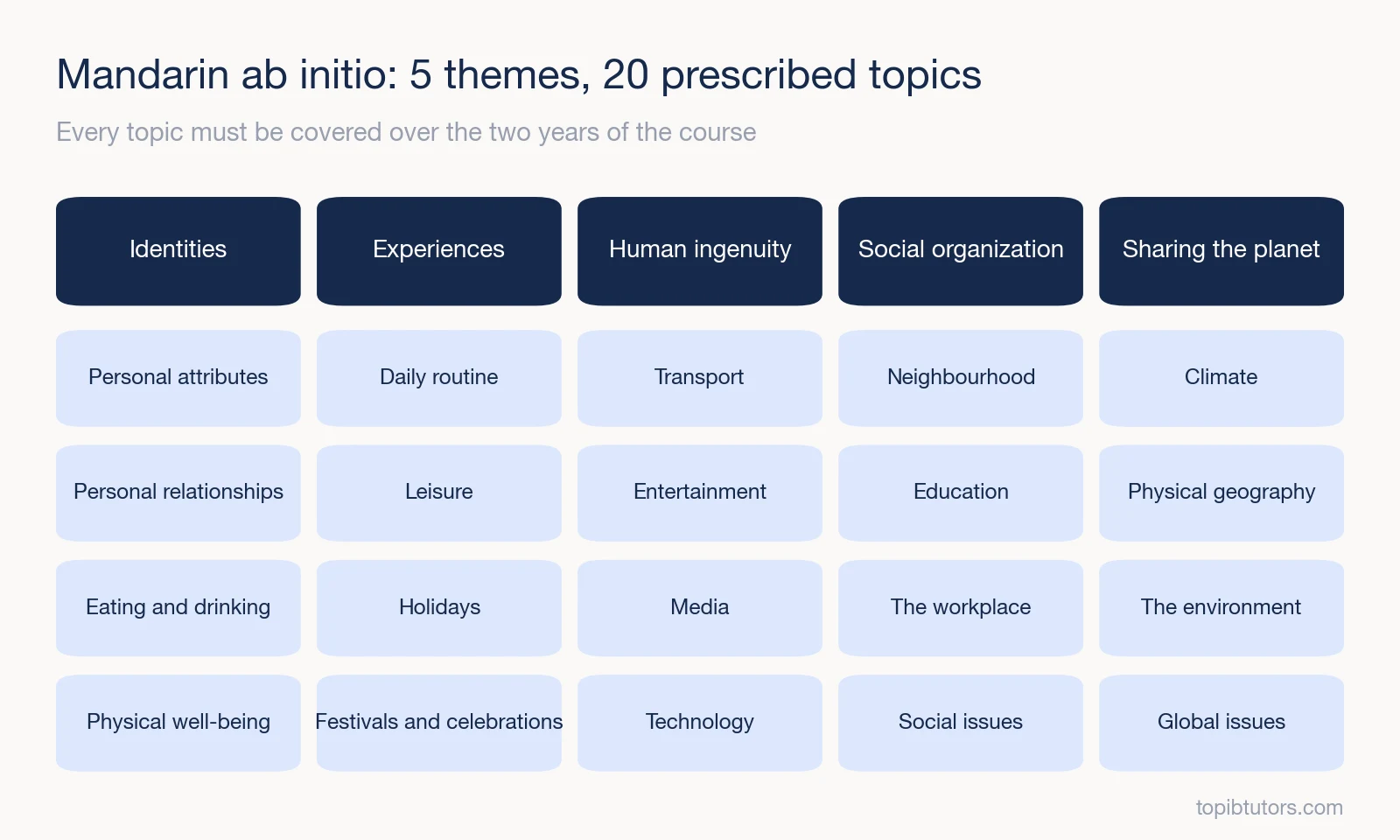
| Theme | What it explores | Prescribed topics |
|---|---|---|
| Identities | Who we are and how we express it | Personal attributes Personal relationships Eating and drinking Physical well-being |
| Experiences | The events and journeys that shape our lives | Daily routine Leisure Holidays Festivals and celebrations |
| Human ingenuity | How creativity and innovation affect our world | Transport Entertainment Media Technology |
| Social organization | How groups of people organise themselves | Neighbourhood Education The workplace Social issues |
| Sharing the planet | Challenges and opportunities in the modern world | Climate Physical geography The environment Global issues |
The IB also gives example questions to guide each theme, such as "How do I present myself to others?" or "What can I do to help the environment?". The questions are simple, but they push you to use Mandarin to share real opinions, not just facts.
A Chinese angle on the topics: festivals and celebrations can mean the Spring Festival (春节) or the Mid-Autumn Festival (中秋节); eating and drinking can mean dumplings, tea culture or school canteens; and transport can mean high-speed rail and shared bikes.
Assessment Overview
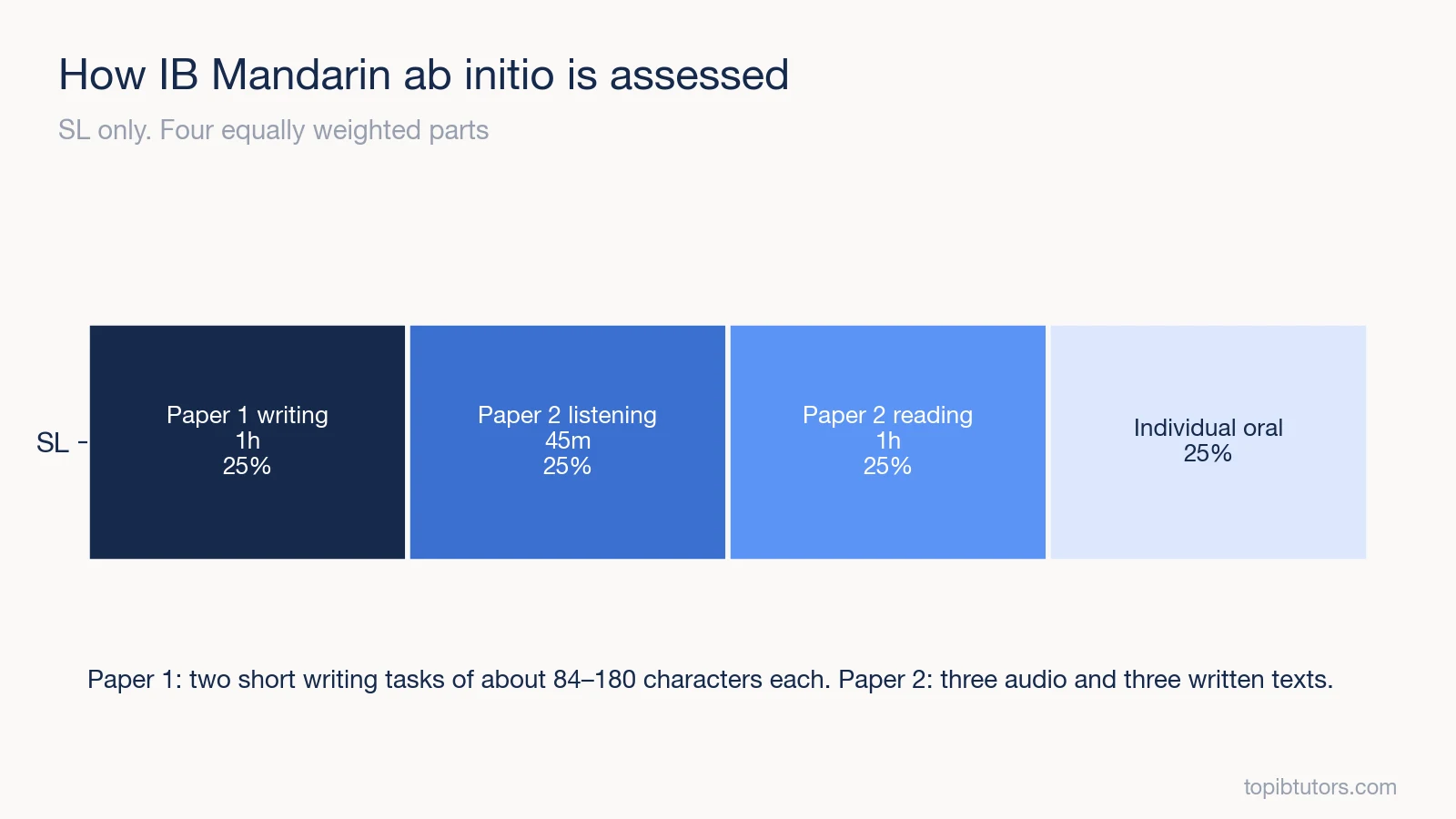
| Component | What it involves | Time | Weighting |
|---|---|---|---|
| Paper 1: writing (30 marks) | Two short writing tasks (about 84–180 characters each in Mandarin), each chosen from three options. You choose a suitable text type from those given | 1h | 25% |
| Paper 2: listening (25 marks) | Comprehension exercises on three audio passages | 45m | 25% |
| Paper 2: reading (40 marks) | Comprehension exercises on three written texts | 1h | 25% |
| Individual oral (30 marks) | A presentation on a visual stimulus, a follow-up discussion and a general conversation | Up to 10 min, plus 15 min preparation | 25% |
Paper 1 and Paper 2 are marked by IB examiners. The individual oral is marked by your teacher and moderated by the IB.
Paper 1: Writing
In Paper 1 you complete two short writing tasks. For each one, you choose one of three questions. The IB sets the length in words (70–150) for word-based languages. For Mandarin, it is counted in characters: schools and teachers use about 84–180 characters per task, in line with the 1.2 characters-per-word ratio the IB uses for Chinese Extended Essays. Always check the range printed on your exam paper. Each task gives you a situation, an audience and a purpose, and lists text types you can choose from.
Examples of text types you might practise: - Personal texts: an email, a text message, a postcard, a diary entry or a blog post - Professional texts: a formal email or letter, or a set of instructions - Mass media texts: a poster, an advertisement, a leaflet or a short article
Your writing is judged on three things: your language (vocabulary and grammar), your message (whether you answer every part of the task, with clear and relevant ideas), and your conceptual understanding (whether your text type, register and format suit the audience and purpose).
Tips for Paper 1: - Answer every point in the task. Missing a required detail costs marks, even if your Chinese is accurate. - Show the text type clearly. An email needs a greeting, a subject line and a sign-off. A blog needs a title and date. A poster needs a heading and short sections. - Choose the right register and format. Use 您 for teachers and people you don't know well. A letter needs a greeting with a colon (亲爱的…: or 尊敬的…:), a closing, and your name and the date at the bottom right. - Stay within the character range. Be precise. Aim for a mix of simple and slightly longer sentences linked with 因为…所以…, 但是, 然后 and 还有, and write the characters you know accurately.
Paper 2: Listening and Reading
Paper 2 tests how well you understand Mandarin. It has two sections:
- Listening (45 minutes): questions on three audio passages
- Reading (1 hour): questions on three written texts
The texts are drawn from the five themes. Questions test your understanding of Mandarin, not your general knowledge of the topics. Expect question types such as multiple choice, matching, true or false, and short answers in Mandarin. No dictionaries are allowed.
Tips for Paper 2: - Learn vocabulary by topic. The 20 prescribed topics are your vocabulary map. - Read questions carefully before the audio starts, and predict the words you might hear. - Listen to slow, clear Mandarin regularly, and practise reading texts in characters only, without pinyin. - In reading, look for key words, numbers, dates and negatives (不, 没有, 别). They often decide the answer.
The Individual Oral
The individual oral is the internal assessment. It takes place in your final year and is conducted entirely in Mandarin.
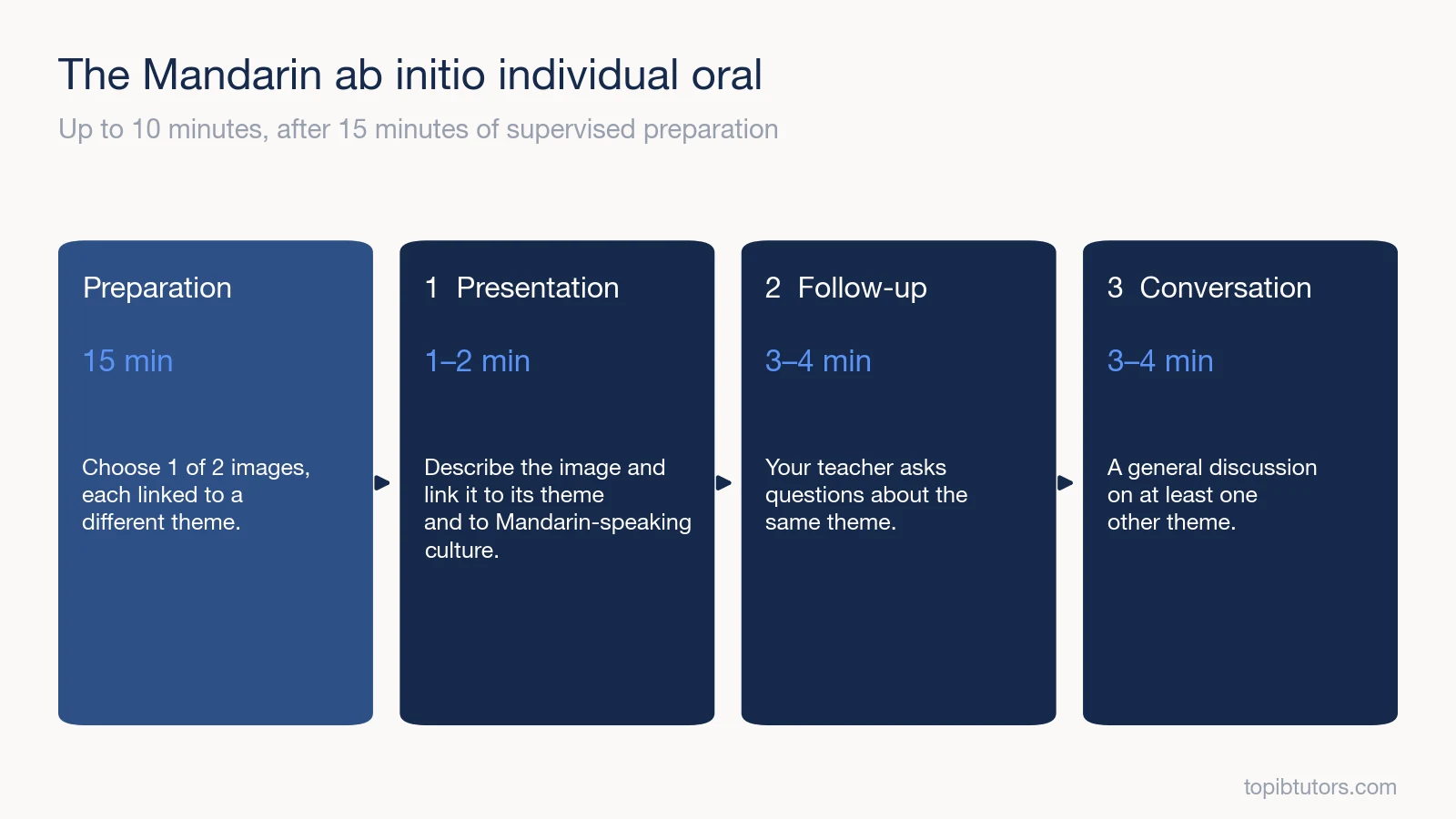
You're shown two visual stimuli, such as photos, each linked to a different theme. You choose one and prepare for 15 minutes under supervision, without a dictionary or class notes. Then:
| Part | What happens | Time |
|---|---|---|
| Preparation | Choose one of two images and plan what to say | 15 min |
| 1: Presentation | Describe the image and connect it to its theme and to Chinese-speaking culture | 1–2 min |
| 2: Follow-up discussion | Your teacher asks questions about the theme of your image | 3–4 min |
| 3: General discussion | A conversation on at least one other theme from the course | 3–4 min |
Your teacher marks the oral against four criteria: language (A), the message of your presentation (B1), the message in your conversation (B2) and interactive skills (C), for a total of 30 marks.
Tips for the oral: - Use a simple structure for describing images: 这张照片里有…, 在前面/在后面…, 我觉得…, 这张照片让我想起… - Link the image to Chinese-speaking culture. Mention a real comparison: 在中国,学生…, 在我的国家… - Give opinions and reasons (我认为…,因为…) and ask a question back when it's natural to. That shows interaction. - Practise talking about all 20 topics. Part 3 can move to any other theme, so you need something to say about each one.
What Changes in 2029?
The IB will launch an updated ab initio course in February 2027, for first teaching in August 2027 and first assessment in May 2029. The IB has confirmed that the structure stays the same (five themes, four prescribed topics each) and that there are no changes to the assessment model. Paper 1, Paper 2 and the oral all stay as described above. Only the wording of the top descriptors in two oral criteria (B2 and C) is slightly clarified.
The updates are mainly in teaching: a clearer subject guide, more focus on critical thinking, a new framing around cultures, communication and perspectives, and new teacher support materials.
Tips for Success in IB Mandarin ab initio
1. Little and often. Fifteen minutes of Mandarin every day works better than a long session once a week. 2. Build topic vocabulary lists. Make one list for each of the 20 topics, with phrases you can actually use. 3. Master the key grammar. By the exam you should be confident with 了 for completed actions, 过 for experiences, 在 for actions in progress, 会/要 for the future, and comparisons with 比. 4. Learn measure words and word order. Using the right measure word (一本书, 一张桌子) and putting time and place before the verb are two of the first big hurdles. 5. Speak from day one. Practise describing photos and answering questions aloud, even if it feels slow at first. 6. Use past papers. Find out why past papers are the ultimate tool for exam preparation, and time yourself. 7. Immerse yourself. Watch Chinese dramas and films with Chinese subtitles, listen to Mandarin songs and follow accounts on topics you enjoy.
Common Mistakes to Avoid
- Using 个 for every noun instead of the right measure word
- Putting time and place at the end of the sentence, as in English
- Writing similar-looking characters incorrectly, or relying on pinyin
- Ignoring tones when speaking
- Translating word for word from English or your own language, which often gives the wrong word order
- Ignoring the text type, or forgetting a greeting and sign-off in a letter or email
- Writing far below or above the character range
- Memorising a fixed speech for the oral instead of responding to the image
Frequently Asked Questions
Can I take Mandarin ab initio if I studied some Mandarin before?
It depends on how much. Ab initio is for students with no previous Mandarin or very limited exposure. If you have studied Mandarin for several years, your school will usually place you in Chinese B. Your school makes the final decision.
Is Mandarin ab initio easy?
It is designed for beginners, but it isn't easy. You go from zero to communicating in four skills, and learning characters and tones, in two years, so steady, regular practice is essential.
Can I take Mandarin ab initio at HL?
No. Language ab initio is only available at SL.
Can I write my Extended Essay in Mandarin ab initio?
The IB's Extended Essay guide gives subject guidance for Language B, not ab initio. Check the list of subjects available for your exam session with your EE coordinator before choosing. Our Extended Essay guide explains the options.
Does Mandarin ab initio count for university?
Yes. It is a full IB Diploma subject graded 1 to 7. Mandarin is especially useful for study and work in China, Taiwan and Singapore, and in international business, trade and diplomacy.
What changes in Mandarin ab initio from 2029?
The updated course is first taught in August 2027 and first assessed in May 2029. The themes, topics and all the assessments stay the same.
Get Support With IB Mandarin ab initio
Starting a new language is exciting, and the right support early on makes a big difference. Our experienced IB Chinese tutors can help you build vocabulary, grammar and confidence for every part of the assessment, online wherever you are. To see how your subjects fit together, read our guide to everything you need to know about the IB.


