




Psychology is one of the most popular subjects for the International Baccalaureate (IB) Extended Essay (EE). The IB's own Psychology guide calls it "a popular subject choice for extended essays". It's easy to see why: questions about memory, stress, motivation or social media feel immediately relevant. But a Psychology EE has one rule that surprises many students. You can't run your own experiment or survey.
This guide explains how to write a Psychology EE under the new Extended Essay criteria, first assessed in May 2027. All the rules and requirements come from the IB's official Extended essay guide (first assessment 2027, updated November 2025) and the IB's Psychology guide (first assessment 2027), explained in our own words.
Key Takeaways
- A Psychology EE must be based on secondary sources only. The IB doesn't allow you to collect primary data.
- In practice, the essay is a critical review of published, peer-reviewed research that answers your question.
- Define and operationalise your variables, and apply your definitions consistently.
- Evaluate the studies you use: their methods, samples, ethics and limitations.
- Link your essay to psychological theory and concepts, such as the course's concepts of bias, causality and measurement.
- The essay is up to 4,000 words, plus a 500-word reflective statement, marked out of 30.
The Big Rule: Secondary Sources Only
The IB's Extended essay guide is clear: a Psychology EE "must be based on secondary sources only", and collecting primary data is not permitted.
That means no experiments, surveys, questionnaires or interviews of your own. Instead, the guide describes the Psychology EE as a review of literature: an analysis of peer-reviewed research.
This isn't a weakness. Working with published research lets you tackle questions no school student could test, and it builds exactly the skills university psychology demands: finding studies, judging their quality and combining their findings into an argument.
What Makes a Psychology EE Different?
In the new guide, Psychology sits in the Individuals and Societies subject group. The IB says what makes an essay belong to a subject is the approach: the concepts, methods and theories you use.
A strong Psychology EE:
- asks a focused question about behaviour or mental processes
- uses published research, mainly from peer-reviewed journals
- links studies to psychological theory
- evaluates the evidence and reaches a balanced conclusion.
The new DP Psychology course, first assessed in 2027, is built around six concepts: bias, causality, change, measurement, perspective and responsibility. The IB's Psychology guide notes that these concepts reach beyond psychology itself. Using them deliberately in your essay is a strong way to show understanding.
The IB strongly recommends writing a subject-focused EE in a subject you study in the Diploma Programme (DP). If you don't take IB Psychology, talk to your supervisor first.
Choosing a Psychology Topic
A good Psychology topic has a clear question, a solid body of published research, and studies that disagree or have limitations you can discuss.
Check the research exists. Search databases such as Google Scholar or PubMed early. If you can't find several peer-reviewed studies directly on your question, adjust it.
Narrow your population or context. "Stress" is too broad. "Exam stress in adolescents" is better.
Avoid overlap with your IA. In the new course, the Psychology IA is a research proposal. The IB says your EE must not duplicate other work you submit, so choose a separate topic.
Be careful with sensitive topics. Topics such as self-harm, eating disorders or trauma need care. The IB recommends talking to your supervisor and following its ethical guidelines.
Examples From the IB
The IB's Psychology guide suggests these example EE questions:
- To what extent does emotional intelligence improve job performance in the workplace?
- To what extent is nudging useful in promoting healthy eating in adolescent boys?
- To what extent can acculturative stress be a risk factor for depression?
The Extended essay guide adds two more worked examples:
- Perfectionism and sport: does being a perfectionist harm performance in team sports? The guide stresses that sporting performance must be operationalised, meaning defined in measurable terms, and that one sport should be studied, with the definition applied consistently.
- Coping with stress: is mindfulness or cognitive behavioural therapy (CBT) more effective? The guide advises that describing each approach should not take up much of the essay. The focus should be on comparing and evaluating research findings.
Writing a Strong Research Question
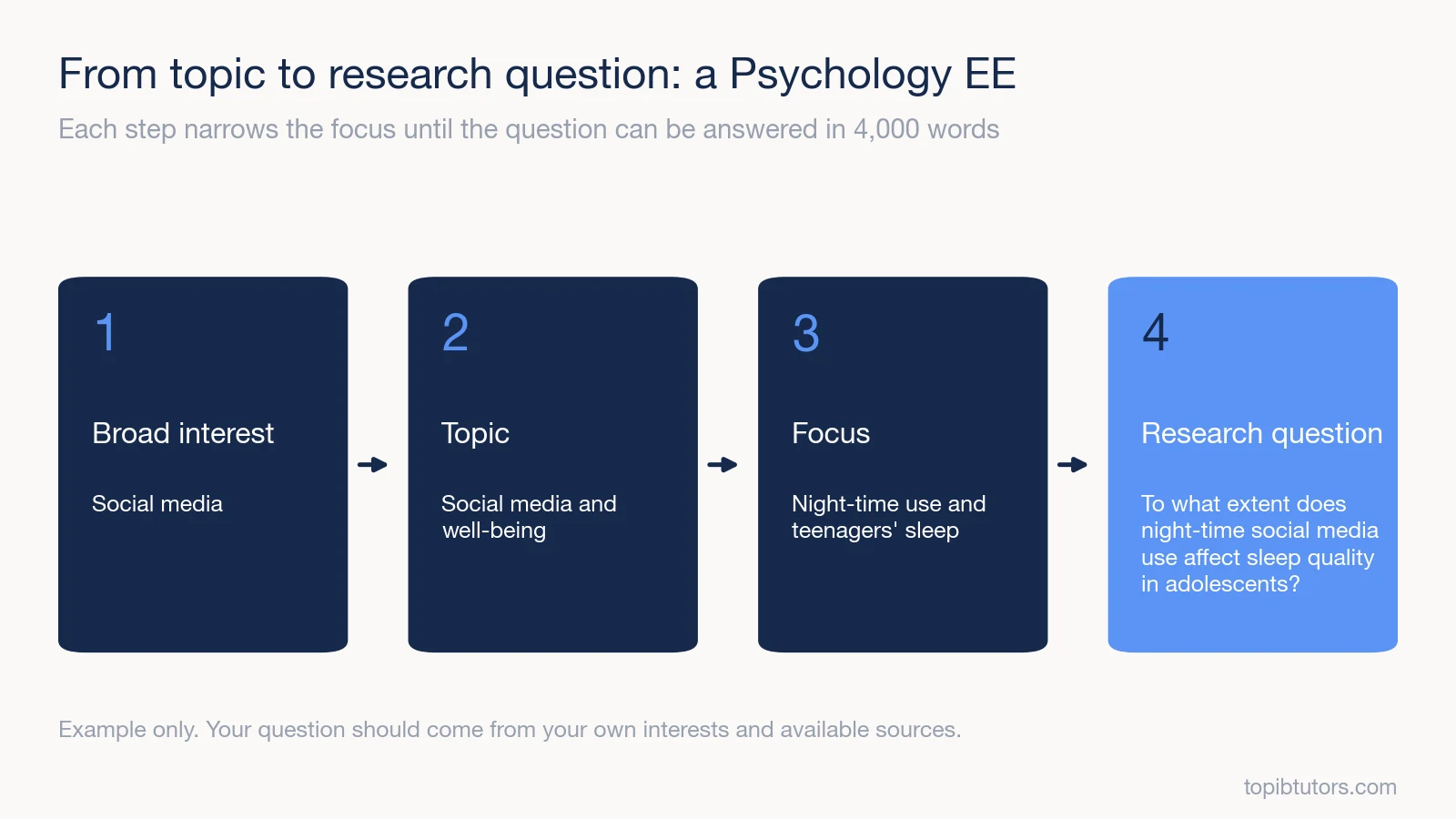
The IB's general guidance says your research question should be clear and focused, invite analysis rather than description, avoid combining two questions, and be answerable in 4,000 words.
For Psychology, a strong question usually names a variable or treatment, an outcome and a population.
| Weak question | Why it's weak | Stronger version |
|---|---|---|
| What is depression? | Descriptive, with nothing to analyse | To what extent is exercise an effective treatment for mild to moderate depression in adolescents? |
| Does social media affect people? | Vague variables and population | To what extent does night-time social media use affect sleep quality in adolescents? |
| How does memory work? | Far too broad | How reliable is eyewitness testimony when the witness is under high stress? |
| Is CBT or medication better for anxiety, and why? | Two questions in one | To what extent is cognitive behavioural therapy more effective than medication in treating generalised anxiety disorder in adults? |
These are examples only. Your question should come from your own interests and the research you can access.
Finding and Evaluating Research
Since your essay depends on published research, the quality of your sources matters.
Where to look: peer-reviewed journals (through Google Scholar, PubMed or your school's databases), systematic reviews and meta-analyses, and academic textbooks for background.
How to evaluate each study. For every key study, consider:
| Question | Why it matters |
|---|---|
| What method was used? | Experiments can suggest cause and effect Correlational studies can't |
| Who took part, and how many? | Small or narrow samples limit how far findings generalise |
| Where and when was it done? | Results from one culture or era may not apply elsewhere |
| How were variables measured? | Self-reports, for example, can be biased |
| Were there ethical issues? | Ethical limits can affect what a study could test |
| Has it been replicated? | Replicated findings are more trustworthy |
This kind of evaluation links directly to the course concepts. Bias, causality and measurement in particular give you a precise vocabulary for judging research.
Operationalise Your Variables
The IB's perfectionism example shows why this matters. If your question involves something abstract, such as "performance", "stress" or "well-being", define exactly how it's measured. Then use that definition consistently and only compare studies that measure it in similar ways.
How the Five Criteria Apply to Psychology
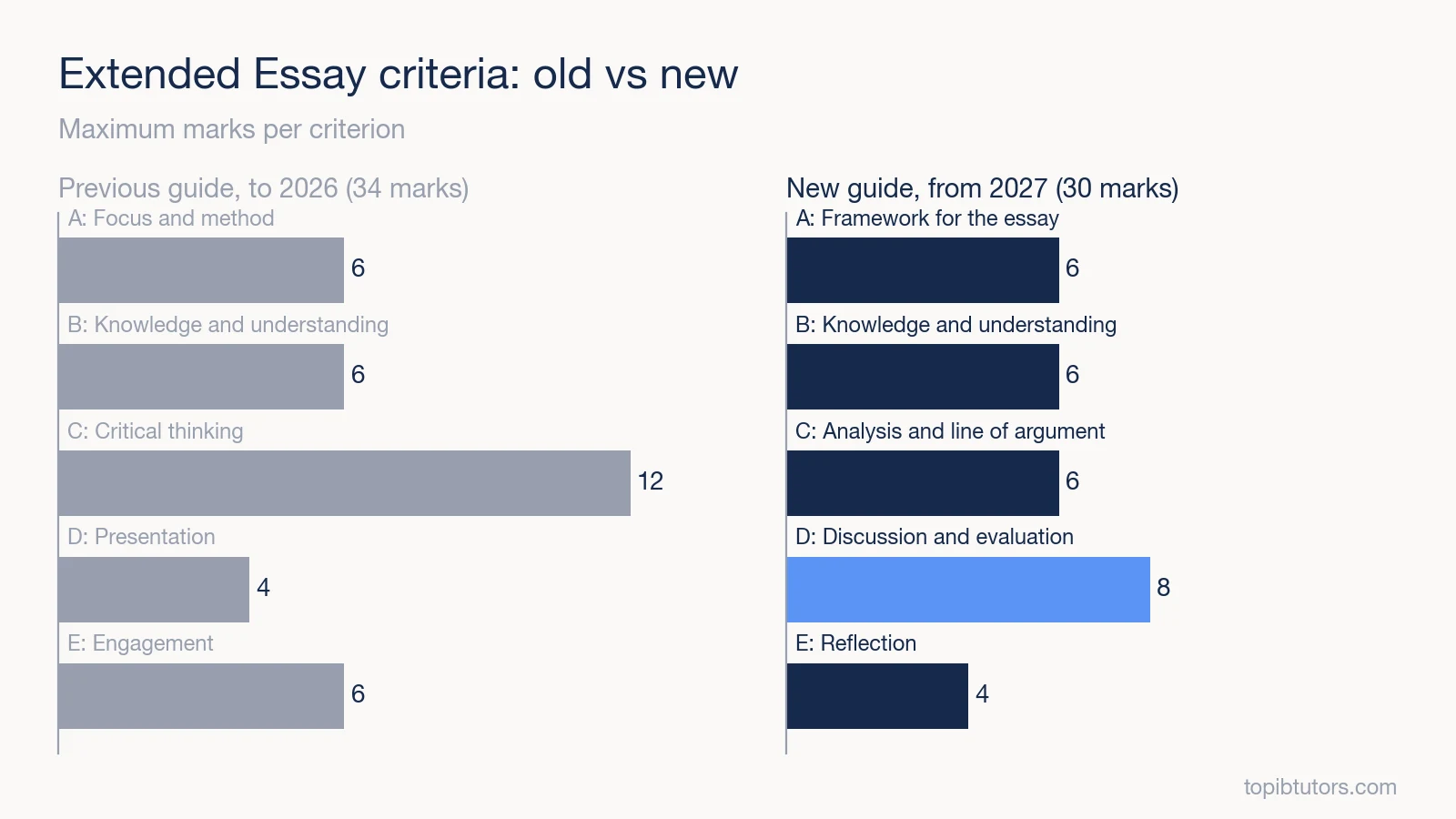
| Criterion | Marks | What it means for a Psychology EE |
|---|---|---|
| A: Framework for the essay | 6 | A focused question, a clear literature-review method (how you found and selected studies) and a logical structure |
| B: Knowledge and understanding | 6 | Accurate knowledge of the research and theory, correct psychological terminology, and meaningful use of concepts |
| C: Analysis and line of argument | 6 | Linking studies to theory to build an argument that answers your question, not just summarising one study after another |
| D: Discussion and evaluation | 8 | A balanced discussion of evidence on both sides, evaluation of the studies' strengths and limitations, and the limits of your own essay |
| E: Reflection | 4 | Your 500-word reflective statement on the EE process |
Don't Just Describe Studies
The most common weakness in Psychology EEs is a list of study summaries: aim, method, results, repeated five times. Instead, organise your essay around arguments, and use studies as evidence for or against each one. The IB's CBT and mindfulness example says the research should be compared and evaluated, building towards partial and final conclusions.
Our Psychology command terms guide explains what "evaluate", "discuss" and "to what extent" ask for.
A Suggested Structure
The IB requires a title page, contents page, introduction, body, conclusion and bibliography. A Psychology EE often works well like this:
1. Introduction: your research question, key definitions and why the question matters. 2. Method: how you searched for and selected studies. 3. Background theory: brief, only what's needed. 4. Body sections: each built around an argument, with studies as evidence and evaluation throughout. 5. Discussion: weighing the evidence as a whole, including what it can't tell us. 6. Conclusion: a clear answer to your question, with any qualifications.
For formatting and word count rules, see our complete Extended Essay guide.
Psychology in an Interdisciplinary EE
From 2027, you can combine two subjects in an interdisciplinary EE. Psychology appears in several of the IB's examples:
- Dance and psychology: how dance movement therapy might ease the symptoms of dementia, under the framework "evidence, measurement, innovation".
- Language and literature with psychology: exploring poetry using ideas from cognitive neuroscience.
- Psychology with business management: investigating how global sustainability could be achieved in the use of plastics.
Check with your supervisor how the secondary-sources rule applies to an interdisciplinary essay that includes Psychology.
Common Mistakes in Psychology EEs
- Collecting your own data. Surveys, experiments and interviews aren't allowed in a Psychology EE.
- Summarising studies one by one. Build arguments, and use studies as evidence.
- Undefined variables. Operationalise abstract terms and use them consistently.
- Using unreliable sources. Rely on peer-reviewed research, not popular websites.
- Treating correlation as causation. Be precise about what each study can show.
- Ignoring cultural bias. Much psychology research uses narrow samples. Say so when it matters.
- Overlap with your IA. Choose a different topic from your research proposal.
A note on AI: the IB says using AI to write your essay and presenting it as your own is dishonest. If you use AI-generated material, you must acknowledge it and check it against other sources. AI tools can also invent studies that don't exist, so always check the original paper.
Frequently Asked Questions
Can I do an experiment or survey for my Psychology EE?
No. The IB's Extended essay guide says a Psychology EE must be based on secondary sources only, and collecting primary data isn't permitted.
What counts as a secondary source in Psychology?
Mainly published, peer-reviewed research: journal articles, systematic reviews and meta-analyses. Academic textbooks are useful for background.
How many studies should I use?
The IB doesn't set a number. You need enough high-quality studies to argue both sides of your question and reach a supported conclusion.
Can my EE be on the same topic as my Psychology IA?
No. The IB says your EE must not duplicate other work you submit for the Diploma.
Does the new Psychology course change the EE?
The EE follows the new 2027 Extended essay guide for all subjects. The new Psychology course's concepts, such as bias, causality and measurement, are useful lenses for your analysis. See our IB Psychology guide for the course changes.
Get Expert Support With Your Psychology EE
A Psychology EE rewards a focused question and careful evaluation of research. Our Extended Essay tutoring gives you one-to-one support from experienced IB tutors, from refining your research question to finding and evaluating studies and preparing for your viva voce, always within the IB's rules on authentic work.
Organise an Extended Essay tutor today →
Sources: IB, Extended essay guide (first assessment 2027, updated November 2025); IB, Psychology guide (first assessment 2027, updated December 2025); IB, DP Psychology course page.


