




Biology is one of the most popular subjects for the International Baccalaureate (IB) Extended Essay (EE), especially among students heading towards medicine, life sciences or environmental study. A Biology EE lets you design your own investigation and see it through from question to conclusion. But it also demands a precise method, careful data analysis and a realistic plan for what you can do in a school lab.
This guide explains how to write a Biology EE under the new Extended Essay criteria, first assessed in May 2027. All the rules and requirements come from the IB's official Extended essay guide (first assessment 2027, updated November 2025) and the IB's published information on DP Biology, explained in our own words.
Key Takeaways
- A Biology EE can be based on primary data (your own experiment) or secondary data (published studies and databases), or both.
- Choose a realistic topic. The IB says simple experimental data is just as valid as research done in a university lab.
- Your method must be detailed enough to repeat, with defined variables, standardised conditions and SI units.
- If you use secondary data, the analysis must be your own, and you must explain how you selected your sources.
- "Negative" results are fine. The IB says they're as valid as results that support your hypothesis.
- The essay is up to 4,000 words, plus a 500-word reflective statement, marked out of 30.
What Makes a Biology EE Different?
Biology sits in the sciences group with Chemistry, Physics, Computer Science, Design Technology and Sports, Exercise and Health Science. The IB says a science EE gives you the chance to investigate and collect primary or secondary data based on a focused research question, using scientific methodology. Your findings must lead to a valid, evidence-based conclusion.
The guide highlights three features that separate science from pseudoscience: hypotheses, replicable data and the use of peer-reviewed publications. A good Biology EE has all three.
The IB strongly recommends writing a subject-focused EE in a subject you study in the Diploma Programme (DP). If you don't take IB Biology, talk to your supervisor first.
Choosing a Biology Topic
The IB's advice on science topics is practical:
- Be realistic about your facilities. Avoid topics that need sophisticated equipment that school labs don't usually have.
- Check it's ethical and feasible. Don't choose a topic where collecting enough data would be unethical or impractical.
- Keep it manageable. The guide's basic rule is not to overcomplicate your topic.
- Choose something you understand. You should already know some of the theory, especially if you're working with secondary data.
Some reassurance from the IB: essays based on simple experimental data are just as valid as research carried out in university labs or hospitals.
Avoid overlap with your IA. Biology students also complete a scientific investigation for their internal assessment (IA). The IB says your EE must not duplicate other work you submit, so choose a separate investigation.
Examples From the IB
The guide gives two Biology examples, one for each type of data:
- Primary data: the effect of different potassium nitrate (KNO₃) concentrations on the growth rate of onion roots. The guide recommends a pilot experiment, because some concentrations may kill the plants.
- Secondary data: whether parity (the number of times a woman has given birth) is a measurable variable in the development of breast cancer. Studies are found through databases such as PubMed, JSTOR and Google Scholar, and selected using clearly stated criteria.
Ethics and Safety
Any experiment must follow the IB's Sciences experimentation guidelines, which cover areas such as animal behaviour experiments, dissection, human physiology experiments, microbiology, fieldwork and risk assessment. If your research involves people, the IB's Ethical guidelines for extended essays research and fieldwork also apply, including informed consent. Check your plan with your supervisor before you start.
Writing a Strong Research Question
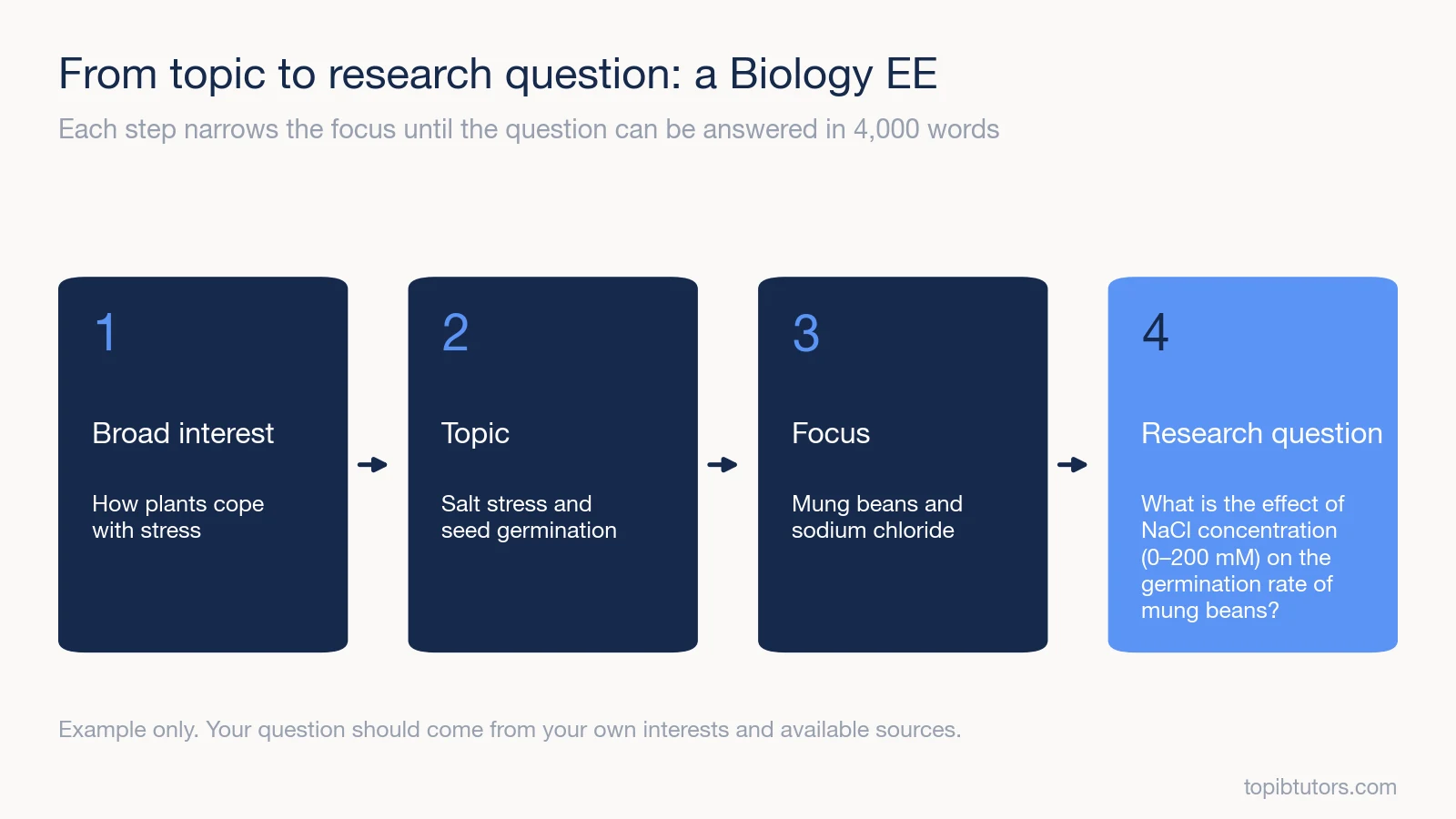
The IB's general guidance applies to every EE: your research question should be clear and focused, invite analysis, avoid combining two questions, and be answerable in 4,000 words.
For Biology, the guide adds that variables in your research question must be defined and justified, and must allow measurements to be made. A good Biology question usually names the independent variable (with its range), the dependent variable and the organism or system.
| Weak question | Why it's weak | Stronger version |
|---|---|---|
| How does salt affect plants? | Vague variables, no organism | What is the effect of NaCl concentration (0–200 mM) on the germination rate of mung beans (Vigna radiata)? |
| Is garlic antibacterial? | A yes/no question with no measurement | How does the concentration of fresh garlic extract affect the zone of inhibition of Escherichia coli K-12 on agar? |
| How does exercise affect the body? | Far too broad | What is the effect of 5 minutes of step exercise on heart rate recovery time in 16–18-year-olds? |
| What causes antibiotic resistance? | Too broad, and not testable in a school lab | To what extent do published surveillance data show a link between antibiotic use and resistance in Klebsiella pneumoniae across European countries? |
These are examples only. Some, such as work with bacteria or human participants, need careful risk assessment and approval from your school. Your question should come from your own interests and the resources you can access.
Designing Your Method
The guide is specific about what a science method needs:
- Background research first. Make sure you understand the theory and concepts behind your topic before you start.
- Replicable. Describe your method in enough detail that someone else could repeat it.
- Standardised conditions. Control your variables so the dependent variable is measured fairly.
- SI units throughout.
- Clearly presented results. Tables and graphs need headings, units and numbering.
- Uncertainties. Include measurement uncertainties in your calculations.
Primary vs Secondary Data
| Primary data | Secondary data | |
|---|---|---|
| What it is | Data you collect from your own experiment | Data from published studies or databases |
| Strengths | Full control over the method Clearly your own work | Larger datasets Topics you couldn't test in school |
| IB requirements | A replicable method, controlled variables, standardised conditions | Explicit selection criteria Studies with similar standardised approaches Your own analysis |
With secondary data, the guide says you may copy graphs or tables from your sources, but the statistical analysis must be done by you.
Working in a University Lab
If you do your research at a university or other organisation, the guide says you must make sure the methods are your own, not just ones the organisation already uses. You can have an external mentor, but your school supervisor still runs your reflection sessions.
How the Five Criteria Apply to Biology
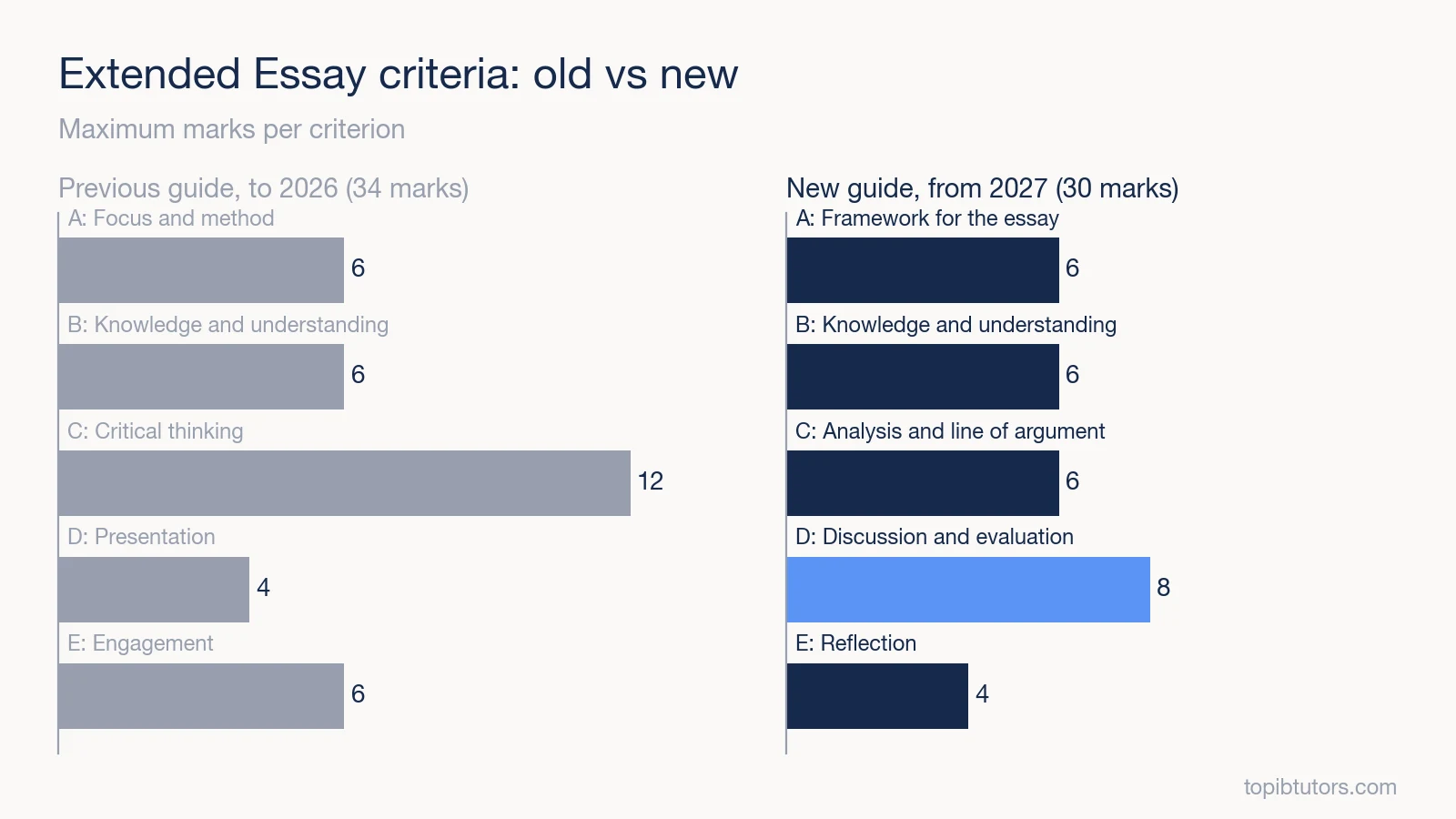
| Criterion | Marks | What it means for a Biology EE |
|---|---|---|
| A: Framework for the essay | 6 | A focused question that leads to a method producing scientific data. Clear, labelled tables and graphs, processed data and uncertainties |
| B: Knowledge and understanding | 6 | A clear explanation of the underlying biology. The guide's example: an essay on an enzyme's turnover rate must discuss enzyme kinetics |
| C: Analysis and line of argument | 6 | Standard qualitative, quantitative and statistical analysis that addresses your question directly. Everything in the essay must be relevant |
| D: Discussion and evaluation | 8 | A critical, scientific discussion linked to your question. Your conclusion should synthesise your results, not repeat them. Evaluate unresolved issues and suggest improvements |
| E: Reflection | 4 | Your 500-word reflective statement on the EE process |
Stay Relevant
The guide gives a useful warning: if your topic is the kinetics of photosynthesis, a discussion of leaf structure isn't relevant. Every section should connect to your research question.
Don't Fear "Negative" Results
If your data doesn't support your hypothesis, that's not a failure. The IB says negative results are just as valid as positive ones, as long as you evaluate them critically. If your question isn't fully answered, explain why and suggest what would improve the investigation.
Use the Course's Big Ideas
The IB's DP Biology course is organised around four themes: unity and diversity, form and function, interaction and interdependence, and continuity and change. Linking your findings to these ideas can strengthen your knowledge and understanding. Our IB Biology guide explains the course, and our Biology command terms guide covers the instruction words.
A Suggested Structure
The IB requires a title page, contents page, introduction, body, conclusion and bibliography. A Biology EE usually follows a scientific report structure:
1. Introduction and background: your research question, why it matters and the relevant theory. 2. Hypothesis: what you expect, and why, based on the theory. 3. Method: variables, materials, procedure, and safety and ethics. 4. Results: raw data summarised, then processed data in clear tables and graphs, with uncertainties. 5. Analysis: statistical tests and trends. 6. Discussion and evaluation: what your results mean, how they compare with published research, limitations and improvements. 7. Conclusion: a clear answer to your research question.
Tables, graphs and calculations don't count towards the 4,000 words, but your discussion of them does. For the full formatting rules, see our complete Extended Essay guide.
Biology in an Interdisciplinary EE
From 2027, you can combine two subjects in an interdisciplinary EE. The IB's guide gives several examples involving Biology:
- Biology with chemistry: investigating enzyme activity using skills from both sciences.
- Biology with geography or economics: the environmental impact of Bt crops in developing countries, under the framework "sustainability, development, change".
- Biology with social and cultural anthropology: the concept of gender from biological and social perspectives.
An interdisciplinary essay must genuinely combine both subjects, not just discuss them side by side.
Common Mistakes in Biology EEs
- Too ambitious a topic. Equipment, time and ethics all limit what you can do. Keep it manageable.
- Too few data points or trials. Plan enough repeats to analyse your data properly.
- Uncontrolled variables. Identify and control everything that could affect your results.
- No uncertainties or statistics. Processing your data properly is part of Criterion A and C.
- A conclusion that repeats the results. Explain what they mean.
- Weak evaluation. Discuss real limitations and specific improvements, not generic ones.
- Overlap with your IA. Choose a different investigation.
A note on AI: the IB says using AI to write your essay and presenting it as your own is dishonest. If you use AI-generated material, you must acknowledge it and check it against other sources.
What the Data Shows
Biology was one of the most popular EE subjects in the IB's May 2026 statistical bulletin. Science essays also did well: 46.9% earned an A or B, one of the highest rates of any subject group. See our analysis of the May 2026 statistical bulletin.
Frequently Asked Questions
Does a Biology EE have to include an experiment?
No. The IB allows Biology EEs based on primary data, secondary data or both. A secondary-data essay must explain how studies were selected, and the analysis must be your own.
Can I do my Biology EE in a university lab?
Yes, but the IB says the methods must be your own, not just procedures the organisation already uses. Your school supervisor still runs your reflection sessions.
What if my results don't support my hypothesis?
That's fine. The IB says negative results are as valid as positive ones, as long as you evaluate them critically.
Can my EE use the same experiment as my Biology IA?
No. The IB says your EE must not duplicate other work you submit for the Diploma.
Can I use animals or human participants?
Only by following the IB's experimentation and ethical guidelines. Many investigations with animals or people are restricted, so check with your supervisor before planning.
Get Expert Support With Your Biology EE
A Biology EE rewards careful planning: a realistic question, a sound method and thorough analysis. Our Extended Essay tutoring gives you one-to-one support from experienced IB tutors, from refining your research question to analysing your data and preparing for your viva voce, always within the IB's rules on authentic work. For the course itself, read how to score a 7 in IB Biology.
Organise an Extended Essay tutor today →
Sources: IB, Extended essay guide (first assessment 2027, updated November 2025); IB, DP Biology course page and Biology subject brief.


