





Every year the International Baccalaureate publishes a statistical bulletin for the May exam session. It goes well beyond the headline numbers released on results day, with grade distributions for every subject, core results, and data by region and country. The May 2026 bulletin covers 209,607 students in 152 countries.
We've read every page and compared it with the May bulletins going back to 2018. This guide pulls out the most useful findings for students and parents: how scores have changed, which subjects award the most 7s, how HL compares with SL, and where the IB is growing fastest.
Key Takeaways
- The Diploma pass rate rose to 82.6%, the third year in a row it has gone up since the post-Covid low of 80.0% in 2023.
- The average Diploma score was 30.8 points, up from 30.2 in 2023 but still below the Covid-era peak of 33.0 in 2021.
- 10.1% of candidates scored 40 points or more, and 31% scored 35 or more.
- Physics HL awarded the most 7s of any large course (20.5%). Visual Arts SL awarded the fewest (1.2%).
- In most subjects HL students averaged higher grades than SL students. English and History were the exceptions.
- Global Politics, Sports, Exercise and Health Science and Business Management have grown fastest since 2022, while English A: Literature is shrinking.
A note on the data: the May 2026 figures come from the IB's provisional statistical bulletin. They are a snapshot taken shortly before results were released, so they don't include later re-marks. The IB says it doesn't expect significant changes in the final version. Figures for earlier years come from the IB's final May bulletins.
The May 2026 IB Results at a Glance
| Measure | May 2026 |
|---|---|
| Total students (DP and CP) | 209,607 (+3.7% on 2025) |
| Schools | 3,442 in 152 countries |
| Subject entries | 784,409 across 220 subjects |
| Diploma candidates (final-year) | 104,369 |
| Diploma pass rate | 82.6% |
| Average total points | 30.8 out of 45 |
| Average subject grade (diploma candidates) | 4.9 |
| Bilingual diplomas | 27.0% of candidates |
| Career-related Programme (CP) pass rate | 79.0% |
The bulletin's headline figure for average points is 30.8. Its own trend chart rounds the same figure to 30.9.
Pass Rates Since 2018: Back to Normal, and Rising
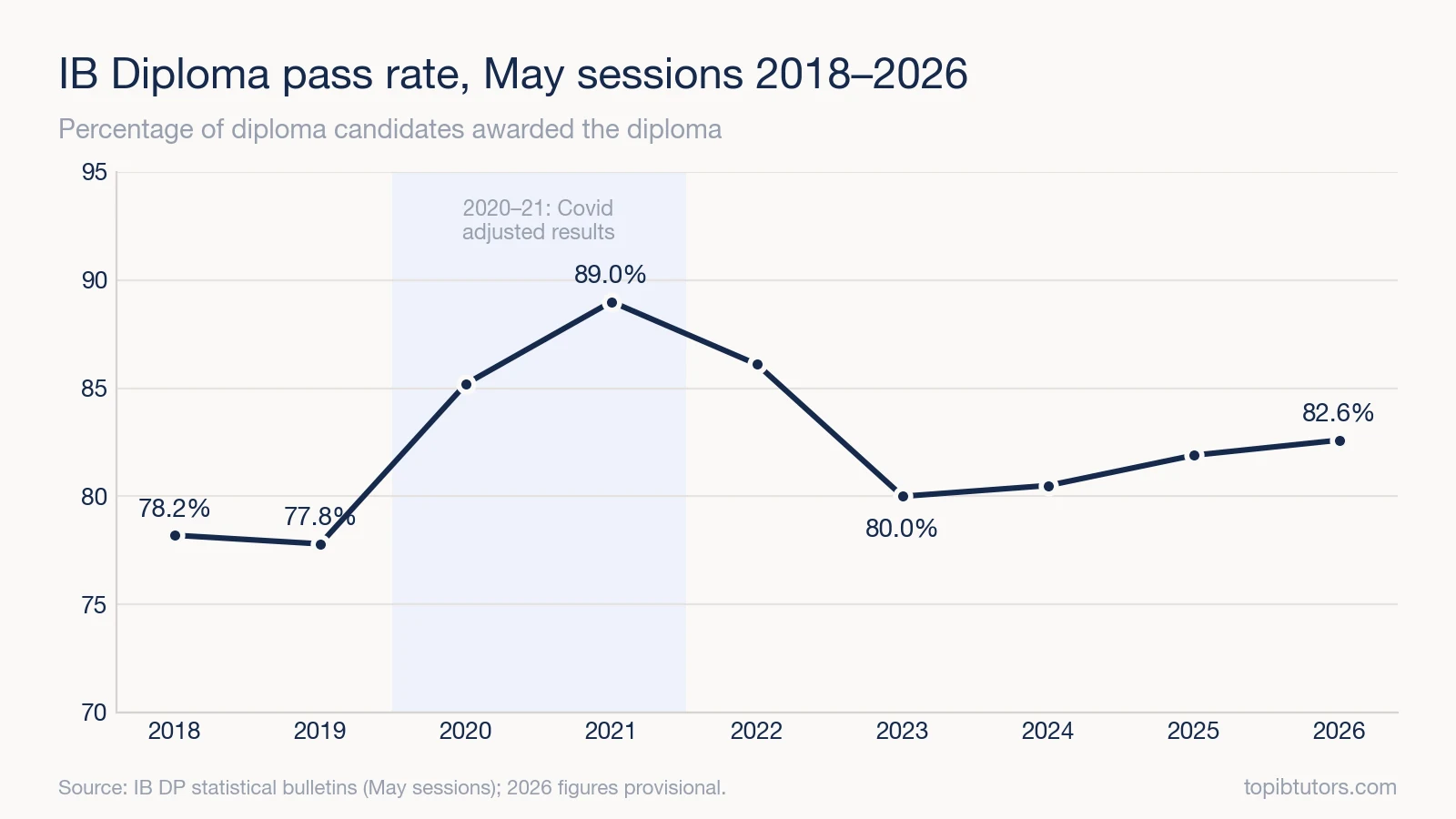
The pass rate tells a clear story:
- 2018–2019: before the pandemic, around 78% of candidates passed.
- 2020–2021: with exams cancelled in 2020 and adjusted arrangements in 2021, pass rates jumped to 85.2% and then 89.0%.
- 2022–2023: the IB brought grading back towards pre-pandemic standards, and the pass rate fell to 80.0% in 2023.
- 2024–2026: it has risen steadily since, to 82.6% in 2026, still about 5 points above 2019.
In practical terms, about 4 in 5 IB Diploma candidates pass.
The Average IB Score: 30.8 Points
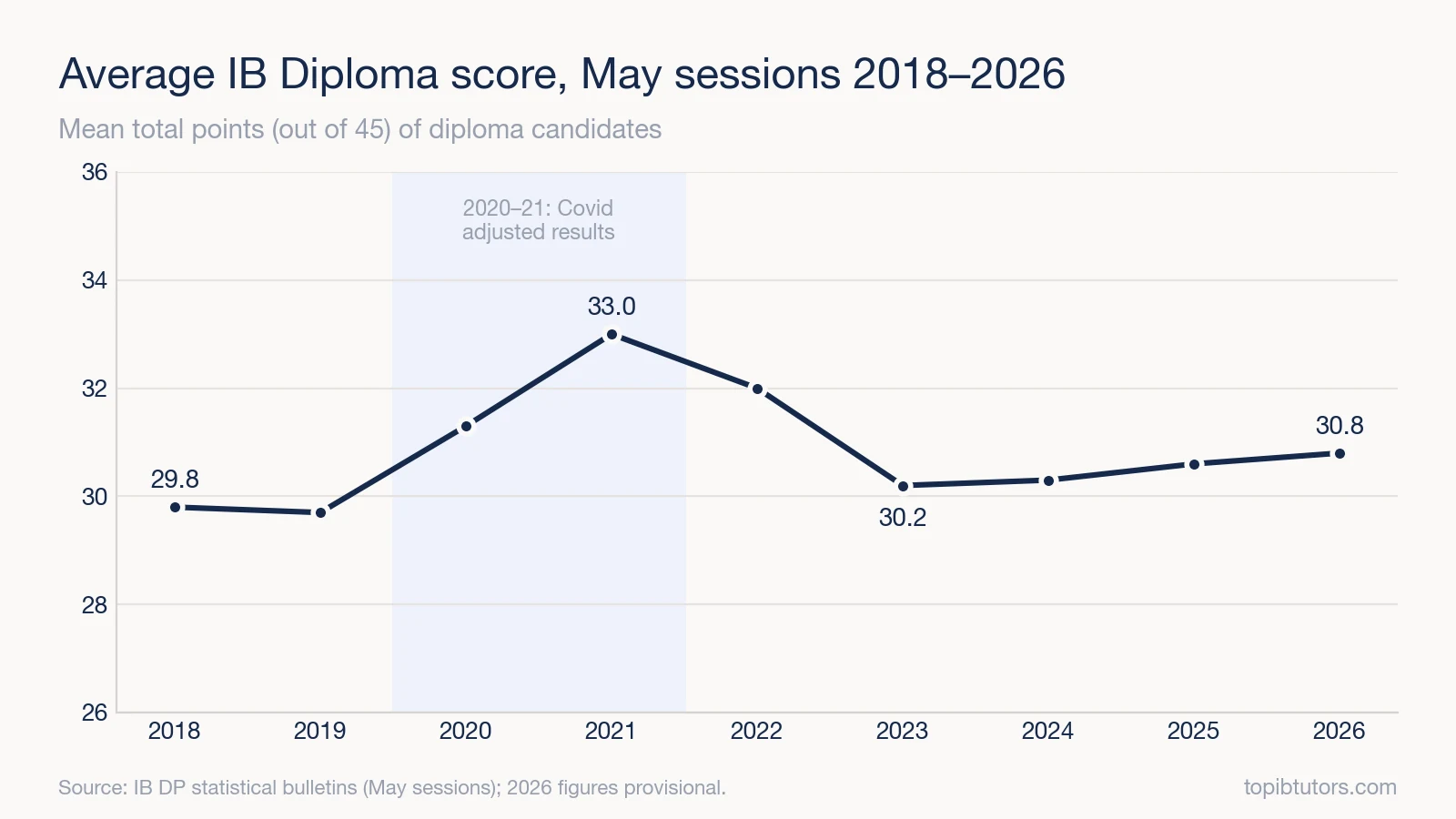
The average total score followed the same path. It was 29.7 in 2019, peaked at 33.0 in 2021, fell to 30.2 in 2023, and has risen a little each year since, to 30.8 in 2026.
If you're comparing your result with friends who graduated in 2021, keep this in mind: a 33 in 2021 was simply average.
What Your Score Means in 2026
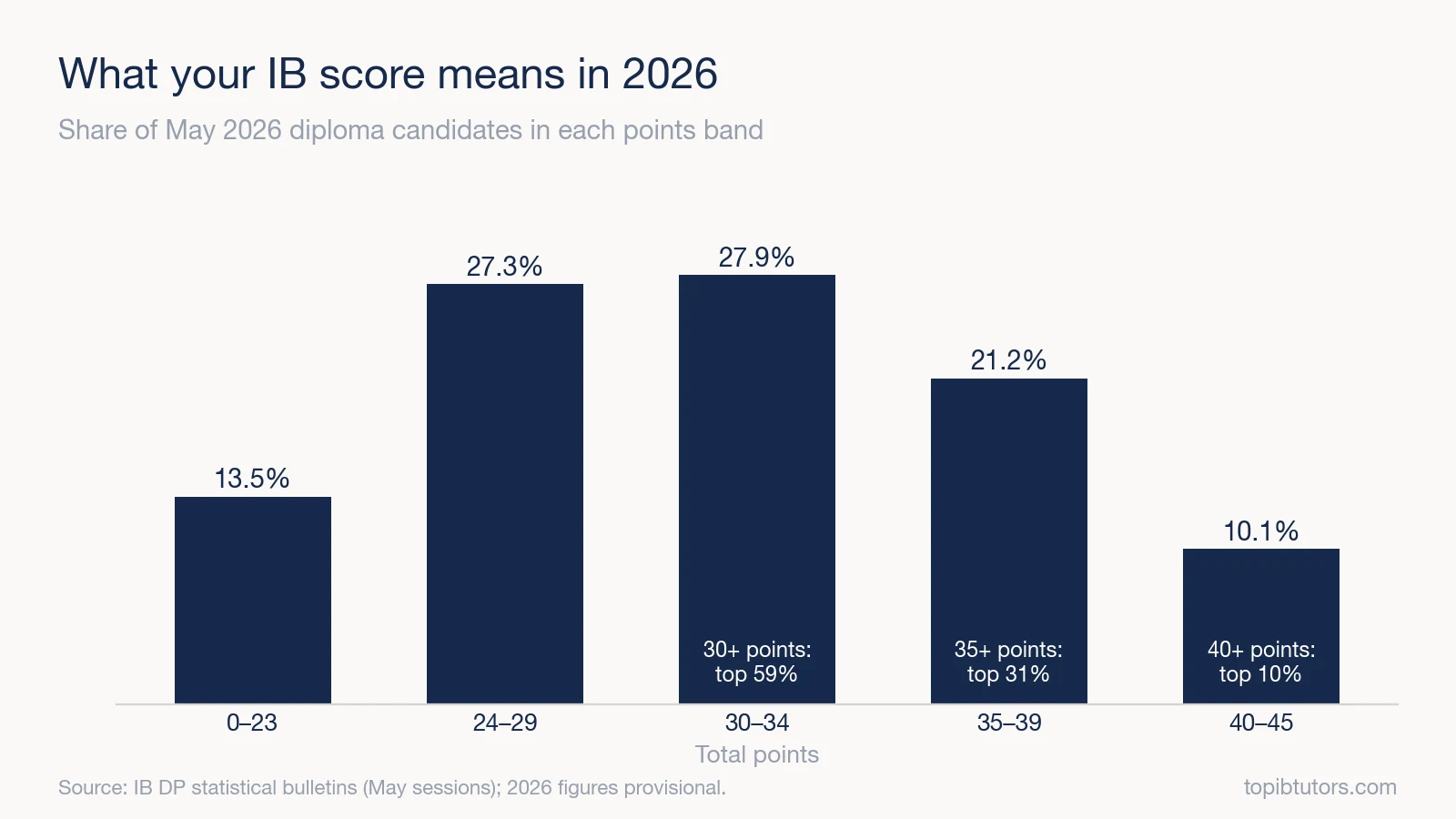
| Points band | Share of candidates (2022) | Share of candidates (2026) |
|---|---|---|
| 0–23 | 10.9% | 13.5% |
| 24–29 | 23.1% | 27.3% |
| 30–34 | 27.8% | 27.9% |
| 35–39 | 23.5% | 21.2% |
| 40–45 | 14.7% | 10.1% |
So in May 2026:
- 40 points or more puts you in roughly the top 10% of candidates.
- 35 or more puts you in about the top 31%.
- 30 or more puts you in about the top 59%.
Top-band scores have become rarer since 2022, when 14.7% of candidates scored 40+. The IB no longer publishes how many students score a perfect 45. For a full explanation of how scores are built, see our guide to how your IB score is calculated.
Points Aren't Everything: 4,000 Students Failed With 24 Points or More
A total of 24 points is the minimum to pass, but it isn't enough on its own. Of the 18,152 candidates who were not awarded the diploma in 2026:
- 3,846 had between 24 and 29 points
- 140 had 30–34 points, and 25 had 35–39 points
That's about 22% of all non-passing candidates. They failed because of the IB's failing conditions, such as an E in TOK or the Extended Essay, too few HL points, or a grade 1 in a subject. Our guide to understanding your IB results explains every condition.
The Core: TOK and the Extended Essay
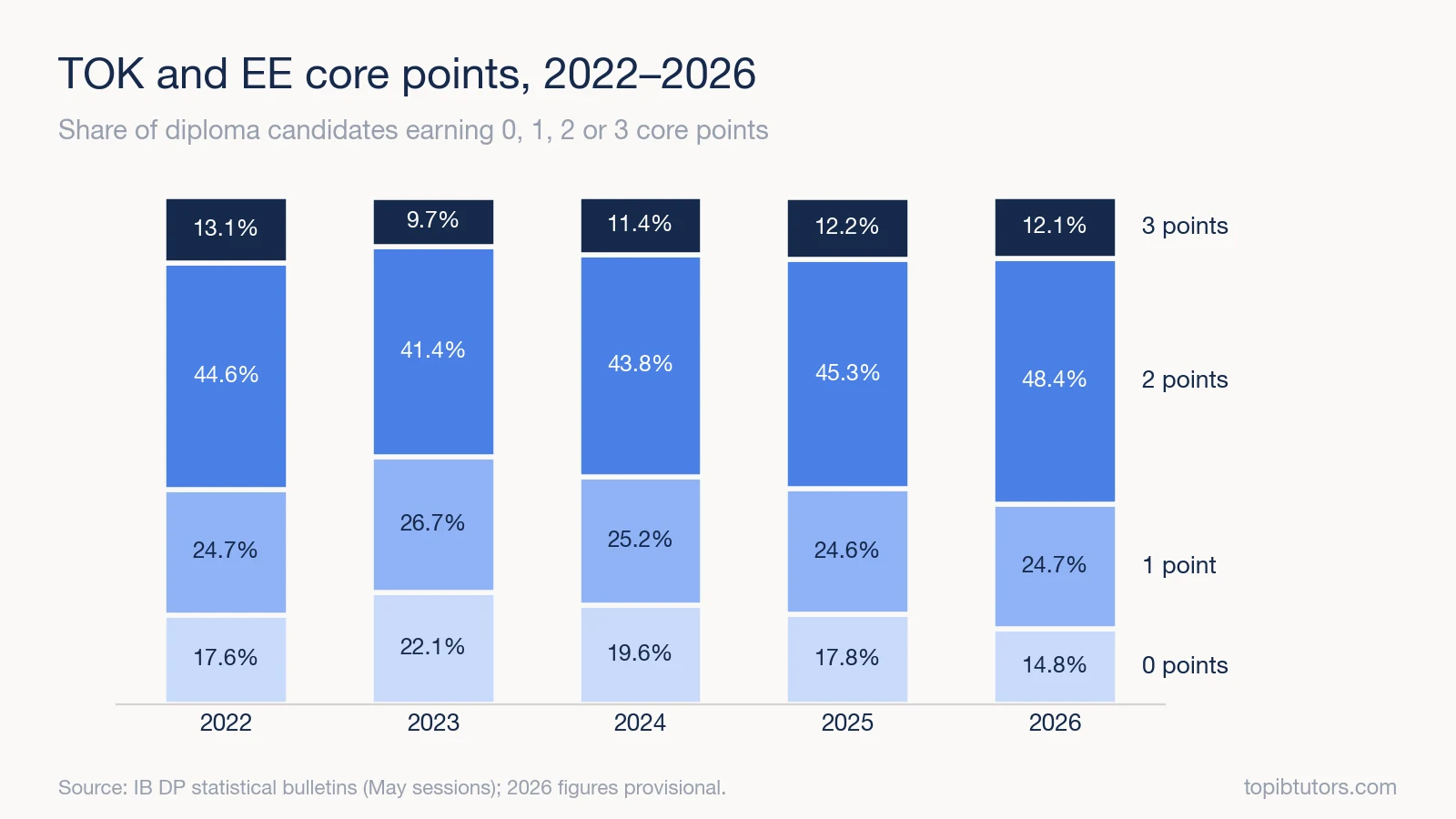
Core points (up to 3, from the combination of your TOK and Extended Essay grades) have improved since 2023. The average reached 1.6, the highest of the last five years. The biggest change was at the bottom: the share of candidates earning zero core points has fallen three years running, from 22.1% in 2023 to 14.8% in 2026.
Extended Essay Grades
| Grade | Share of essays, May 2026 |
|---|---|
| A | 11.4% |
| B | 29.9% |
| C | 41.3% |
| D | 16.1% |
| E | 0.6% |
Some patterns by subject group:
- Mathematics and science essays had the highest share of A and B grades combined: 48.7% and 46.9%.
- The arts (14.8%) and studies in language and literature (14.0%) had the highest share of A grades.
- The most popular EE subjects were English A, History, Business Management, Psychology and Biology. From the bulletin's chart, about 60% of Business Management essays earned an A or B, compared with about a quarter of History essays.
- World Studies was still the sixth most popular EE choice. In 2027 it is replaced by a new interdisciplinary pathway. See our guide to the 2027 Extended Essay.
Theory of Knowledge Grades
TOK grades were tightly bunched: 9.3% A, 40.8% B, 42.4% C, 6.7% D and just 0.1% E. Most students (92,749) completed TOK in English, followed by Spanish (8,006), Chinese (1,918) and French (1,187). Read our guide on how to score an A in TOK.
The Biggest IB Subjects in 2026
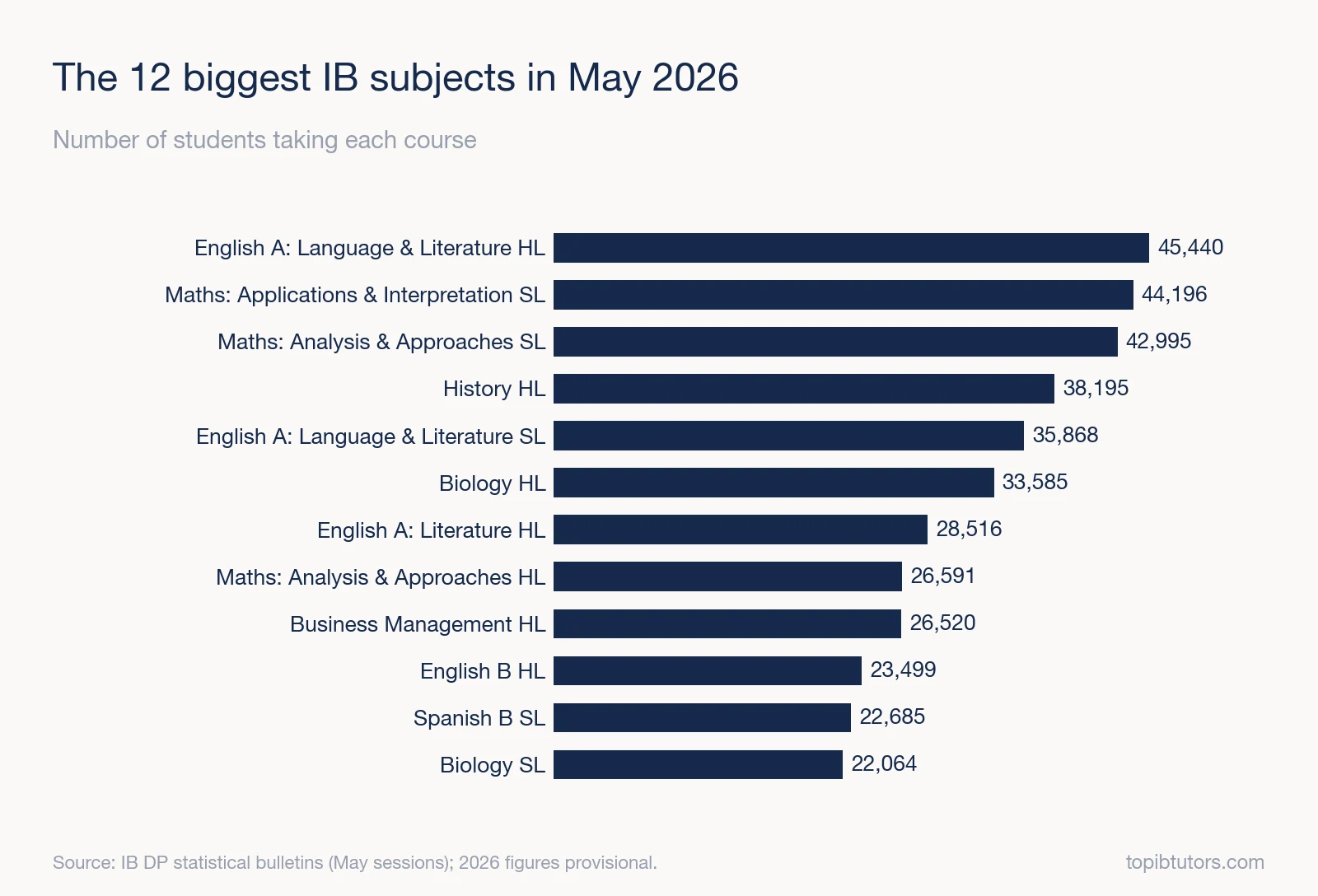
English A: Language and Literature HL is now the single largest IB course, with 45,440 students. The two maths SL courses follow close behind. Together, all the maths courses had 122,282 entries.
The Fastest-Growing (and Shrinking) Subjects
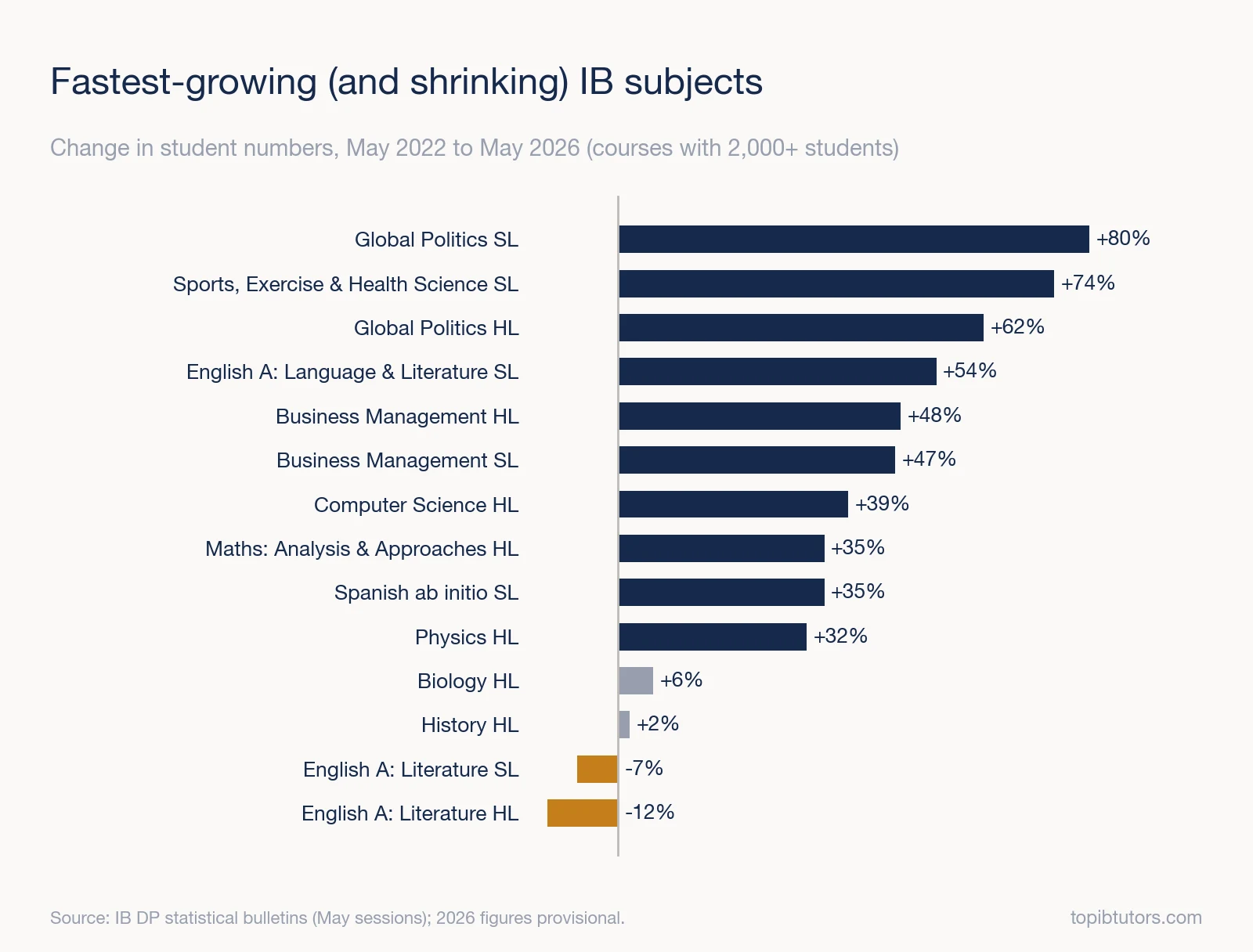
Comparing May 2022 with May 2026, for courses with at least 2,000 students:
- Global Politics grew fastest: +80% at SL and +62% at HL. A new Global Politics course started in 2024 (first assessed in 2026). See our Global Politics guide.
- Sports, Exercise and Health Science SL grew 74%, and its new course was examined for the first time in 2026.
- Business Management grew by nearly half at both levels, adding almost 13,000 students in four years.
- English A: Language and Literature SL grew 54%, while English A: Literature HL shrank 12%. Students are clearly choosing the Language and Literature course over the Literature-only option.
- History and Biology are still huge but barely growing (+2% and +6% at HL).
- Computer Science grew 39% at HL since 2022, but numbers dipped in 2026, the final year of the old course. A new course is first examined in 2027. Read our Computer Science guide.
One more trend stands out: ESS HL was examined for the first time in 2026, with 3,857 students and a mean grade of 4.5. Learn about the new course in our ESS guide.
Which IB Subjects Award the Most 7s?
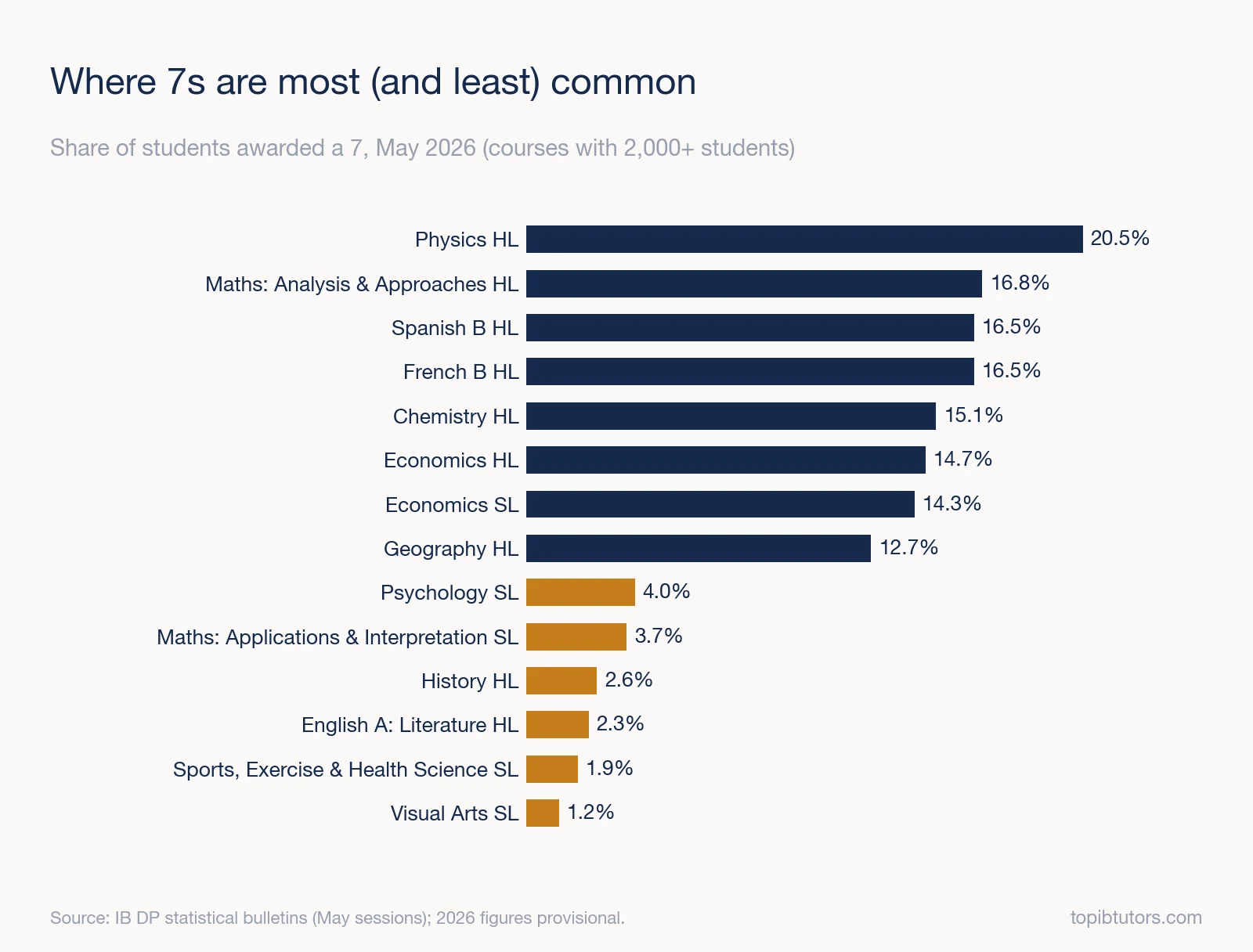
Across all subjects, 8.2% of grades were 7s in May 2026. That figure varies hugely by subject. Among courses with at least 2,000 students:
| Most 7s (2026) | % of 7s | Fewest 7s (2026) | % of 7s |
|---|---|---|---|
| Physics HL | 20.5% | Visual Arts SL | 1.2% |
| Maths AA HL | 16.8% | SEHS SL | 1.9% |
| Spanish B HL | 16.5% | English A: Literature HL | 2.3% |
| French B HL | 16.5% | History HL | 2.6% |
| Chemistry HL | 15.1% | Maths AI SL | 3.7% |
| Economics HL | 14.7% | English A: Lang & Lit HL | 3.8% |
| Economics SL | 14.3% | Psychology SL | 4.0% |
| Geography HL | 12.7% |
Why the gap? A grade 7 doesn't mean the same amount of work in every subject, but these figures don't prove that some subjects are "easy". Each subject's 7s depend on who takes it and how the assessment works:
- Sciences and maths HL attract many students who are very strong in those areas, and their papers reward precise, correct answers.
- Essay-based subjects such as History and English A, and coursework-heavy subjects such as Visual Arts, give top grades for sustained, high-level writing or portfolios, and examiners award them sparingly.
Language courses are a special case. Small languages often have very high shares of 7s: Japanese B HL 44.8%, Italian B HL 38.4%, Chinese B HL 33.6% and Mandarin ab initio 24.2%. Many students in these courses already have strong exposure to the language. See our guides to Japanese B, Italian B and Chinese B.
Is a 7 Getting Harder in Some Subjects?
For some popular courses, the share of 7s has dropped noticeably since 2023, the first year after the post-Covid adjustment:
| Course | % of 7s, 2023 | % of 7s, 2026 | Students, 2026 |
|---|---|---|---|
| Business Management HL | 8.7% | 6.6% | 26,520 |
| Spanish B SL | 10.3% | 8.0% | 22,685 |
| Maths AA SL | 10.1% | 8.5% | 42,995 |
| Sports, Exercise and Health Science SL | 3.3% | 1.9% | 6,313 |
| Chemistry HL | 10.7% | 15.1% | 20,748 |
| Computer Science HL | 7.9% | 10.9% | 4,536 |
Business Management grew rapidly while its share of 7s fell. Chemistry moved the other way: its mean grade rose from 4.6 to 4.9 at HL and from 4.1 to 4.5 at SL between 2023 and 2026, one of the biggest improvements of any large course. Read our tips on how to score a 7 in IB Chemistry.
HL vs SL: Do HL Students Really Score Lower?
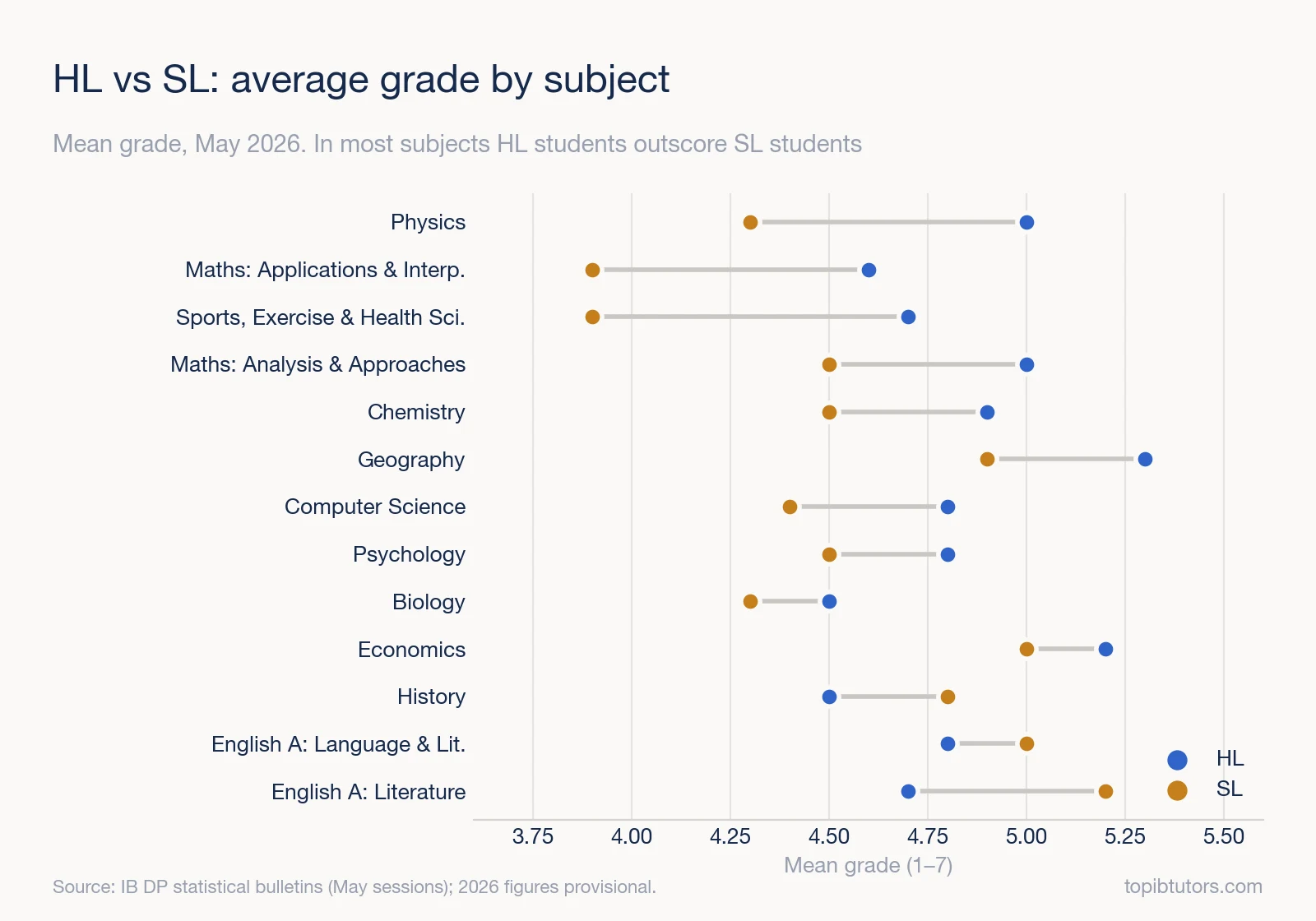
Many students assume SL is the "safer" option for grades. In most subjects, the data says otherwise: HL students averaged higher grades than SL students in 2026.
| Subject | HL mean | SL mean | Difference |
|---|---|---|---|
| Physics | 5.0 | 4.3 | HL +0.7 |
| Maths: Applications and Interpretation | 4.6 | 3.9 | HL +0.7 |
| Sports, Exercise and Health Science | 4.7 | 3.9 | HL +0.8 |
| Maths: Analysis and Approaches | 5.0 | 4.5 | HL +0.5 |
| Chemistry | 4.9 | 4.5 | HL +0.4 |
| Geography | 5.3 | 4.9 | HL +0.4 |
| Psychology | 4.8 | 4.5 | HL +0.3 |
| Economics | 5.2 | 5.0 | HL +0.2 |
| History | 4.5 | 4.8 | SL +0.3 |
| English A: Language and Literature | 4.8 | 5.0 | SL +0.2 |
| English A: Literature | 4.7 | 5.2 | SL +0.5 |
This doesn't mean HL is easier. Students who choose HL in a subject are usually the ones who are strongest and most committed to it. The lesson is that you should choose HL subjects you're good at and enjoy, rather than avoiding HL to protect your grades.
The maths data is especially useful for course choices. Maths AI SL had the lowest mean grade (3.9) and one of the lowest shares of 7s (3.7%) of any large course. Maths AA HL had one of the highest (16.8%). Read our guides to Maths AA and Maths AI before you choose.
Subject Groups: Where Grades Are Highest
| Subject group | Entries (2026) | Mean grade | % of 7s |
|---|---|---|---|
| Language acquisition | 117,213 | 5.2 | 12.7% |
| Studies in language and literature | 155,380 | 4.9 | 4.9% |
| Individuals and societies | 184,461 | 4.8 | 7.1% |
| Sciences | 150,081 | 4.5 | 10.3% |
| Mathematics | 122,282 | 4.4 | 8.7% |
| Interdisciplinary (including ESS) | 25,695 | 4.4 | 5.1% |
| The arts | 28,117 | 4.3 | 3.9% |
The sciences show an interesting pattern: a below-average mean grade (4.5) but an above-average share of 7s (10.3%). Grades in the sciences are more spread out, with more students at both the top and the bottom. By contrast, studies in language and literature have a high average grade but few 7s, because most students cluster around 4–6.
Key Subject Data: 2023 vs 2026
| Course | Students 2026 | Mean 2023 | Mean 2026 | % of 7s 2026 |
|---|---|---|---|---|
| Biology HL | 33,585 | 4.4 | 4.5 | 7.4% |
| Chemistry HL | 20,748 | 4.6 | 4.9 | 15.1% |
| Physics HL | 19,035 | 4.8 | 5.0 | 20.5% |
| Maths AA HL | 26,591 | 4.9 | 5.0 | 16.8% |
| Maths AA SL | 42,995 | 4.6 | 4.5 | 8.5% |
| Maths AI SL | 44,196 | 3.9 | 3.9 | 3.7% |
| Economics HL | 20,472 | 5.1 | 5.2 | 14.7% |
| Business Management HL | 26,520 | 5.0 | 5.0 | 6.6% |
| Psychology HL | 15,455 | 4.8 | 4.8 | 6.0% |
| History HL | 38,195 | 4.3 | 4.5 | 2.6% |
| Geography HL | 5,229 | 5.3 | 5.3 | 12.7% |
| Global Politics HL | 6,894 | 5.1 | 5.0 | 6.1% |
| English A: Lang & Lit HL | 45,440 | 4.8 | 4.8 | 3.8% |
| English A: Literature HL | 28,516 | 4.6 | 4.7 | 2.3% |
| Computer Science HL | 4,536 | 4.4 | 4.8 | 10.9% |
| ESS SL | 20,964 | 4.2 | 4.3 | 5.0% |
| Visual Arts HL | 9,709 | 4.4 | 4.3 | 2.9% |
| Spanish B SL | 22,685 | 4.9 | 4.8 | 8.0% |
| French B SL | 12,705 | 5.0 | 5.1 | 12.6% |
| Spanish ab initio SL | 11,226 | 4.9 | 4.9 | 9.5% |
Where in the World Are IB Students?
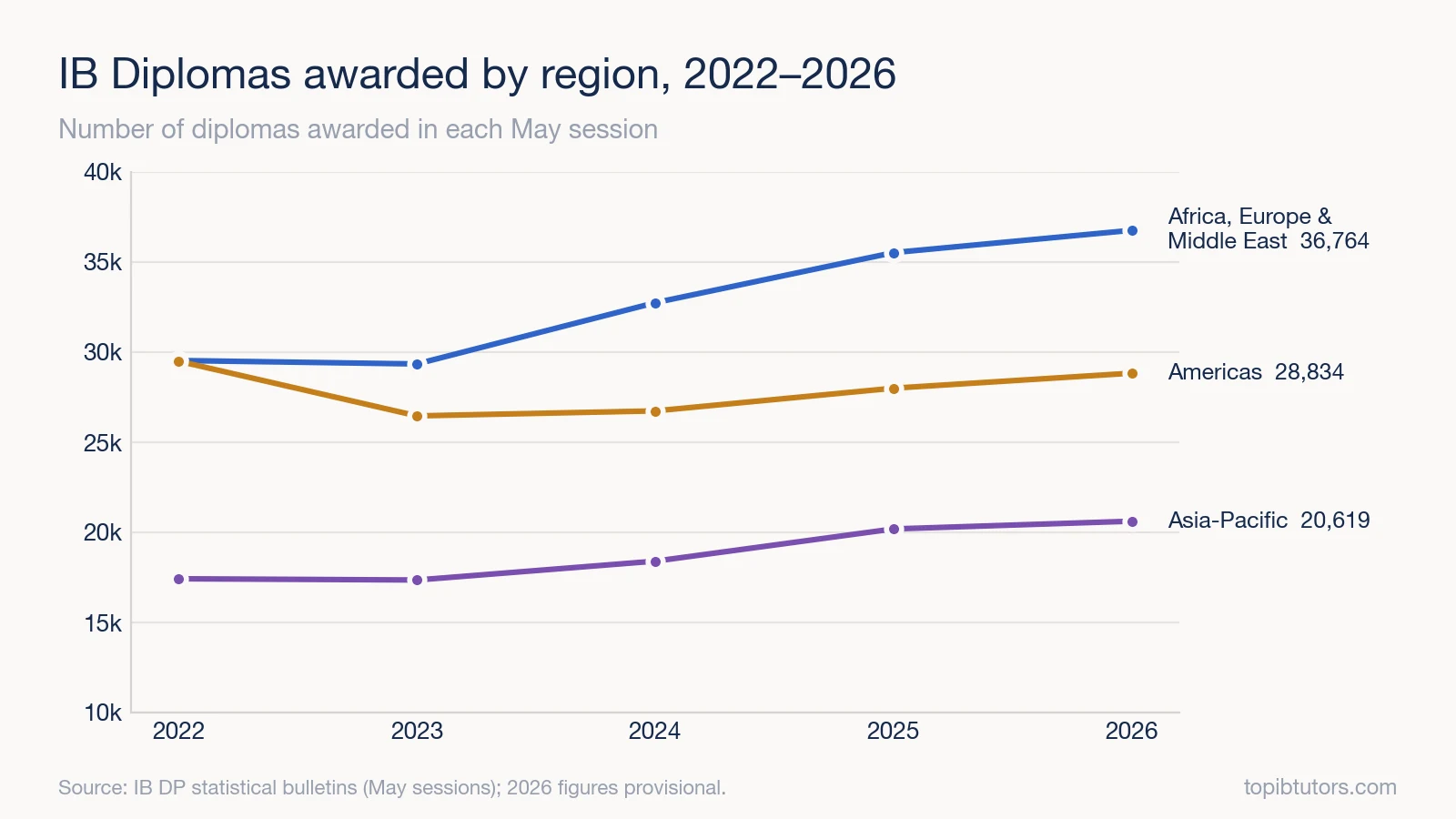
IB Africa, Europe and the Middle East awarded the most diplomas in 2026 (36,764). It has also grown fastest, by 24% since 2022. Asia-Pacific grew 18%. The Americas awarded 28,834 diplomas, slightly fewer than in 2022, even though the region has by far the most IB students overall (62.8%).
The difference is the United States. It has 104,132 IB students, about half the global total, but many of them take individual IB courses rather than the full Diploma. In 2026, 32.4% of all students worldwide were course-only students, and their number fell for the first time in five years (from 71,039 to 67,943).
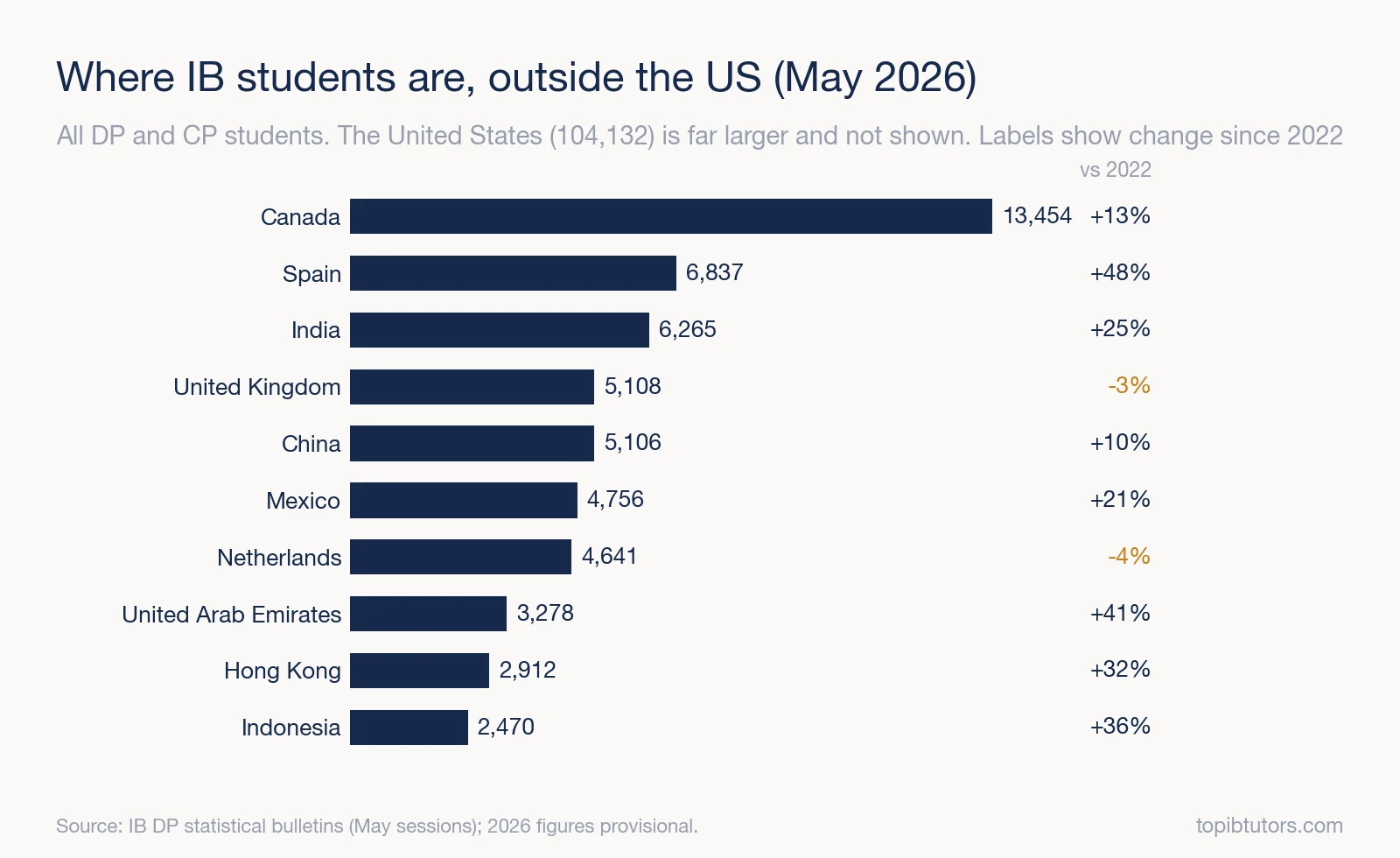
Outside the US, the countries with the most IB students in May 2026 were Canada (13,454), Spain (6,837), India (6,265), the United Kingdom (5,108) and China (5,106). Among the larger countries, the fastest growth since 2022 was in:
- Spain: +48%
- The United Arab Emirates: +41%
- Indonesia: +36%
- Hong Kong: +32%
Smaller IB countries grew quickly too: Japan +55%, Chile +51% and Brazil +50%. The UK and the Netherlands both have slightly fewer students than in 2022.
Other Numbers Worth Knowing
- Gender: 54.3% of Diploma students were female and 45.2% male.
- Anticipated candidates, students taking one or two SL subjects a year early, jumped 27% in one year, from 20,444 to 26,036.
- School size: 508 schools had 10 or fewer students in the session, while 158 schools had more than 200.
- Bilingual diplomas: about 1 in 3 diplomas awarded was a bilingual diploma (27.0% of all candidates).
- The Career-related Programme is growing fast: 10,197 students in 2026, up 22.5% in one year.
What This Means for You
1. A 30 is about average, and a 35+ is a strong result. Universities know the typical spread, so compare your score with the year you graduate, not with older cohorts. 2. Don't ignore the core. Thousands of students fail with 24+ points each year, and an E in TOK or the EE is one of the most common reasons. 3. Pick HL subjects you're strong in. HL students outscore SL students in most subjects. 4. Know your subject's grading profile. If your subject awards few 7s, such as History, English A or Visual Arts, a 6 is an excellent result. Aim for consistent strength across papers and coursework. 5. Consider a re-mark carefully. If you're close to a grade boundary, read our guide on whether to get your IB scores re-marked.
For results-day headlines, see our earlier report on the May 2026 IB results, and for last year's full data, the final May 2025 statistics.
Frequently Asked Questions
What was the IB pass rate in May 2026?
82.6% of Diploma candidates passed in May 2026, up from 81.9% in 2025 and 80.0% in 2023, according to the IB's provisional statistical bulletin.
What was the average IB score in 2026?
The average total score for Diploma candidates was 30.8 points out of 45. The average subject grade was 4.9.
What percentage of IB students get 40 or more points?
In May 2026, 10.1% of Diploma candidates scored between 40 and 45 points. That is lower than in 2022 (14.7%), but up slightly each year since 2023.
Which IB subject has the most 7s?
Among large courses, Physics HL had the highest share of 7s in May 2026 (20.5%), followed by Maths: Analysis and Approaches HL (16.8%). Some smaller language courses, such as Japanese B HL, had much higher shares.
Which IB subject is the hardest to get a 7 in?
Among large courses, Visual Arts SL (1.2%), Sports, Exercise and Health Science SL (1.9%), English A: Literature HL (2.3%) and History HL (2.6%) had the lowest shares of 7s in May 2026.
How many students took the IB in May 2026?
209,607 students at 3,442 schools in 152 countries took IB DP or CP exams in May 2026. Of these, 104,369 were final-year Diploma candidates.
Is the May 2026 data final?
Not yet. The IB's May 2026 bulletin is provisional. A final version will follow after the session closes, but the IB says it doesn't expect significant changes.
Get Support With Your IB Subjects
Whichever subjects you take, our experienced IB tutors can help you aim for the top grade bands, from online IB tutoring in any subject to Extended Essay support and IB exam preparation.
Source: International Baccalaureate, The IB Diploma Programme and Career-related Programme Provisional Statistical Bulletin, May 2026 Assessment Session, and final statistical bulletins for the May 2018 to May 2025 sessions.


