




Business Management is one of the most popular subjects for the International Baccalaureate (IB) Extended Essay (EE), and one of the most successful. If you're interested in how real companies make decisions, it's an excellent choice. The best essays investigate one real organisation in depth, apply business theory and tools, and reach a balanced judgement backed by evidence.
This guide explains how to write a Business Management EE under the new Extended Essay criteria, first assessed in May 2027. All the rules and requirements come from the IB's official Extended essay guide (first assessment 2027, updated November 2025) and the IB's Business management guide (first assessment 2024), explained in our own words.
Key Takeaways
- A Business Management EE investigates a real business issue, usually in one real organisation, using business theory and tools.
- The IB expects your essay to be based mainly on secondary sources, such as company reports, but primary research can be added where appropriate.
- Your EE is not an extension of your IA. The IB says you should choose a different organisation for each.
- Use the course's concepts (change, creativity, ethics and sustainability) and tools to structure your analysis.
- In May 2026, roughly 60% of Business Management EEs earned an A or B, one of the highest rates of any subject.
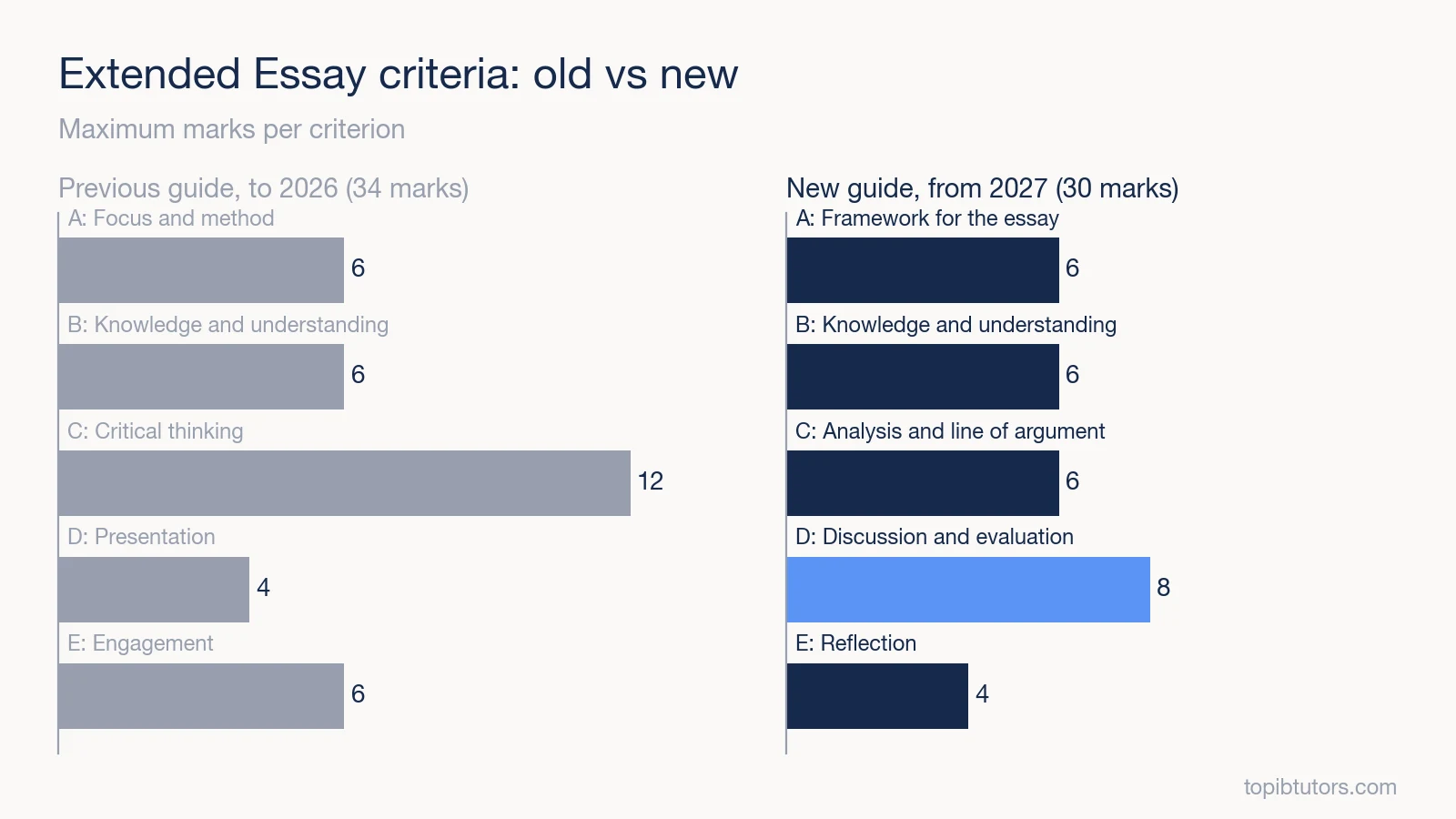
- The essay is up to 4,000 words, plus a 500-word reflective statement, marked out of 30.
What Makes a Business Management EE Different?
In the new guide, Business Management sits in the Individuals and Societies subject group. The IB says what makes an essay belong to a subject is the approach: the concepts, methods and theories you use. Its example: a topic about sport could become a Business Management essay by analysing a case study of a brand sponsoring a football club.
The IB's Business management guide says an EE in the subject lets you research in depth across areas such as human resource management, finance, operations and marketing. It adds that you should apply relevant business theory and use thorough analysis and evaluation to answer your research question.
The course is built around four concepts: change, creativity, ethics and sustainability. These make useful lenses for an EE.
The IB strongly recommends writing a subject-focused EE in a subject you study in the Diploma Programme (DP). If you don't take IB Business Management, talk to your supervisor first.
The EE Is Not Your IA
This is the rule that matters most in Business Management. The Business Management IA is a business research project on a real organisation. The IB's subject guide says:
- the EE is not an extension of the IA, and you need to understand the difference between them
- your IA and EE must be distinct pieces of work using different research approaches
- because the tasks have different requirements and criteria, you should choose different organisations for each.
So if your IA is about a local café, your EE should be about a different organisation entirely. Our IB Business Management guide explains the IA in detail.
Choosing an Organisation and Topic
Pick an organisation with enough information. The IB's subject guide notes that company data is often available because of businesses' reporting requirements. Large, listed companies publish annual reports, financial statements and sustainability reports. Small local businesses may give you interviews but little published data.
Focus on one decision or issue. "Apple's success" is too broad. A single strategy, change or problem gives you a focused essay.
Choose a past or current decision you can evaluate. You need evidence of what happened, so the decision should already have had some effect.
Examples From the IB
The Extended essay guide gives two Business Management examples, both about McDonald's:
- Training managers: to what extent is McDonald's Hamburger University an optimal form of training? The essay uses secondary sources, supported by primary research: interviews with trainers and surveys of graduates.
- Charity and brand: who benefits more from the relationship between McDonald's and Ronald McDonald House Charities? This essay uses secondary data only, weighing the advantages and disadvantages of the relationship.
Both show that strong essays can use secondary sources alone, or combine them with primary research.
Writing a Strong Research Question
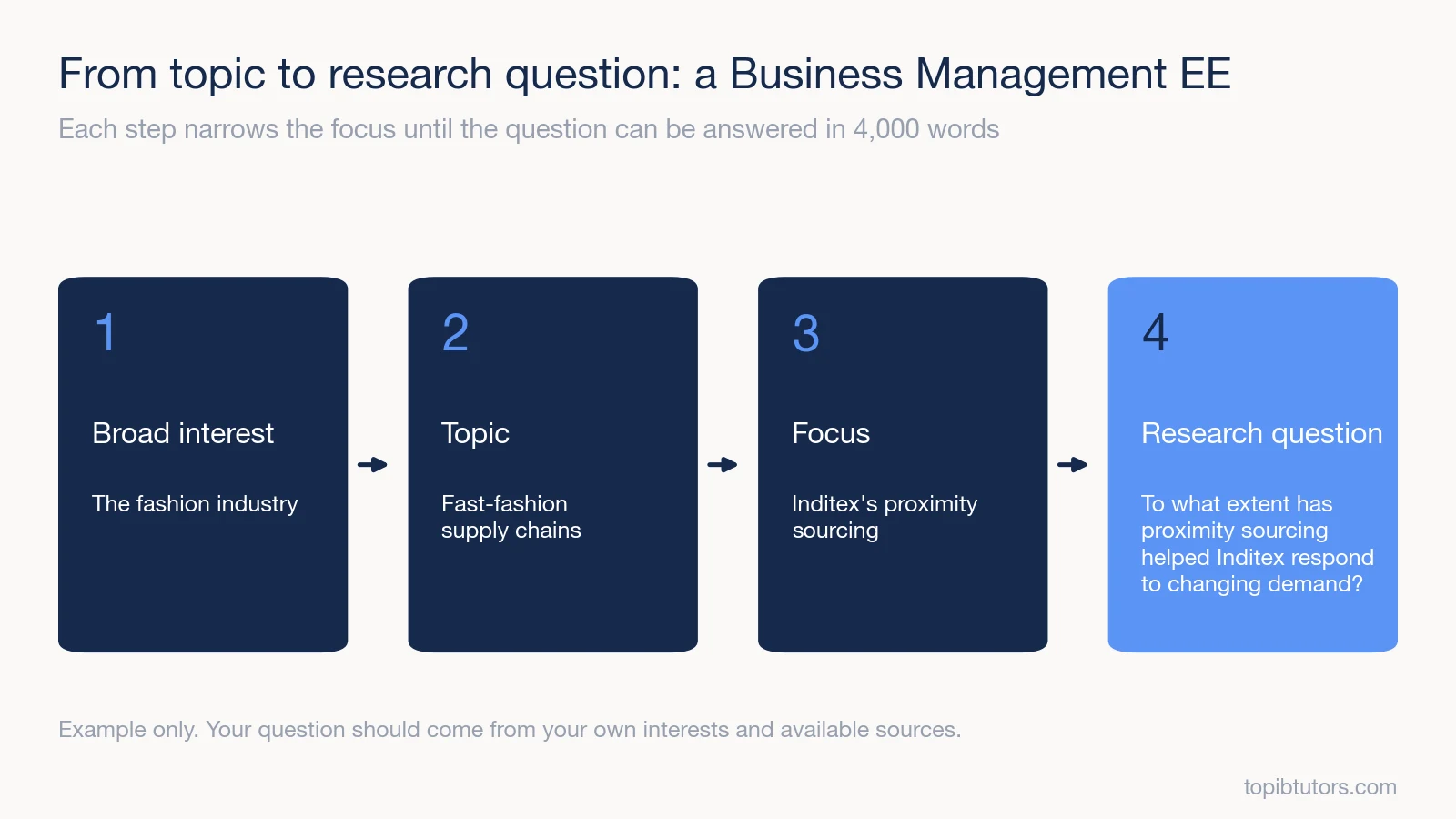
The IB's general guidance says your research question should be clear and focused, invite analysis rather than description, avoid combining two questions, and be answerable in 4,000 words.
For Business Management, a strong question usually names one organisation, one decision or issue and an outcome you can measure or evaluate.
| Weak question | Why it's weak | Stronger version |
|---|---|---|
| How does Nike do marketing? | Descriptive and broad | To what extent has Nike's shift to direct-to-consumer sales improved its profitability since 2017? |
| Is Tesla a good company? | A value judgement, no clear criteria | How effective has vertical integration been in reducing Tesla's production costs? |
| How do businesses use social media? | No organisation, far too broad | To what extent has influencer marketing increased brand awareness for Gymshark in the UK? |
| What is Inditex's strategy? | Invites description | To what extent has proximity sourcing helped Inditex respond to changing demand? |
These are examples only. Choose an organisation and question that interest you and that you can find evidence for.
Using Sources and Business Tools
| Type | Examples | How to use them |
|---|---|---|
| Secondary sources | Annual reports, financial statements, sustainability reports, investor presentations, industry reports, academic articles, quality business journalism | The main evidence base. Financial data and published strategy documents are especially valuable |
| Primary sources | Interviews with managers or employees, customer surveys | To add evidence that isn't published, where it's appropriate to your question |
Apply the Toolkit
The Business Management course includes a toolkit of analysis tools, such as SWOT analysis, STEEPLE analysis, the Ansoff matrix, the BCG matrix and decision trees, with extra tools at HL, such as force field analysis and Porter's generic strategies. Financial ratios from the finance unit are also useful for many EEs. Using the right tools gives your analysis structure and shows your knowledge of the subject. But choose tools that fit your question. Three well-applied tools are better than eight listed ones.
Be Careful With Company Sources
Companies present themselves in the best light. Balance their own reports with independent sources, such as journalism, analysts' reports or academic studies. Discussing this bias is part of good evaluation.
If you interview or survey people, follow the IB's Ethical guidelines for extended essays research and fieldwork, including informed consent.
How the Five Criteria Apply to Business Management
| Criterion | Marks | What it means for a Business Management EE |
|---|---|---|
| A: Framework for the essay | 6 | A focused question about a real organisation, research methods that suit it, and a clear structure. Label any charts or tables and refer to them in your text |
| B: Knowledge and understanding | 6 | Accurate business terminology, and meaningful use of theories, tools and concepts such as change, creativity, ethics and sustainability |
| C: Analysis and line of argument | 6 | Applying business tools and data to build an argument that answers your question |
| D: Discussion and evaluation | 8 | A balanced discussion of different stakeholders' perspectives and of the evidence, and evaluation of your sources and your essay's limitations |
| E: Reflection | 4 | Your 500-word reflective statement on the EE process |
Think About Stakeholders
A balanced discussion considers different perspectives. In Business Management, that often means stakeholders: shareholders, employees, customers, suppliers, local communities and governments. A decision that boosts profit may harm workers or the environment. Weighing these effects is strong evaluation. Our Business Management command terms guide explains what each instruction word asks for.
A Suggested Structure
The IB requires a title page, contents page, introduction, body, conclusion and bibliography. A Business Management EE often works well like this:
1. Introduction: your research question, the organisation and why the issue matters. 2. Methods: your sources and research approach, and why they suit the question. 3. Background: a short profile of the organisation, only what the reader needs. 4. Analysis: applying theory, tools and data, section by section. 5. Evaluation: stakeholder perspectives, limitations of the evidence and other factors. 6. Conclusion: a clear answer to your question.
Charts and tables don't count towards the 4,000 words, but your discussion of them does. For formatting rules, see our complete Extended Essay guide.
Business Management in an Interdisciplinary EE
From 2027, you can combine two subjects in an interdisciplinary EE. Business Management appears in several of the IB's examples:
- Digital society with business management: how Instagram influencers have changed the way service industries market their products, under the framework "evidence, measurement, innovation".
- Business management with language and literature: analysing the covers of women's magazines from the perspectives of language and marketing.
- Psychology with business management: investigating how global sustainability could be achieved in the use of plastics.
An interdisciplinary essay must genuinely combine both subjects, not just discuss them side by side.
Common Mistakes in Business Management EEs
- Using the same organisation as your IA. The IB says to choose different organisations.
- Describing the company instead of analysing. Keep the background short.
- A question with no clear evaluation criteria. "Is X successful?" needs a defined measure of success.
- Listing tools without applying them. Each tool should produce a finding.
- Relying only on the company's own reports. Balance them with independent sources.
- Ignoring stakeholders. Consider who gains and who loses.
- Predicting the future without evidence. Base your judgement on what has actually happened.
A note on AI: the IB says using AI to write your essay and presenting it as your own is dishonest. If you use AI-generated material, you must acknowledge it and check it against other sources.
What the Data Shows
Business Management was one of the most popular EE subjects in the IB's May 2026 statistical bulletin. It was also one of the most successful: judging by the bulletin's chart, about 60% of Business Management essays earned an A or B. See our analysis of the May 2026 statistical bulletin.
Frequently Asked Questions
Can I use the same company for my EE and my IA?
The IB says you should choose different organisations. The EE and IA must be distinct pieces of work with different research approaches.
Do I need primary research?
No. The IB's subject guide expects the EE to be based on secondary sources, such as company data, with primary research added where appropriate.
Can I write about a small local business?
Yes, but check that you can get enough information. Small businesses often don't publish data, so you may rely on interviews, which need the owner's cooperation.
Do I have to use business management tools?
There's no rule, but tools from the course give your analysis structure and show your subject knowledge. Choose ones that fit your question.
How is the Business Management EE marked?
Against the same five criteria as every EE: framework (6 marks), knowledge and understanding (6), analysis and line of argument (6), discussion and evaluation (8) and reflection (4), for a total of 30.
Get Expert Support With Your Business Management EE
A Business Management EE rewards a focused question, good evidence and balanced evaluation. Our Extended Essay tutoring gives you one-to-one support from experienced IB tutors, from choosing an organisation and refining your question to applying the toolkit and preparing for your viva voce, always within the IB's rules on authentic work. For the course itself, read how to score a 7 in IB Business Management.
Organise an Extended Essay tutor today →
Sources: IB, Extended essay guide (first assessment 2027, updated November 2025); IB, Business management guide (first assessment 2024); IB, DP Business Management course page.


