




Economics is a strong choice for the International Baccalaureate (IB) Extended Essay (EE) if you're curious about how markets, governments and people make choices. The best Economics EEs take a real situation, such as a tax, a price change or a new policy, and test economic theory against real evidence. The weakest ones explain theory from a textbook without ever applying it.
This guide explains how to write an Economics EE under the new Extended Essay criteria, first assessed in May 2027. All the rules and requirements come from the IB's official Extended essay guide (first assessment 2027, updated November 2025) and the IB's published information on DP Economics, explained in our own words.
Key Takeaways
- An Economics EE should apply economic theory to a real-world issue, using evidence to test it.
- Your research question must invite analysis. The IB recommends wording such as "to what extent" or "how effective".
- You must use secondary sources, and you can add primary data, such as surveys or interviews, where it fits your question.
- Use economic terminology and concepts accurately. The IB's own example is "supply and demand".
- Diagrams should be clearly labelled and referred to in your writing. They don't count towards the word limit.
- The essay is up to 4,000 words, plus a 500-word reflective statement, marked out of 30.
What Makes an Economics EE Different?
In the new guide, Economics sits in the Individuals and Societies subject group, alongside Business Management, Geography, History, Psychology and others. The IB says what makes an essay belong to a particular subject is the approach: the concepts, methods and theories you use, not just the topic.
For Economics, that means your essay should:
- focus on a specific economic question in a real context
- use economic theory and models to explain what's happening
- test those models against real data and evidence
- evaluate: weigh up the strengths and limits of the theory and of your evidence.
The IB's DP Economics course is built around nine key concepts: scarcity, choice, efficiency, equity, economic well-being, sustainability, change, interdependence and intervention. The IB says students should appreciate both the value and the limitations of economic models. That's exactly the mindset a strong EE needs.
The IB strongly recommends writing a subject-focused EE in a subject you study in the Diploma Programme (DP). If you don't take IB Economics, talk to your supervisor first.
Choosing an Economics Topic
Good Economics topics have three things: a clear economic theory to apply, a specific real context, and enough data to test the theory.
Start local or specific. A national policy, a single market or a change in your own city can make a better essay than a big global question. The IB notes that Individuals and Societies topics can come from your own experience or from current debates.
Make sure the data exists. Before you commit, check that you can find the statistics you need, for example from government sources, central banks or international organisations. The IB advises being ready to change your topic if sources are lacking.
Avoid overlap with your IA. The Economics IA is a portfolio of three commentaries on news articles. The IB says your EE must not duplicate other work you submit for the Diploma, so choose a different issue.
Examples From the IB
The guide gives two Economics examples:
- Minimum wage theory: does current research invalidate the neoclassical argument that raising the minimum wage increases unemployment? The essay presents the neoclassical model, then evaluates the counterarguments and the evidence behind them, using recent data from news articles and data banks.
- Mobile banking and development: how has access to mobile banking contributed to economic development in a particular town or village since 2010? This essay uses primary research alongside data from randomised controlled trials, looking at incomes, health, education and the empowerment of women.
Notice that both essays test a theory against evidence, rather than just explaining it.
Writing a Strong Research Question
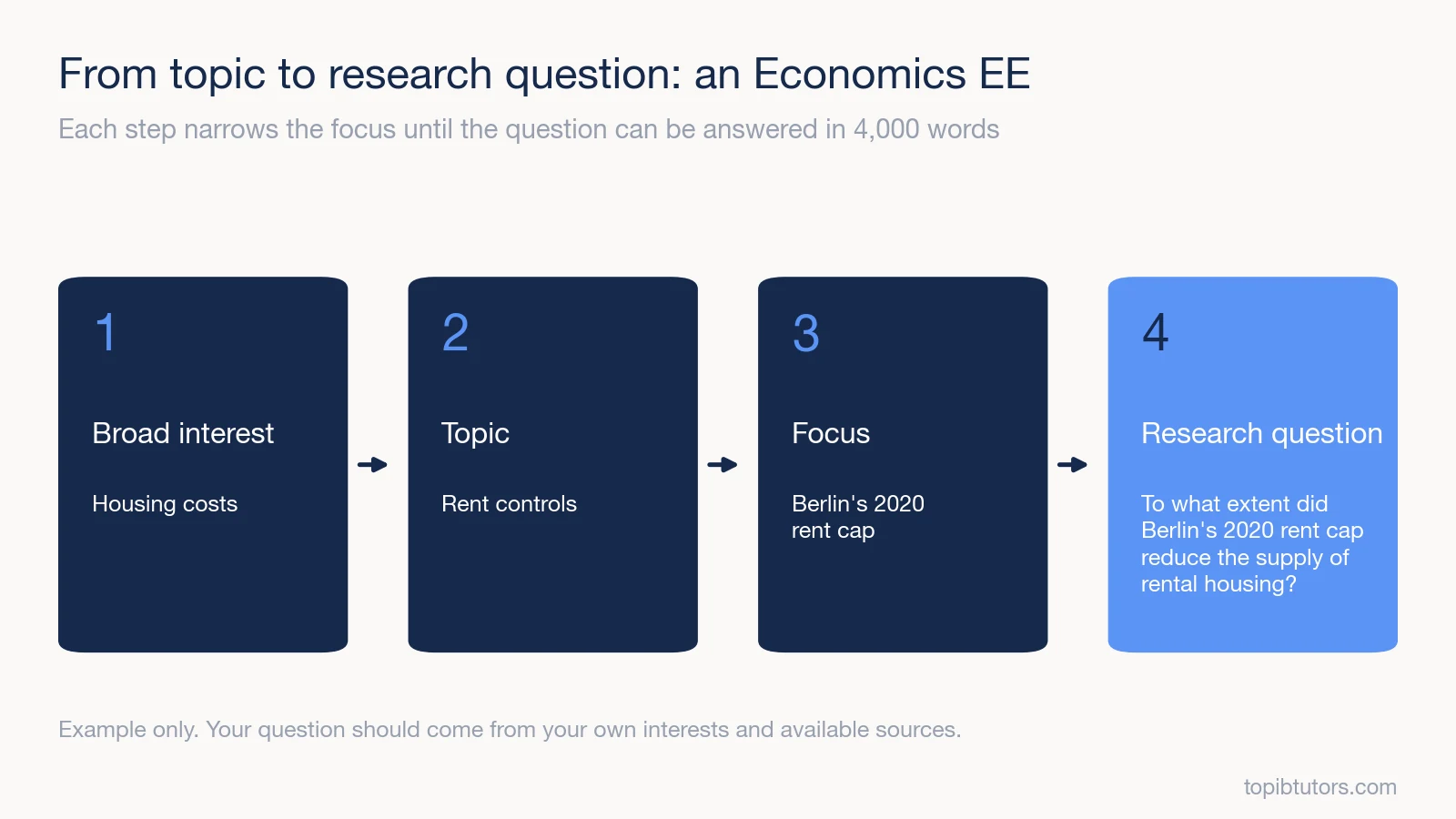
The IB's general guidance says your research question should be clear and focused, invite analysis rather than description, avoid combining two questions, and be answerable in 4,000 words.
For Economics, a strong question usually names a policy or change, a specific market or place, a time period and an economic outcome.
| Weak question | Why it's weak | Stronger version |
|---|---|---|
| What is inflation? | Descriptive, with nothing to analyse | To what extent did the 2022 energy price cap reduce inflation in the United Kingdom? |
| Are taxes good? | A value judgement, far too broad | How effective has Mexico's 2014 tax on sugary drinks been in reducing consumption? |
| How does globalisation affect developing countries? | Far too broad | To what extent has export-led growth in the garment sector raised real wages in Bangladesh since 2010? |
| What happened to rents in Berlin? | Invites a narrative | To what extent did Berlin's 2020 rent cap reduce the supply of rental housing? |
These are examples only. Your question should come from your own interests and the data you can access.
Using Sources and Data
Every EE must include secondary research. The IB says most Individuals and Societies subjects also use primary sources, but that the right mix depends on your subject and question.
| Type | Examples | How to use them |
|---|---|---|
| Secondary sources | Academic articles, textbooks, central bank and government reports, statistics from organisations such as the World Bank or IMF, quality news reporting | To set out the theory and the debate, and as a source of data |
| Primary sources | Your own surveys, interviews with businesses or officials, price data you collect yourself | To gather evidence that isn't published, especially for local topics |
Some tips for working with data:
- Use reliable sources and say where every figure comes from.
- Choose a clear time period and explain why.
- Watch for other factors. Many things affect an economic outcome at once. Discussing them is part of a good evaluation.
- Present data clearly. The IB says diagrams, graphs and tables should be clearly labelled, credited if they're someone else's work, and referred to in your writing.
If you collect primary data from people, follow the IB's Ethical guidelines for extended essays research and fieldwork, including informed consent.
How the Five Criteria Apply to Economics
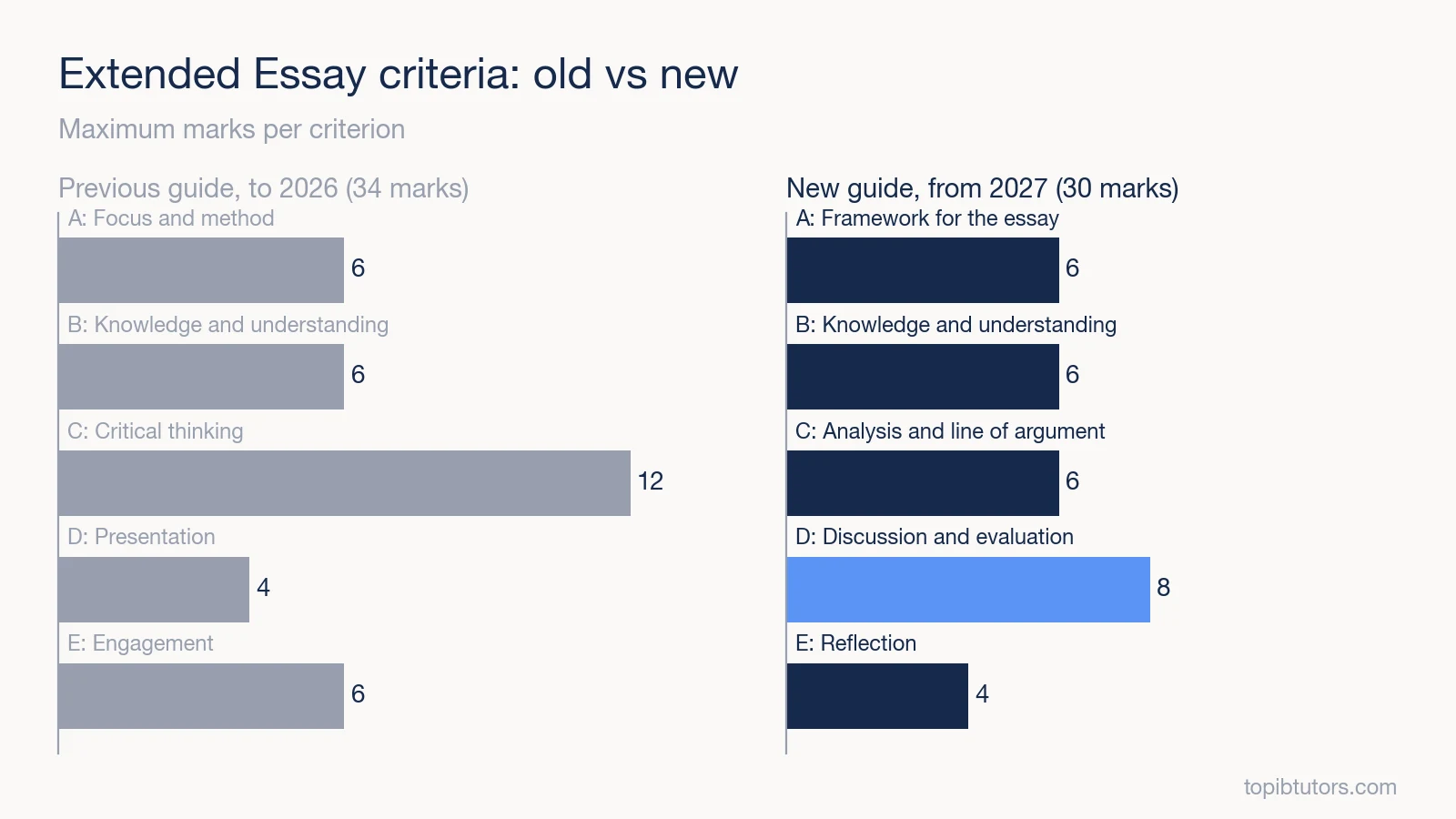
| Criterion | Marks | What it means for an Economics EE |
|---|---|---|
| A: Framework for the essay | 6 | A focused economic question, methods that suit it (data analysis, surveys, a literature review) and a clear structure. Label diagrams and graphs and refer to them in the text |
| B: Knowledge and understanding | 6 | Accurate economic terminology, such as "supply and demand" (the IB's own example), and meaningful use of concepts like efficiency, equity and intervention |
| C: Analysis and line of argument | 6 | Applying theory to your evidence to build an argument, with small conclusions along the way that lead to your final answer |
| D: Discussion and evaluation | 8 | A balanced discussion of different perspectives and evidence, and evaluation of your model's assumptions, your data and your essay's limits |
| E: Reflection | 4 | Your 500-word reflective statement on the EE process |
Diagrams Are Your Friend
Economic diagrams show examiners that you understand the theory, and they don't count towards your 4,000 words. But a diagram is only useful if you explain it. Every diagram should be labelled, accurate and discussed in your text. Our Economics command terms guide explains what "analyse" and "evaluate" mean in Economics.
Evaluate the Theory, Not Just the Policy
The IB's minimum wage example shows what strong evaluation looks like: it questions whether the theory itself holds up against evidence. Ask yourself:
- What assumptions does the model make? Do they hold in your context?
- Who wins and who loses? Consider different stakeholders.
- What happened in the short run versus the long run?
- What else could explain the outcome?
A Suggested Structure
The IB requires a title page, contents page, introduction, body, conclusion and bibliography. An Economics EE often works well like this:
1. Introduction: your research question, the context and why it matters. 2. Theory: the relevant economic models, explained briefly with diagrams. 3. Methods: your data sources and why you chose them. 4. Analysis: applying the theory to your evidence, section by section. 5. Evaluation: limitations of the theory, the data and other explanations. 6. Conclusion: a clear answer to your research question.
Keep the theory section short. Examiners want to see you use theory, not just explain it. For formatting rules, see our complete Extended Essay guide.
Economics in an Interdisciplinary EE
From 2027, you can combine two subjects in an interdisciplinary EE. Economics appears in several of the IB's examples:
- Economics with global politics: how India's rise as an economic power has affected the balance of forces in its region, under the framework "power, equality, justice".
- Economics with geography: how effective Singapore's food security measures have been since 2018, and how gentrification has turned Lisbon's historic centre into a contested space.
- Economics with biology: the environmental impact of Bt crops in developing countries.
An interdisciplinary essay must genuinely combine both subjects. Our Global Politics guide is a good starting point for that combination.
Common Mistakes in Economics EEs
- All theory, no evidence. An essay that explains models without testing them against real data won't reach the top bands.
- A topic that's too broad. "The effects of globalisation" can't be done in 4,000 words.
- Unlabelled or unexplained diagrams. Every diagram should be discussed.
- Ignoring other factors. Real economic outcomes have many causes.
- One-sided arguments. Consider different stakeholders and perspectives.
- Relying only on news articles. Use academic and official sources too.
- Overlap with your IA. Choose a clearly different issue from your commentaries.
A note on AI: the IB says using AI to write your essay and presenting it as your own is dishonest. If you use AI-generated material, you must acknowledge it and check it against other sources.
Frequently Asked Questions
Do I need primary data for an Economics EE?
Not always. Every EE needs secondary research, and many strong Economics EEs rely on published data. Primary data, such as surveys or interviews, is useful when your topic is local and published data doesn't exist.
Do diagrams count towards the word limit?
No. Charts, diagrams and tables don't count towards the 4,000 words, but your discussion of them does.
Can I write about a very recent economic event?
You can, but make sure enough data and analysis exist. Very recent events may not have reliable data yet.
Can my EE be on the same issue as my Economics IA?
No. The IB says your EE must not duplicate other work you submit for the Diploma.
How is the Economics EE marked?
Against the same five criteria as every EE: framework (6 marks), knowledge and understanding (6), analysis and line of argument (6), discussion and evaluation (8) and reflection (4), for a total of 30.
Get Expert Support With Your Economics EE
An Economics EE rewards a sharp question, good data and honest evaluation. Our Extended Essay tutoring gives you one-to-one support from experienced IB tutors, from refining your research question to applying theory and preparing for your viva voce, always within the IB's rules on authentic work. For the course itself, see our IB Economics guide and how to score a 7 in IB Economics.
Organise an Extended Essay tutor today →
Sources: IB, Extended essay guide (first assessment 2027, updated November 2025); IB, DP Economics course page.


