





If you're sitting your International Baccalaureate (IB) exams in May 2027, your Theory of Knowledge (TOK) essay must answer one of six prescribed titles. The IB released the May 2027 titles to schools in September 2026. Choosing the right one, and understanding exactly what it asks, is the most important decision you'll make for this essay.
This guide explains all six titles. For each one we cover what the title is really asking, the key terms you'll need to define, arguments worth exploring and the traps to avoid. We finish with advice on choosing a title and planning your essay.
Key Takeaways
- There are six prescribed titles for May 2027. You answer one, using the title exactly as the IB wrote it.
- The TOK essay has a maximum of 1,600 words, is marked by IB examiners out of 10, and is worth two-thirds of your TOK grade.
- Five of the six titles name at least one area of knowledge you must use. Titles 2 and 5 let you choose any two.
- Your TOK grade combines with your Extended Essay grade to give up to 3 bonus points towards your Diploma total.
- Choose the title where you have strong, specific examples for both sides of the argument, not the one that sounds easiest.
A note on the wording: the IB shares prescribed titles with schools through its Programme Resource Centre, not on its public website. The wording below matches the titles as reported by several independent IB resources. Always check the exact wording on your school's official title sheet before you start writing.
The TOK Essay at a Glance
| Feature | Details |
|---|---|
| Length | Up to 1,600 words |
| Marks | 10, marked by IB examiners |
| Weighting | Two-thirds of your TOK grade (the TOK exhibition is the other third) |
| Titles | One of the six prescribed titles for your exam session |
| Teacher support | Three formal interactions with your TOK teacher, recorded on a planning and progress form |
| Grade | A to E for TOK overall |
Examiners mark the essay against one global question from the IB's assessment instrument: does the student provide "a clear, coherent and critical exploration of the essay title"? There are no separate criteria for structure or examples. Everything you write should serve that one question.
Your TOK grade is then combined with your Extended Essay (EE) grade:
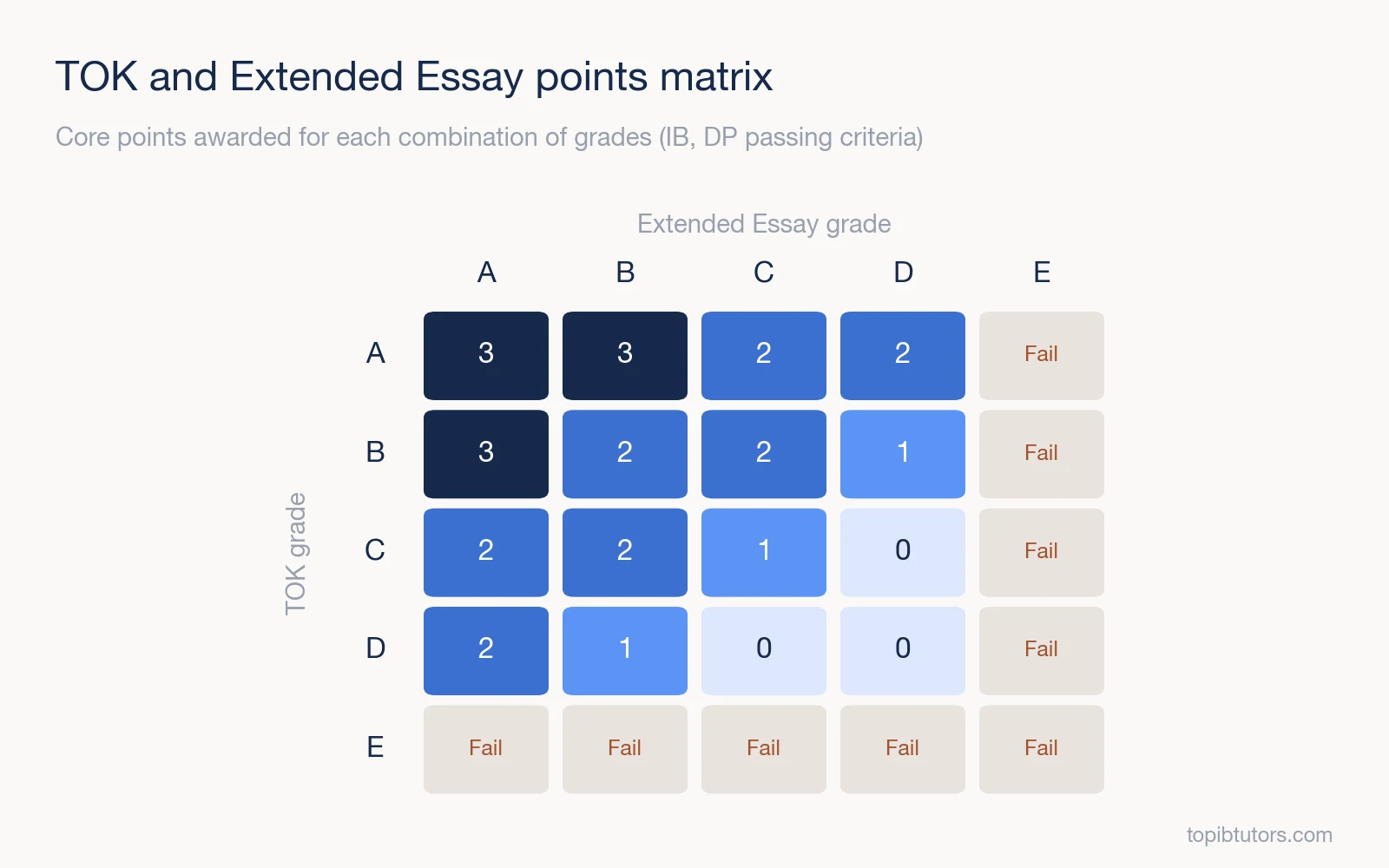
An E in either TOK or the EE means you can't be awarded the Diploma. For more on how this fits into your 45 points, see how your IB score is calculated.
The Six May 2027 TOK Prescribed Titles
| # | Title (shortened) | Areas of knowledge |
|---|---|---|
| 1 | Artist or historian: who gives a better appreciation of human experience? | The arts and history |
| 2 | How can changing values continue to guide the pursuit of knowledge? | Any two |
| 3 | How can knowledge be reliable if it is built on assumptions? | Human sciences + one other |
| 4 | "Any coincidence is worth noticing" (Agatha Christie) | Mathematics + one other |
| 5 | How far should simplicity be prioritised when choosing between explanations? | Any two |
| 6 | What value is there in exploring the paradoxical or counterintuitive? | Natural sciences + one other |
The five areas of knowledge (AOKs) in TOK are history, the human sciences, the natural sciences, mathematics and the arts. Read each title in full below.
Title 1: The Artist or the Historian?
"Do we gain a better appreciation of the human experience from the artist or the historian? Discuss with reference to the arts and history."
What it's really asking: Which kind of knowledge helps us understand what it was like to be human in a given time or situation? The historian works with evidence, sources and methods designed to limit bias. The artist works with imagination, emotion and interpretation. The title asks you to weigh these approaches against each other.
Key terms to define: "appreciation" (is it understanding, empathy, or valuing?) and "the human experience" (individual feelings, or shared social events?). How you define these will shape your whole argument.
Arguments to explore: - History offers verified, contextualised knowledge, but its sources often record the powerful and leave out ordinary lives. - Art can capture emotional truths a historical account can't, such as a war poem or a painting of a famine. But it may distort events for effect. - The two may depend on each other. Historians use art as a source, and many artists rely on historical research.
Watch out for: turning this into a simple "art is emotional, history is factual" essay. Strong essays question that split, for example by showing that historians also interpret and select.
Title 2: Values That Change Over Time
"If values change over time, how can they, nevertheless, continue to guide the pursuit of knowledge? Discuss with reference to two areas of knowledge."
What it's really asking: Values such as honesty, objectivity, fairness or respect for human dignity shape how we produce knowledge. But values aren't fixed. If they shift, can they still be a reliable guide? The word "nevertheless" signals that the title expects you to explore how they still guide us, not just whether they do.
Key terms to define: "values" (ethical values, epistemic values like accuracy and simplicity, or cultural values?) and "guide" (setting limits, setting priorities, or setting standards?).
Arguments to explore: - In the natural or human sciences, ethical values about research on people have changed a great deal. Yet changed values have arguably improved the pursuit of knowledge rather than weakened it. - Some values, such as honesty in reporting results, may be more stable than others. Perhaps the core values stay while their application changes. - In history or the arts, the values of each generation change which questions are asked and whose stories are told.
Watch out for: choosing two AOKs where values work in almost the same way. Contrast makes this essay stronger.
Title 3: Knowledge Built on Assumptions
"In the production of knowledge, how can knowledge be reliable if it is built on assumptions? Discuss with reference to the human sciences and one other area of knowledge."
What it's really asking: All knowledge rests on assumptions: that our senses are mostly accurate, that people answer surveys honestly, that the future will resemble the past. If those foundations can't be proven, how can what we build on them be trusted?
Key terms to define: "reliable" (consistently accurate? good enough to act on?) and "assumptions" (unstated beliefs, or deliberate starting points such as the "rational agent" model in economics?).
Arguments to explore: - In the human sciences, models such as rational choice in economics are openly simplified. They can still make useful predictions, which suggests reliability can be partial and practical. - Hidden assumptions are the real danger. Psychology's replication problems and research based mainly on Western participants are good examples. - In mathematics, assumptions are explicit axioms, and knowledge is reliable within that system. In the natural sciences, assumptions are tested and sometimes overturned.
Watch out for: concluding that knowledge with assumptions is simply unreliable. The more interesting question is how knowledge communities manage assumptions.
Title 4: Any Coincidence Is Worth Noticing
"To what extent do you agree with the claim that 'any coincidence is worth noticing; you can throw it away later if it is only a coincidence' (Agatha Christie)? Answer with reference to mathematics and one other area of knowledge."
What it's really asking: Should we pay attention to every pattern we spot, even if most turn out to be chance? The quote is from a detective novel, where noticing small details solves the case. The title asks whether this is a good strategy for producing knowledge.
Key terms to define: "coincidence" (a pattern with no causal link?) and "worth noticing" (worth investigating, or worth believing?). The second half of the quote, "you can throw it away later", is just as important as the first.
Arguments to explore: - In mathematics, noticing patterns has led to famous conjectures. But many patterns that hold for the first cases break down later, which is why proof matters. - In the natural sciences, unexpected observations have led to discoveries. Yet noticing every coincidence risks false positives, wasted time and "p-hacking". - Humans are prone to seeing patterns in noise. Can we really "throw away" a coincidence once we've noticed it, or does it bias us?
Watch out for: spending too long on the novel or on Agatha Christie. The quote is a starting point, and the essay must be about knowledge.
Title 5: Is Simpler Better?
"In the production of knowledge, when choosing one explanation over another, to what extent should simplicity be prioritized? Discuss with reference to two areas of knowledge."
What it's really asking: When two explanations fit the evidence, should we prefer the simpler one? This is the principle known as Occam's razor. The title asks how much weight simplicity should have compared with other qualities, such as accuracy, completeness or usefulness.
Key terms to define: "simplicity" (fewer assumptions? fewer variables? easier to understand?) and "prioritized" (the first consideration, or a tie-breaker?).
Arguments to explore: - In the natural sciences, simpler theories are easier to test and often more general. But reality is sometimes complex, and some accepted theories are anything but simple. - In history, a single-cause explanation for a war is simpler but usually weaker than one that weighs several causes. - In mathematics, an "elegant" proof is valued, but a long proof is no less true.
Watch out for: treating simplicity as the same as being easy to understand. Distinguishing types of simplicity will lift your analysis.
Title 6: The Paradoxical and the Counterintuitive
"In the pursuit of knowledge, what value is there in exploring the paradoxical or the counterintuitive? Discuss with reference to the natural sciences and one other area of knowledge."
What it's really asking: Paradoxes and results that go against common sense can feel like dead ends. This title asks whether exploring them is actually valuable, and what kind of value it brings.
Key terms to define: "paradoxical" (an apparent contradiction) and "counterintuitive" (true, but against what we expect). They aren't the same, and good essays show the difference.
Arguments to explore: - In the natural sciences, counterintuitive findings such as quantum behaviour or relativity forced major advances. Here the value is clear. - Exploring paradoxes can show the limits of our current concepts. In mathematics, paradoxes have led to stronger foundations. - The counterargument: time spent on puzzles may slow practical progress, and "counterintuitive" claims are sometimes simply wrong.
Watch out for: listing famous paradoxes without analysis. One well-explained example is worth more than five mentioned in passing.
How to Choose Your Title
Read all six titles carefully before deciding. Then ask yourself these questions:
1. Do I understand every word? If you can't define the key terms, you'll struggle to build a clear argument. 2. Do I have specific examples? You need real situations from the AOKs, ideally from your own IB subjects. Examples from your Extended Essay or internal assessments can work well. 3. Can I argue both sides? A strong essay explores claims and counterclaims. If you can only think of one side, choose another title. 4. Do the required AOKs suit me? Titles 1, 3, 4 and 6 name at least one AOK. Make sure you're comfortable writing about it. 5. Is it interesting to me? You'll spend months on this essay. Genuine interest shows in the quality of your thinking.
Our tutors' advice: Students often pick the title that looks easiest on first reading. Those titles tend to produce generic essays that examiners have read many times. A title that seems harder, but where you have one or two original, well-understood examples, usually leads to a higher mark.
A Planning Timeline
Your school sets its own internal deadlines, so follow those first. The IB starts marking May-session coursework, including TOK essays, between mid-March and mid-April, so schools submit essays before then. A typical path looks like this:
| Stage | What to do |
|---|---|
| Choose your title | Read all six, discuss them in class, and pick one with your teacher's input |
| First interaction | Share your initial ideas and planned examples with your teacher |
| Plan and draft | Build your argument, with claims, counterclaims and examples from each AOK |
| Second interaction | Your teacher gives feedback on one full draft |
| Final version | Revise, check the word count and make sure your conclusion answers the title |
| Third interaction | A final discussion about your essay, recorded on the planning and progress form |
Your teacher can comment on only one draft, so make it a complete one.
Common Mistakes to Avoid
- Changing the title. You must use the title exactly as given. Answering a reworded version can cost you heavily.
- Describing instead of analysing. Examples should support an argument, not simply be explained.
- Using only textbook examples. Original, specific examples, including from your own studies, stand out.
- Ignoring counterclaims. Examiners look for a critical exploration, which means testing your own argument.
- A weak conclusion. Your conclusion should give a clear, balanced answer to the question in the title.
- Going over 1,600 words. Examiners stop reading at the word limit.
A note on AI: the IB allows AI tools in limited ways, but any AI-generated content must be properly credited, and the essay must be your own work. Using AI to write your essay is academic misconduct. Check your school's academic integrity policy before using any AI tool.
Frequently Asked Questions
When were the May 2027 TOK titles released?
The IB released the six May 2027 prescribed titles to schools in September 2026, through its Programme Resource Centre. Your TOK teacher will share the official title sheet.
Can I change the wording of a TOK title?
No. You must use one of the six titles exactly as the IB wrote it, without changing or adding words.
How long is the TOK essay?
The maximum is 1,600 words. Examiners won't read beyond that limit, so anything over it won't count.
How much is the TOK essay worth?
The essay is worth two-thirds of your TOK grade, and the TOK exhibition is worth one-third. Your TOK grade combines with your EE grade to give up to 3 points.
Which TOK title is the easiest?
No title is easiest for everyone. The best title is the one where you have specific examples and can argue both sides with confidence. In May 2026, 9.3% of students earned an A in TOK, according to the IB's statistical bulletin.
Get Expert Help With Your TOK Essay
A strong TOK essay depends on clear thinking and well-chosen examples. Our TOK tutoring gives you one-to-one support from experienced IB tutors who can help you choose a title, develop your argument and understand the assessment, while keeping all the writing your own. For more tips, read how to score an A in Theory of Knowledge, and check your exam dates in our May 2027 IB exam schedule.
Titles © International Baccalaureate Organization, quoted for the purpose of commentary.


