




English A is one of the most popular subjects for the International Baccalaureate (IB) Extended Essay (EE). If you love reading closely and arguing about what a text means, it can be a natural choice. But an English EE has its own rules about which texts you can use, and many essays lose marks by retelling the plot instead of analysing how a text works.
This guide explains how to write an English A EE under the new Extended Essay criteria, first assessed in May 2027. All the rules and requirements come from the IB's official Extended essay guide (first assessment 2027, updated November 2025) and the IB's published information on the DP Language A courses, explained in our own words.
Key Takeaways
- An English A EE analyses one or more texts, exploring the effects they create and the techniques used to create them.
- You can't base your EE on a text you study in your Language A course, though you can choose a different text by the same author.
- In a comparative essay, at least one main text must have been originally written in English. The others can be in translation.
- Analysis means identifying a feature and explaining its effect. Plot summary earns very little.
- You need both primary sources (your texts) and secondary sources (criticism and theory), and you must engage with them critically.
- The essay is up to 4,000 words, plus a 500-word reflective statement, marked out of 30.
What Makes an English A EE Different?
In the IB's words, a Language A EE analyses one or more texts to explore "both the effects that the text(s) achieve and the devices the text(s) use to create these effects". It's a chance to do independent literary criticism and to engage with what critics have already said.
The guide allows three kinds of essay:
| Type of essay | What it involves |
|---|---|
| A single text | One literary or language text, originally written in English |
| A literary comparison | Two or more literary texts |
| A literary and language comparison | A literary text compared with a non-literary text, such as a speech or advertising campaign |
The Rules on Texts
These rules catch students out every year:
- Write in English. A Language A EE must be written in the language it's registered for. You can't submit a Language A EE in the language you study as Language B.
- No texts from your course. Your EE can't be based on a text you study in your Language A course. You can write about a different work by an author you've studied.
- Originally written in English. A single-text essay needs a text originally written in English. In a comparison, at least one main text must be, and the others may be translations.
- Literary merit. Your texts must be complex and original enough to sustain 4,000 words of close analysis.
Choosing Your Texts and Topic
Your topic must be about literature or language, and based on one or more clearly defined texts. The guide lists a wide range of acceptable text types: novels, poems, short stories, plays, non-fiction, films, songs, speeches, advertisements, newspaper articles, and electronic texts such as blogs, web pages and social media posts.
The IB's guidance on choosing well:
- Issues are fine, if the analysis is literary. You can explore a social, political or philosophical issue in a text. But your focus must be on how the text treats the issue, not on the issue itself. The text shouldn't be used as documentary evidence.
- Avoid biographical, historical, psychological or sociological topics. These pull you away from literary analysis and towards narrative or description.
- Avoid "applying a template". The guide warns that simply applying a generic convention to a text limits your essay. Its example: asking how the Harry Potter series reveals the Hero's Journey.
- Be careful with very new books. A recently published work may not have much criticism written about it yet. The guide also warns that some young adult novels lack the depth needed.
- Define your texts. If you're analysing a body of work, such as a writer's tweets or an advertising campaign, set clear time boundaries.
Poetry and Short Stories
The IB doesn't set a number of poems or stories. Instead, it suggests starting with a few complementary texts, such as three or four poems by one poet on a theme. Then see whether they give you enough to analyse without repeating yourself.
Film
If you choose a film, the guide says your focus must be on the screenplay: the written or spoken word, how it's delivered and its effect. Camera work alone isn't enough for an English A essay.
Examples From the IB
The guide gives several example topics, including:
- how Oscar Wilde presents and critiques social expectations in The Importance of Being Earnest
- whether the Artificial Friends in Kazuo Ishiguro's Klara and the Sun can build relationships by imitating humans
- satire in Adventures of Huckleberry Finn and Candide
- ghosts in Toni Morrison's Beloved and Henry James's The Turn of the Screw
- sexism in Van Heusen menswear advertisements from 1949 to 1951
- rhetorical techniques in commencement speeches by Steve Jobs and Michelle Obama.
Notice that the last two are language essays, not literature essays. The English A EE isn't limited to novels and poems.
Writing a Strong Research Question
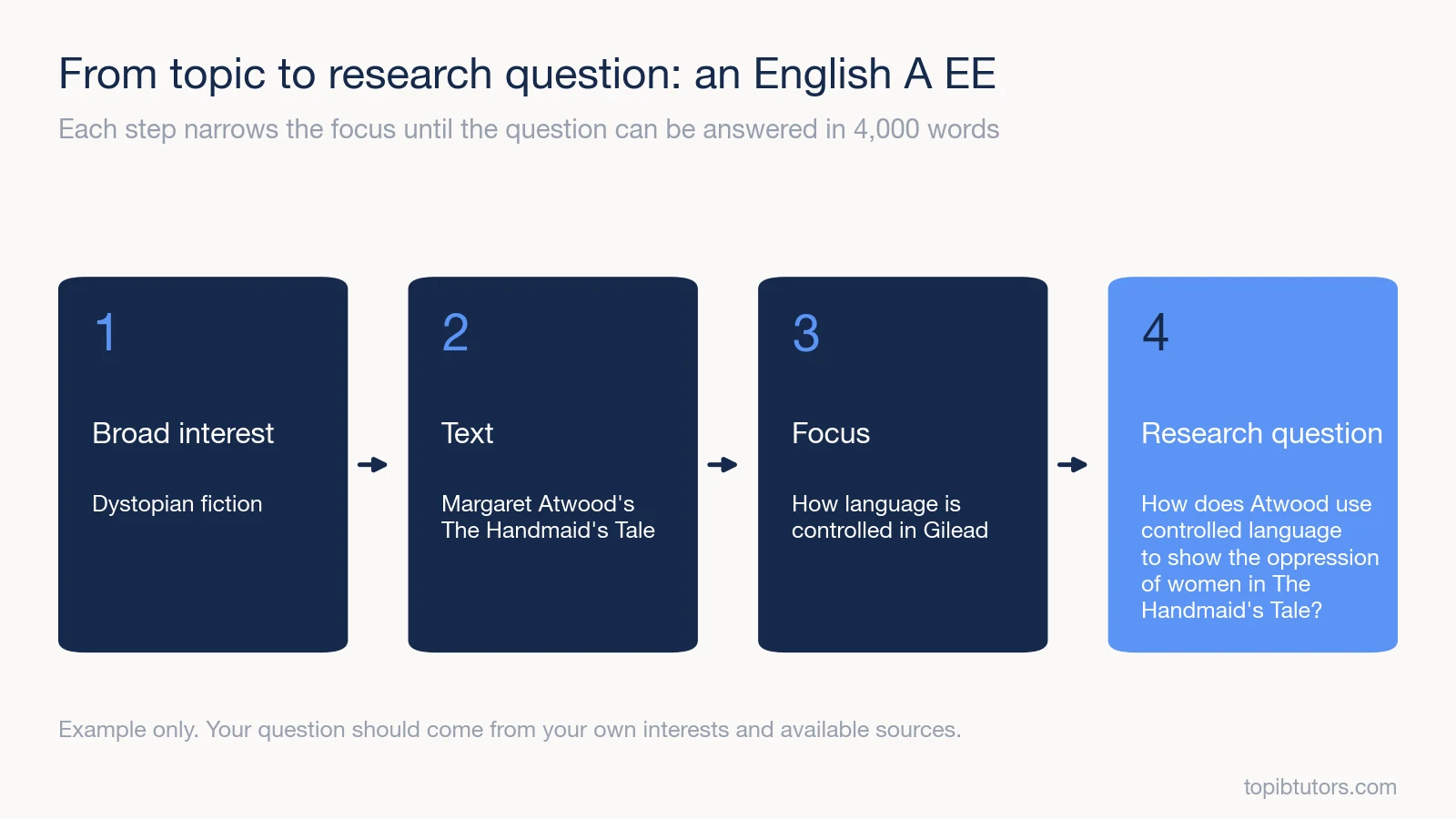
The IB's general guidance applies to every EE. Your research question should be clear and focused, invite analysis rather than description, avoid combining two questions, and be answerable in 4,000 words.
For English A, the strongest questions usually ask how and to what effect a writer does something. That wording pushes you straight towards analysing techniques and their effects.
| Weak question | Why it's weak | Stronger version |
|---|---|---|
| What happens to Offred in The Handmaid's Tale? | Invites plot summary | How does Atwood use controlled language to show the oppression of women in The Handmaid's Tale? |
| Is Gatsby a tragic hero? | A yes/no question with no clear criteria | To what extent does Fitzgerald's use of Nick as narrator shape the reader's sympathy for Gatsby? |
| How do Shakespeare's plays show power? | Far too broad | How does Shakespeare use soliloquy to reveal Macbeth's changing relationship with power? |
| What did critics think of Beloved? | Focuses on critics, not the text | How, and to what effect, does Morrison use fragmented narration to represent trauma in Beloved? |
These are examples only. Remember, you can't use a text you study in class.
Using Sources
The guide says scholarly research is essential, and you need both kinds of source:
| Type | Examples | How to use them |
|---|---|---|
| Primary sources | The novels, poems, plays, speeches or other texts you're analysing | The heart of your essay. Support every point with quotations and close reading |
| Secondary sources | Critical studies, journal articles, reviews, biographies, studies of genre, literary theory | To frame your analysis. Agree, disagree, or build on critics' readings |
Two warnings from the IB:
- Don't let the essay become your personal opinion. Ground your analysis in the text first, then give your considered view, supported by evidence.
- Don't just summarise critics. An essay that repeats what established critics say won't score well. Engage with their views critically.
Comparative essays have extra requirements. You need to explain why you chose these texts and what the comparison achieves, beyond listing similarities and differences. Give equal attention to each text.
How the Five Criteria Apply to English A
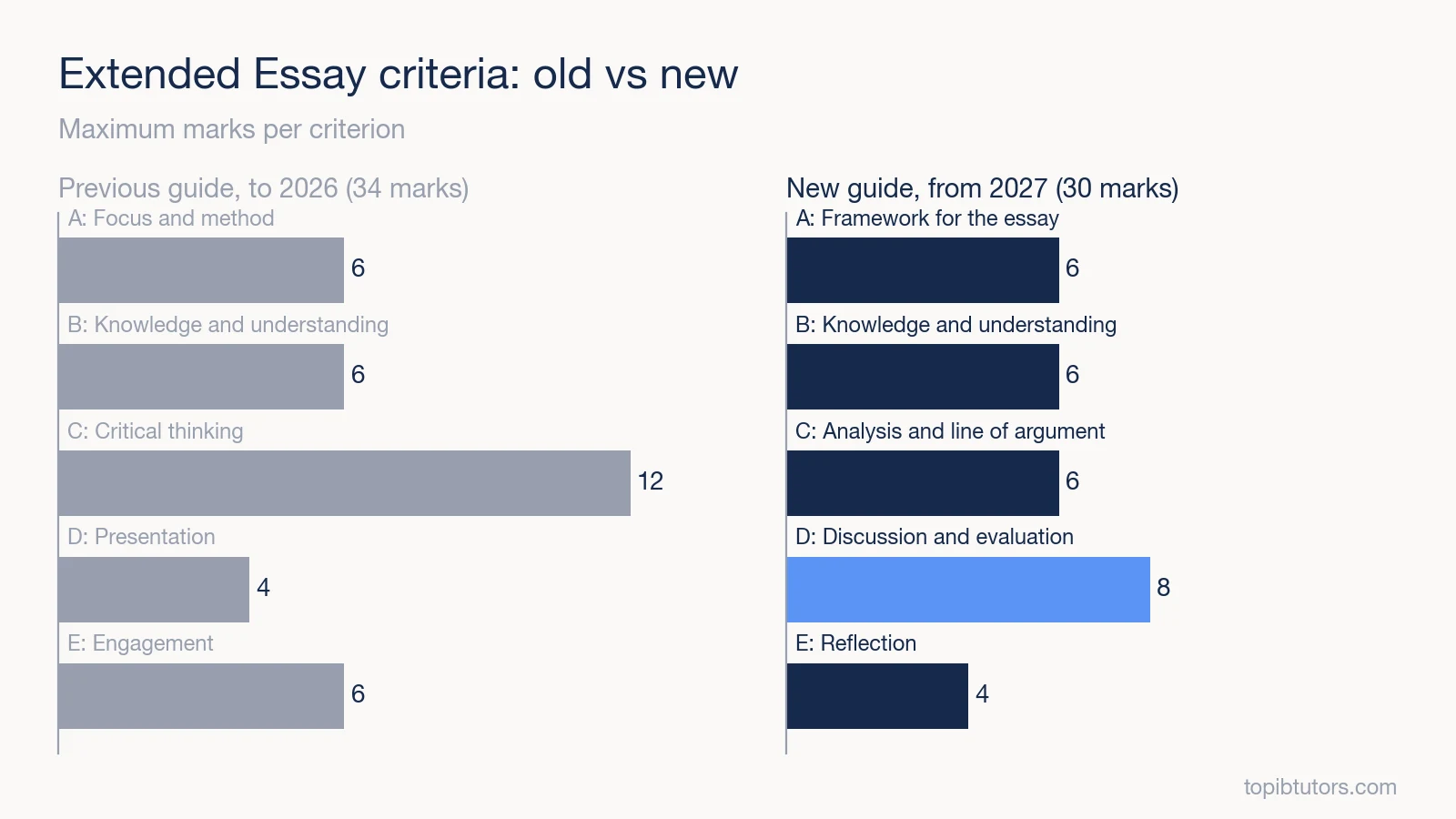
| Criterion | Marks | What it means for an English A EE |
|---|---|---|
| A: Framework for the essay | 6 | A focused question, suitable texts and methods, and a clear structure: an introduction that names your texts, body paragraphs that build an argument, and a conclusion |
| B: Knowledge and understanding | 6 | Accurate use of literary terminology, such as metaphor, enjambment, stage directions or camera shots, and concepts, such as the tragic hero, dystopia or intertextuality |
| C: Analysis and line of argument | 6 | Analysis instead of plot description, with an argument linking your question to your conclusion |
| D: Discussion and evaluation | 8 | A balanced discussion of different readings, supported by close reading of primary and secondary sources, and evaluation of your essay's limitations |
| E: Reflection | 4 | Your 500-word reflective statement on the EE process |
The "So What?" Test
The guide gives a simple model for literary analysis. It has two parts:
1. Identify a feature in the text, such as a metaphor, a narrative choice or a pattern of imagery. 2. Explain its significance or effect. Ask "so what?" What does it show about the character, the theme or the text as a whole?
Spotting techniques without explaining their effect isn't analysis. Every paragraph should answer the "so what?" question.
Use the Course's Ideas
The IB's Language A courses are organised around three areas of exploration: readers, writers and texts; time and space; and intertextuality: connecting texts. These offer useful angles for an EE, such as how context shapes meaning, or how texts respond to one another. Our guide to English command terms and our list of 100+ literary devices will help with your terminology.
A Suggested Structure
The IB requires a title page, contents page, introduction, body, conclusion and bibliography. Within that, an English A EE often works well like this:
1. Introduction: your research question, the texts you'll analyse, why they're worth studying together, and a brief note on context. 2. Body sections: organise by argument, not by plot. Each section makes a point about technique and effect, supported by quotations. 3. Engagement with criticism: woven through the body, where critics support or challenge your reading. 4. Conclusion: a clear answer to your question, drawing on your close reading.
You can use headings, but the guide warns that too many sections can make an essay feel fragmented. For word count and formatting rules, see our complete Extended Essay guide.
What About English B?
If English is your Language B, the rules are different. The IB's Language B guidance says:
- You can write about language use, literature or culture in an English-speaking country, or a combination.
- All texts must have been originally written or spoken in English. Translations aren't acceptable.
- You can't write a Language B EE in a language you study as Language A.
- You don't need advanced fluency, but your meaning must be clear.
English in an Interdisciplinary EE
From 2027, you can combine two subjects in an interdisciplinary EE. The IB's guide gives several examples involving Language A, including:
- Language and literature with history: how literary works might influence political movements, such as plays connected to the Irish cultural revival.
- Language and literature with psychology: exploring poetry using ideas from cognitive neuroscience.
- Language and literature with business management: analysing the covers of women's magazines from the perspectives of language and marketing.
An interdisciplinary essay must genuinely combine both subjects. Our History EE guide covers the History side of that first example.
Common Mistakes in English EEs
- Retelling the plot. Assume the examiner knows the text. Every sentence should support your analysis.
- Choosing a text from your course. This isn't allowed.
- Too many texts. Two well-chosen texts analysed closely usually beat four analysed superficially.
- Listing techniques without effects. Always explain the "so what?".
- Ignoring or just summarising critics. Engage with secondary sources, don't just quote them.
- An unbalanced comparison. Give each text equal attention.
- Choosing a text without enough depth. Check that critics have written about it.
A note on AI: the IB says using AI to write your essay and presenting it as your own is dishonest. If you use AI-generated material as a source, you must acknowledge it and check it against other sources.
What the Data Shows
In the IB's May 2026 statistical bulletin, English A was one of the most popular EE subjects. Essays in studies in language and literature had one of the highest shares of A grades (14.0%), second only to the arts. See our analysis of the May 2026 statistical bulletin.
Frequently Asked Questions
Can I write my English EE on a book I'm studying in class?
No. The IB says a Language A EE can't be based on a text studied in your Language A course. You can write about a different work by the same author.
Can I use texts in translation?
In a comparative essay, yes, as long as at least one main text was originally written in English. A single-text essay must use a text originally written in English.
How many texts should I use?
The IB doesn't set a number. One rich novel or play can sustain an essay, and many strong comparative essays use two texts. For poetry or short stories, start with three or four complementary pieces.
Can I write about a film or song?
Yes, but the focus must be on language. For film, the IB says to focus on the screenplay and how the words are delivered.
Do I need secondary sources?
Yes. The IB says literary scholarship is essential, and you must engage with it critically rather than just summarising it.
Get Expert Support With Your English EE
An English EE rewards careful text choices and sharp analysis. Our Extended Essay tutoring gives you one-to-one support from experienced IB tutors, from choosing texts and refining your question to structuring your argument and preparing for your viva voce, always within the IB's rules on authentic work. For your coursework, see our guides to IB English Literature and IB English Language and Literature.
Organise an Extended Essay tutor today →
Sources: IB, Extended essay guide (first assessment 2027, updated November 2025); IB, Language A: literature and Language A: language and literature course pages and subject briefs.


