



History is one of the most popular subjects for the International Baccalaureate (IB) Extended Essay (EE). It's easy to see why: almost any period, place or person can become a research topic, and History students already practise working with sources and building arguments. But History is also a subject where many essays fall short, usually because they tell a story instead of answering a question.
This guide explains how to write a History EE under the new Extended Essay criteria, first assessed in May 2027. All the rules and requirements come from the IB's official Extended essay guide (first assessment 2027, updated November 2025) and the IB's published information on the DP History course, explained in our own words.
Key Takeaways
- A History EE is a research essay of up to 4,000 words, plus a 500-word reflective statement, marked out of 30 against five criteria.
- Your research question must invite analysis, not narrative. The IB recommends wording such as "to what extent", "how significant" or "how successful".
- In History, primary sources give first-hand evidence of the period, and secondary sources are historians' interpretations. A strong essay uses and evaluates both.
- Build your argument around historical concepts such as cause and consequence, change and continuity, perspectives and significance.
- Your EE must not repeat your History internal assessment (IA). Choose a clearly different topic.
- You can also combine History with another subject in an interdisciplinary EE, a new option from 2027.
What Makes a History EE Different?
In the new guide, History sits in the Individuals and Societies subject group, alongside Business Management, Economics, Geography, Global Politics, Psychology and others. The IB describes these subjects as exploring questions connected to human experience and behaviour "across time and space".
What makes an essay a History essay isn't the topic itself. The guide stresses that it's the approach: the concepts, methods and evidence you use. A topic about sport, for example, could be a Business Management essay (a sponsorship case study) or a Global Politics essay (gender rights). It becomes a History essay when you investigate the past using historical evidence and historical reasoning.
That means a History EE should:
- focus on a specific event, person, development or period in the past
- use evidence from the time (primary sources) alongside historians' interpretations (secondary sources)
- analyse and evaluate that evidence to reach a reasoned judgement
- engage with historical concepts, such as causation and consequence, which the guide gives as examples for a History EE.
The IB strongly recommends that you only write a subject-focused EE in a subject you're studying in the Diploma Programme (DP). If you don't take IB History, talk to your supervisor before choosing it.
Choosing a History Topic
The best History topics sit where three things meet: a genuine interest, enough accessible sources, and room for debate.
Start with what interests you. The IB suggests topics can come from your own experience, current debates, or something related to a subject you enjoy. In History, local or family connections can lead to excellent essays, for example a development in your city's past.
Check your sources early. Before you commit, make sure you can find both primary sources and serious secondary work. The IB advises being ready to change your topic if your early research shows a shortage of suitable sources.
Look for a debate. If every historian agrees, there's little to argue about. Topics where historians disagree give you a natural way to discuss and evaluate different interpretations.
Avoid overlap with your IA. The History IA is also a historical investigation of your choice. The IB is clear that your EE must not duplicate other work you submit for the Diploma, so choose a separate topic.
Our advice on very recent events: topics from the last few years often have plenty of news coverage but little published analysis by historians. That makes it hard to discuss historical interpretations. If you choose a recent topic, check with your supervisor that there's enough scholarly work.
Examples From the IB
The IB's guide gives two example History essays:
- The collapse of the Soviet Union in 1991. The IB's research question asks to what extent the collapse was caused by Mikhail Gorbachev's political reforms. The guide notes that this narrows "an otherwise overly broad topic". The essay can weigh the reforms against other factors, such as economic failure, the war in Afghanistan and rising nationalism.
- Women's suffrage in New Zealand. The research question asks how significant the Women's Christian Temperance Union was in winning the vote in 1893. The essay can compare its role with other factors, such as support from the Liberal Party.
Both follow the same pattern: one clear question, one main factor to assess, and other factors to weigh it against.
Writing a Strong Research Question
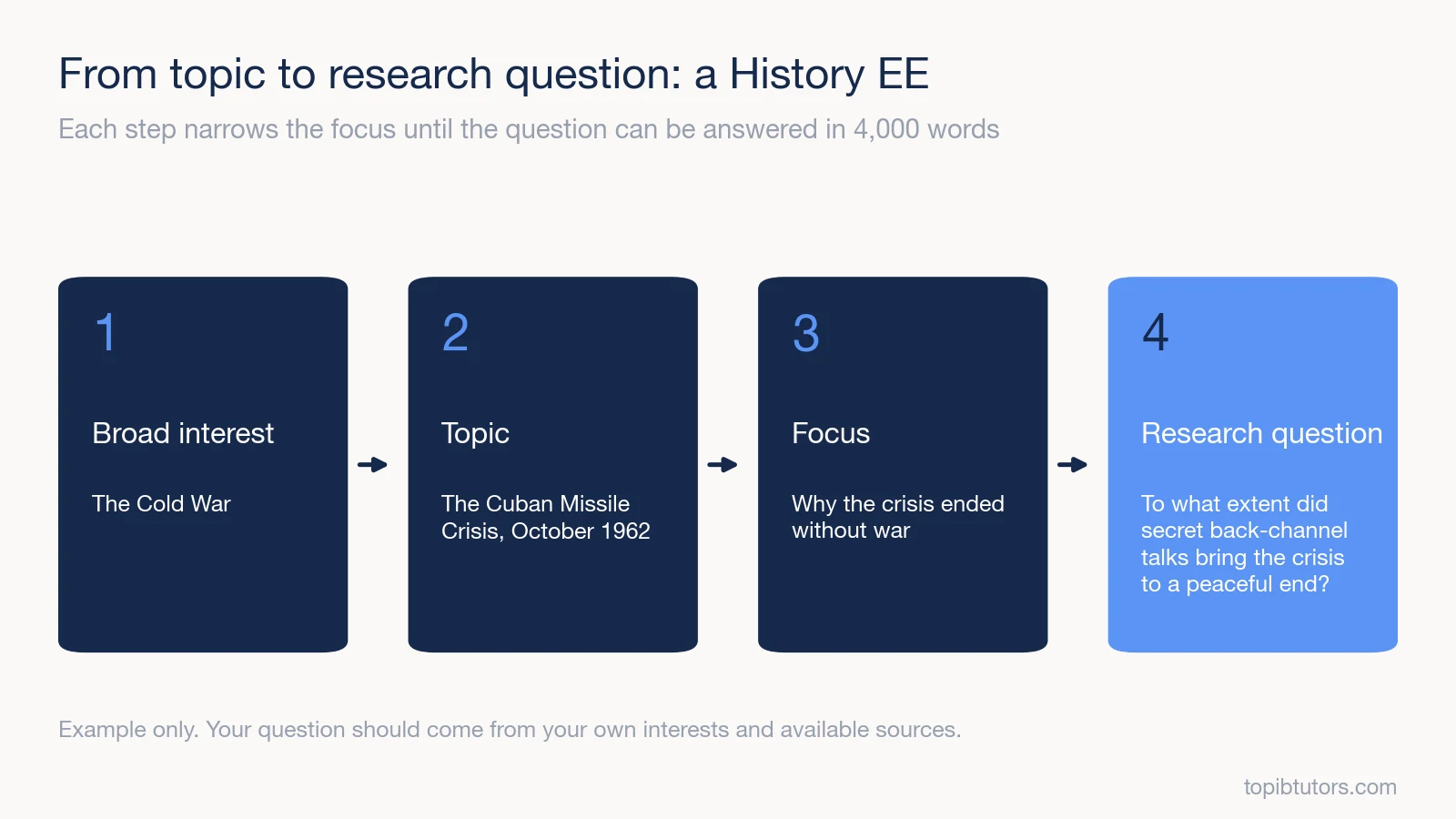
Your research question drives the whole essay. The IB's guidance says it should:
- be clear, specific and focused
- encourage critical analysis rather than a descriptive or narrative response
- allow a strong line of argument to develop
- avoid combining two questions in one ("double-barrelled" questions)
- not have an obvious answer
- be answerable within 4,000 words.
It can also change as your research develops, so treat your first version as a draft.
Good and Weak History Research Questions
These are examples only. Your question should come from your own interests and the sources you can access.
Tip: "To what extent", "how significant" and "how successful" all point you towards a judgement, which is exactly what examiners want to see. Our guide to History command terms explains what each instruction word asks for.
Using Sources in a History EE
The IB's guide explains the difference simply: in History, primary sources give first-hand evidence of the event or period you're studying, while secondary sources interpret and analyse primary sources. Every EE must include secondary research, whatever the subject.
Evaluate, Don't Just Quote
Examiners want to see that you can judge your evidence. For each important source, ask:
- Who created it, and when?
- Why was it created, and for whom?
- What makes it valuable for your question?
- What are its limitations?
For Criterion D, the guide suggests that evaluating evidence can include working out who wrote it and why they were writing it, and that a balanced discussion should consider different perspectives. If you study IB History, you'll know this kind of source analysis from Paper 1.
Engage With Historiography
Historians often disagree. A strong History EE shows that you know the main interpretations of your topic and can weigh them. For example, has your topic been seen differently by historians from different countries or generations? Which interpretation does your evidence support best, and why?
Interviews and Oral History
If you interview people about events they lived through, follow the IB's Ethical guidelines for extended essays research and fieldwork. These cover informed consent, privacy and confidentiality, and the comfort of the people you interview. Talk to your supervisor before you start, especially if the topic is sensitive.
How the Five Criteria Apply to History
Every EE is marked against the same five criteria. The IB's guide includes advice on applying them to Individuals and Societies subjects. Here's what that means for History.
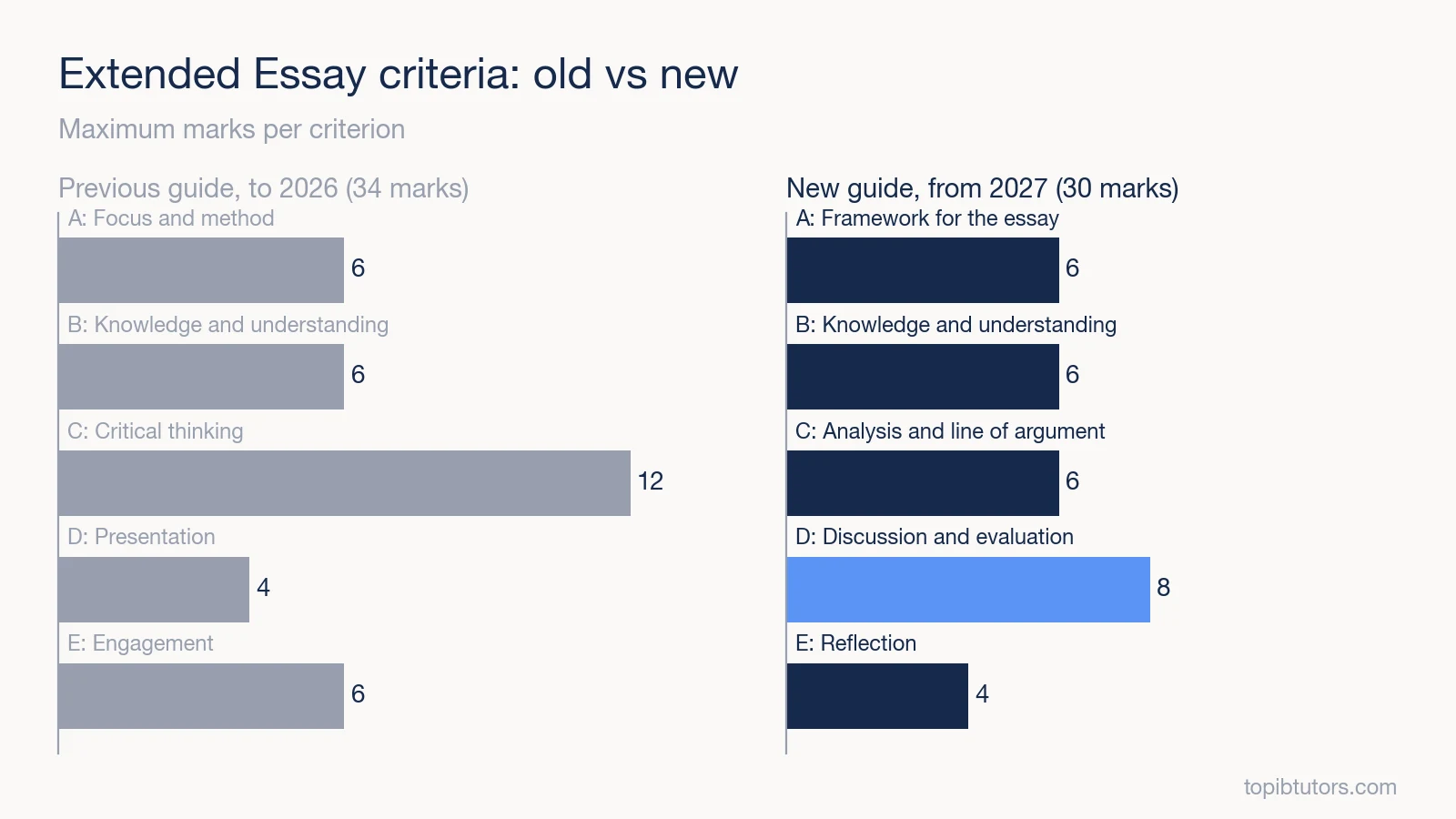
Criteria C and D are worth 14 of the 30 marks. In History, this is where narrative essays lose the most. Every paragraph should help answer your question.
Use Historical Concepts
The guide names concepts as a key part of Criterion B, and gives "causation" and "consequence" as examples for History. The IB's DP History course is built around key concepts. The new course, first assessed in 2028, names four: cause and consequence, continuity and change, perspectives, and significance. Using these ideas deliberately, and not just as labels, shows examiners that you think like a historian.
A Suggested Structure
The IB requires a title page, contents page, introduction, body, conclusion and bibliography. Within that, a History EE often works well like this:
1. Introduction: state your research question, explain why it matters, outline the historical context briefly, and set out your approach and main sources.
2. Body sections: organise by argument or factor, not by date. Each section should make a point, support it with evidence and link back to your question.
3. Discussion of interpretations: this can be its own section or woven through the body.
4. Conclusion: give a clear answer to your question, explain how far your evidence supports it, and note any limitations or questions that remain.
Keep background narrative short. The context should only be as long as the reader needs to follow your argument.
For the full formatting rules, including what does and doesn't count towards the 4,000 words, see our complete Extended Essay guide.
History in an Interdisciplinary EE
From 2027, students can choose an interdisciplinary pathway, combining two DP subjects within one of five frameworks. History works well in combination. The IB's guide gives several examples involving History:
- History and Global Politics: how disputes over property in the Sheikh Jarrah area of East Jerusalem reflect wider Israeli–Palestinian conflicts, under the framework "power, equality, justice".
- History and Language A: how literary works might influence political movements, such as plays connected to the Irish cultural revival.
- Physics and History: applying chaos theory to the Cuban Missile Crisis.
An interdisciplinary essay must genuinely combine both subjects, not just discuss them side by side. The IB strongly recommends that you study at least one of the two subjects in the DP. If you choose this route, you'll also find our IB Global Politics guide useful.
Common Mistakes in History EEs
- Telling a story. A chronological account of events, however detailed, doesn't answer an analytical question.
- A topic that's too broad. "The causes of the Second World War" can't be done properly in 4,000 words.
- Relying on one or two sources. Examiners expect a range of primary and secondary evidence.
- Using sources without evaluating them. Every key source needs some judgement about its value and limitations.
- Ignoring other interpretations. A one-sided essay limits your marks for discussion and evaluation.
- A conclusion that doesn't answer the question. Your conclusion should give a clear, supported judgement.
- Overlapping with your IA. Choose a clearly different topic from your History internal assessment.
- Over-quoting. The IB warns against extensive quoting. Your knowledge should show in your own writing.
A note on AI: the IB says using AI to write your essay and presenting it as your own is dishonest. You may use AI-generated material as a source if you acknowledge it and check it against other sources. Given that AI tools can invent facts and quotations, this matters especially in History.
History EE Results: What the Data Shows
History is consistently one of the most popular EE subjects in the IB's statistical bulletins. But popularity doesn't make it easy. In May 2026, judging by the bulletin's chart, only about a quarter of History essays earned an A or B, compared with about 60% in Business Management. See our analysis of the May 2026 statistical bulletin for more.
That gap is a reminder that History rewards careful planning. A focused question, good sources and a clear argument make all the difference.
Frequently Asked Questions
How long is a History Extended Essay?
The essay can be up to 4,000 words, plus a reflective statement of up to 500 words. Examiners don't read beyond the word limit.
Do I need to study IB History to write a History EE?
It isn't formally required, but the IB strongly recommends writing a subject-focused EE in a subject you study in the DP, so you have the subject knowledge you need.
Can my History EE be on the same topic as my History IA?
No. The IB says your EE must not duplicate any other work you submit for the Diploma, including your internal assessment.
Do I need primary sources for a History EE?
In History, primary sources are the main evidence for your argument, so a strong essay will use them. Every EE must also include secondary research, such as historians' books and articles.
Can I write about a recent event?
The 2027 guide doesn't set a cut-off date. But very recent events usually have little published analysis by historians, which makes it harder to discuss interpretations. Check with your supervisor.
How is the History EE marked?
Against the same five criteria as every EE: framework (6 marks), knowledge and understanding (6), analysis and line of argument (6), discussion and evaluation (8) and reflection (4), for a total of 30.
Get Expert Support With Your History EE
A History EE rewards good choices made early: the right topic, a sharp question and a plan for your sources. Our Extended Essay tutoring gives you one-to-one support from experienced IB tutors, from refining your research question to structuring your argument and preparing for your viva voce, always within the IB's rules on authentic work. For the History course itself, see our IB History guide.
Organise an Extended Essay tutor today →
Sources: IB, Extended essay guide (first assessment 2027, updated November 2025); IB, DP History course page and History updates (updated 19 February 2026).


