




Choosing a topic is the most important decision you'll make for your International Baccalaureate (IB) Extended Essay (EE). The IB calls it "arguably the most important stage" of the whole process, because everything else depends on it. A good topic keeps you motivated for months and leads naturally to analysis. A poor one leaves you stuck with too few sources, or writing a description instead of an argument.
This guide walks you through choosing a topic step by step, using the process in the IB's official Extended essay guide (first assessment 2027, updated November 2025). Then it gives you 60 topic ideas with full research questions across 15 subject areas, all checked against the new 2027 rules.
Key Takeaways
- Start with genuine interest. The IB says your topic should hold your interest and keep you motivated.
- Choose your pathway early: subject-focused (one subject) or interdisciplinary (two subjects).
- Do a preliminary investigation before you commit. Check that enough sources exist and that there's a range of views.
- Narrow your topic until it can be answered in 4,000 words, then turn it into a research question starting with "how", "why" or "to what extent".
- Changing direction is normal. The IB says it's "completely acceptable" and your supervisor will support it.
- Use topic lists as inspiration, not a shortcut. Your question should be your own.
Step 1: Start With a Broad Area You Care About
The IB's Extended essay guide says this is the stage where you find an engaging topic, connected with your Diploma Programme (DP) studies, "that will hold your interest and keep you motivated".
Good starting points include:
- A part of a course you enjoyed and want to explore further
- Something your course didn't cover but made you curious
- A personal interest, such as a sport, a hobby, your family's history or a place you know well
- A current debate in the news
- Your future plans, for example a topic connected to the degree you want to study
Many students choose their EE in one of the most popular subjects. In the IB's May 2026 statistical bulletin, the top 10 EE subjects were English A, History, Business Management, Psychology, Biology, World Studies, Physics, Economics, English B and Mathematics. But popular doesn't mean best for you. Choose the subject where your interest is strongest.
Step 2: Choose Your Pathway
From May 2027, every EE follows one of two pathways:
- Subject-focused: you answer your question through one DP subject.
- Interdisciplinary: you integrate two DP subjects, and place your essay in one of five frameworks. This replaces the old World Studies EE.
For a subject-focused essay, the guide suggests asking three questions:
1. What aspect or issue within this broad topic really interests me? 2. Why is a subject-focused approach appropriate for my topic? 3. How can I challenge myself and expand my thinking in this subject?
The IB strongly recommends writing your EE in a subject you study. If your idea sits between two subjects, read our guide to the interdisciplinary EE.
Step 3: Narrow Your Topic
Broad topics are the most common reason EEs end up descriptive. The IB warns that staying too broad "almost inevitably leads to descriptive, superficial writing". Narrow your topic by adding limits:
Step 4: Do a Preliminary Investigation
Before you commit, the IB suggests asking:
- What has already been written about this topic?
- Is it easy to find sources of information?
- Is there a range of different resources available?
- Is there a range of views or perspectives on the topic?
- What interesting questions have started to emerge from my reading?
If the answers are mostly "no", that's useful information. The IB advises being flexible and ready to change your topic if sources are lacking.
Step 5: Turn Your Topic Into a Research Question
The IB says you must frame your research question as a question, not a hypothesis or a statement. Its advice:
- Brainstorm open-ended questions starting with "how?", "why?" or "to what extent?"
- Evaluate them: are they clear, focused and arguable?
- Avoid questions with an obvious answer, two questions in one, or anything that invites description.
- Choose one as your provisional question. It can change as your research develops.
For subject-specific advice on research questions, see our EE guides for History, English, Biology, Economics, Psychology and Business Management.
Rules That Rule Out Some Topics
Some topic ideas fail not because they're boring, but because they break the rules. Check these before you commit:
- No overlap with your IAs. Your EE must not duplicate an internal assessment (IA). In Business Management, the IB's subject guide says you should use a different organisation.
- English A: you can't base your EE on a text you study in class.
- Psychology: secondary sources only. No experiments, surveys or interviews of your own.
- Sciences: experiments must be feasible in your school and follow the IB's experimentation guidelines.
- Research with people: you need informed consent and must follow the IB's ethical guidelines.
- Interdisciplinary essays: two subjects, written in English, French or Spanish, and not using ESS or Literature and Performance.
60 Extended Essay Topic Ideas by Subject
These ideas are written as full research questions to show what a focused, arguable question looks like. Use them as inspiration, not as finished questions. Thousands of students read lists like this one, so adapt any idea to your own interests, sources and context, and check it with your supervisor. Where you see [city] or [company], substitute a specific case you can research.
English A
1. How does Kazuo Ishiguro use an unreliable narrator to explore memory and self-deception in The Remains of the Day?
2. How does Chimamanda Ngozi Adichie use hair as a symbol of identity and belonging in Americanah?
3. How does Arthur Miller use stage directions to reveal Willy Loman's mental decline in Death of a Salesman?
4. How does Seamus Heaney use imagery of digging and the land to explore inheritance in Death of a Naturalist?
5. How, and to what effect, do Apple's "Shot on iPhone" campaigns (2015–2020) combine image and text to build a premium brand?
Remember: you can't use a text you study in your English course. See our English EE guide.
History
6. To what extent was the Marshall Plan motivated by US economic self-interest rather than humanitarian concern?
7. How significant was the role of women in the Salt Satyagraha of 1930?
8. To what extent did the Meiji government's education reforms contribute to Japan's industrialisation by 1905?
9. How successful was South Africa's Truth and Reconciliation Commission (1996–1998) in promoting national reconciliation?
10. To what extent was the 1968 Warsaw Pact invasion of Czechoslovakia caused by fears that the Prague Spring reforms would spread?
Business Management
11. To what extent has investment in original content strengthened Netflix's competitive position since 2013?
12. How effective has Patagonia's environmental positioning been in building customer loyalty?
13. To what extent did Starbucks' 2008 store closures and restructuring restore its profitability?
14. To what extent has LEGO's licensing strategy contributed to its revenue growth since 2010?
15. How has a shift to hybrid working affected employee motivation at [a local company]?
Remember: choose a different organisation from your Business Management IA.
Psychology
16. To what extent does sleep deprivation impair memory consolidation in adolescents?
17. How effective are mindfulness-based interventions in reducing exam anxiety in secondary school students?
18. To what extent does the bystander effect apply in online environments?
19. To what extent can cultural dimensions explain differences in conformity between countries?
Remember: Psychology EEs must use secondary sources only.
Biology
20. What is the effect of temperature (10–50 °C) on the activity of catalase extracted from potato tissue?
21. How does light intensity affect the rate of photosynthesis in Cabomba, measured by oxygen production?
22. What is the effect of caffeine concentration on the heart rate of Daphnia magna?
23. How does the concentration of manuka honey affect the growth of Escherichia coli K-12 on agar?
24. How has the proportion of meticillin-resistant Staphylococcus aureus (MRSA) changed across European countries since 2010, based on published surveillance data?
Remember: check animal and microbiology work against the IB's experimentation guidelines with your supervisor.
Economics
25. To what extent has Singapore's Electronic Road Pricing reduced traffic congestion in the Central Business District?
26. How effective has the UK's Soft Drinks Industry Levy (2018) been in reducing the sugar content of soft drinks?
27. To what extent did the Swiss National Bank's removal of the franc's euro cap in January 2015 affect Swiss exports?
28. To what extent have rises in the minimum wage affected youth employment in [country] since 2015?
29. How has competition from ride-hailing apps affected taxi fares and drivers' incomes in [city]?
Chemistry
30. How does storage temperature affect the vitamin C concentration of orange juice over seven days, measured by DCPIP titration?
31. What is the effect of temperature on the rate of hydrolysis of aspirin?
32. How does the choice of metal (zinc, iron or magnesium) affect the rate of corrosion in salt water?
33. How accurately do natural indicators such as red cabbage and turmeric measure pH compared with a pH meter?
Physics
34. How does drop height affect the coefficient of restitution of a tennis ball?
35. How does the length of a pendulum affect its rate of damping in air?
36. How does temperature affect the resistance of a copper wire?
37. How does the tilt angle of a small solar panel affect its power output at a fixed latitude?
Mathematics
38. How can Markov chains be used to model the probability of winning a tennis game from deuce?
39. How closely does Benford's law describe the leading digits of national population data?
40. How effective are heuristic algorithms at finding the shortest delivery route between ten locations in [city]?
41. How can the SIR model be used to estimate the basic reproduction number of a past disease outbreak?
The IB's own Mathematics example is a good model too: how RSA encryption uses prime numbers to help make the internet secure.
Geography
42. To what extent does the intensity of the urban heat island vary with green space coverage across [city]?
43. To what extent has coastal management slowed shoreline retreat at [coastal location] since 2000?
44. To what extent has gentrification changed the mix of shops in [neighbourhood]?
45. How do river velocity and channel width change downstream along [river]?
Global Politics
46. How effectively has the European Union used sanctions as a tool of power against Russia since 2014?
47. To what extent have youth climate movements such as Fridays for Future influenced Germany's climate policy?
48. How effective has the African Union been in mediating conflict in [country]?
Visual Arts
49. How did Frida Kahlo use self-portraiture to explore identity and physical pain?
50. To what extent did Japanese ukiyo-e prints influence Vincent van Gogh's use of colour and composition?
51. How has Banksy used public space to communicate political messages?
Computer Science
52. How does the choice of sorting algorithm affect execution time on nearly sorted datasets?
53. To what extent does a convolutional neural network outperform k-nearest neighbours in classifying handwritten digits?
54. How effective is bcrypt compared with SHA-256 at resisting brute-force password attacks?
Environmental Systems and Societies (ESS)
55. To what extent does microplastic concentration differ between beaches near to and far from urban centres in [region]?
56. How does tree cover affect soil moisture in [local park]?
57. To what extent has a plastic bag ban reduced litter in [town]?
Interdisciplinary
58. How effectively has Fiji's relocation policy protected communities displaced by rising sea levels? (geography + global politics)
59. How accurately can an SIR model predict the course of the 2014 Ebola outbreak in Sierra Leone? (mathematics + biology)
60. How far does Fitzgerald's portrayal of wealth in The Great Gatsby reflect economic inequality in 1920s America? (language and literature + history)
See our interdisciplinary EE guide for the rules on combining subjects.
How to Make a Topic Idea Your Own
Lists like this one are a starting point. To turn an idea into a strong EE:
- Add your own context. Swap in your city, a company you know, or a text you love.
- Narrow it further. Most of the ideas above could be narrowed again, by date, place or variable.
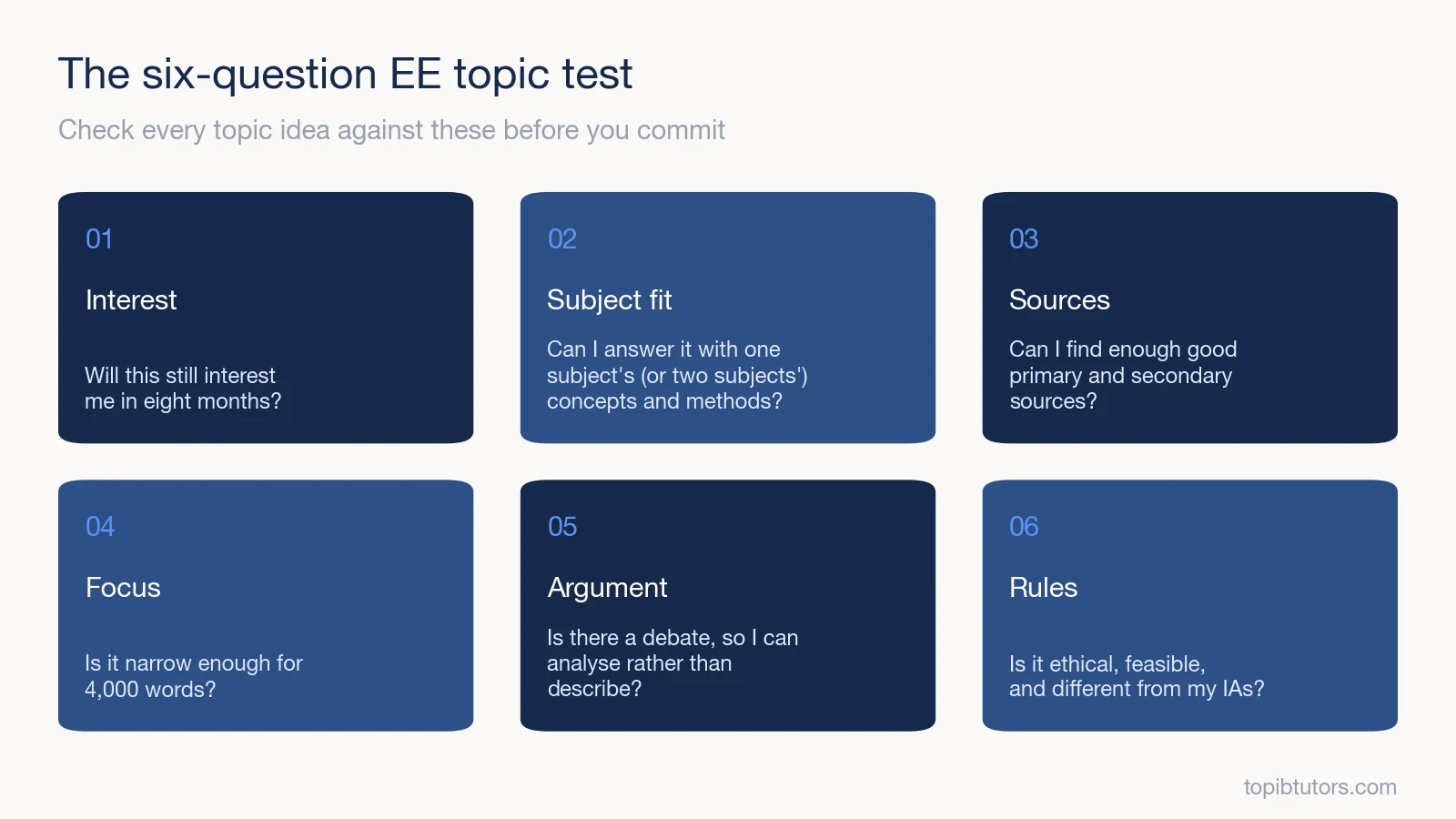
- Test it. Run it through the six-question topic test above.
- Talk to your supervisor early. They can tell you if it's feasible, and help you adjust it.
Signs You Should Change Your Topic
The IB says changing direction is "completely acceptable" and will be supported by your supervisor. Consider changing if:
- you can't find enough sources after a genuine search
- every source agrees, leaving nothing to argue
- your question can only be answered descriptively
- you've lost interest
- it overlaps with your IA.
Sometimes just a slight change of wording is enough.
Frequently Asked Questions
How do I choose an Extended Essay topic?
Start with a broad area you genuinely care about, choose a subject-focused or interdisciplinary pathway, narrow your topic, check that sources exist, and turn it into a focused research question starting with "how", "why" or "to what extent".
What is the best subject for an Extended Essay?
The best subject is the one you're most interested in and study in the DP. The most popular EE subjects in May 2026 were English A, History, Business Management, Psychology and Biology.
Can I change my EE topic?
Yes. The IB says changing your topic or research question is completely acceptable and your supervisor will support it.
Can I use a topic idea from a list?
You can use one as inspiration, but adapt it. Your research question should reflect your own interests, sources and context.
How narrow should my EE topic be?
Narrow enough to answer properly in 4,000 words. If your topic would need a book to cover, narrow it by place, time, group or variable.
When should I choose my EE topic?
Schools set their own timelines, but many students choose a topic in their first year of the Diploma. Starting early gives you time for a preliminary investigation and to change direction if needed.
Get Expert Help Choosing Your EE Topic
The right topic makes everything that follows easier. Our Extended Essay tutoring gives you one-to-one support from experienced IB tutors, from brainstorming and testing topics to refining your research question and planning your research, always within the IB's rules on authentic work. For the full EE rules, see our complete Extended Essay guide.
Organise an Extended Essay tutor today →
Sources: IB, Extended essay guide (first assessment 2027, updated November 2025); IB, Business management guide; IB, DP and CP statistical bulletin, May 2026.


