



From May 2027, every International Baccalaureate (IB) student chooses between two pathways for the Extended Essay (EE): subject-focused or interdisciplinary. The interdisciplinary pathway lets you combine two Diploma Programme (DP) subjects to answer a single research question. It's the IB's biggest change to the EE in years. The IB says the new EE "puts a stronger emphasis" on interdisciplinary research to address complex issues.
Done well, an interdisciplinary EE can be the most original essay you write. Done badly, it reads like two short essays stapled together. This guide explains how to get it right: deciding whether it's the right pathway, choosing your subjects and framework, and, most importantly, integrating the two subjects.
All the rules and requirements come from the IB's official Extended essay guide (first assessment 2027, updated November 2025) and the IB's Extended Essay updates page, explained in our own words.
Key Takeaways
- An interdisciplinary EE integrates knowledge, concepts, theories, perspectives or methods from two DP subjects to answer one research question.
- Choose it only when two subjects give a better answer than one. The IB says both pathways are equally valid.
- You register your essay in one of five frameworks, but the framework itself isn't assessed.
- The IB strongly recommends that you study at least one of your two subjects.
- Essays must currently be written in English, French or Spanish, and ESS and Literature and Performance can't be used.
- Integration is what examiners look for. The two subjects don't need equal weight, but they must work together.
What Is an Interdisciplinary EE?
The IB defines it simply: you research and write in an interdisciplinary way when you integrate knowledge, concepts, theories, perspectives or methods, or a combination of these, from two chosen DP subjects. The guide adds that integration can lead to insights "that would not be possible through research within one DP subject alone".
It replaces the old World Studies EE, but it's much broader. World Studies required a global issue linked to a local example. The interdisciplinary pathway allows any topic where combining two subjects helps. Read our World Studies EE guide for more on what changed.
Is the Interdisciplinary Pathway Right for You?
Ask yourself the IB's key question: why is an interdisciplinary approach appropriate for my topic?
One example from the IB's guide shows this honestly. A student interested in culture and migration admits: "I could research this topic through one subject", but argues that adding a second subject's perspective would deepen the answer. That kind of reasoning is exactly what you need to be able to explain.
The Rules
- Two DP subjects. Not more. The IB excludes ESS and Literature and Performance from this pathway because each already combines two subject groups. Including them would mean integrating more than two disciplinary perspectives.
- Study at least one. The IB strongly recommends you're studying at least one of the two subjects in the DP.
- Language. For now, interdisciplinary essays must be written in English, French or Spanish. You can still explore a text or topic in another language.
- No duplication with your internal assessments (IAs).
- Title page. It must name both subjects and your framework.
The Five Frameworks
When you register your essay, you place it in one framework:
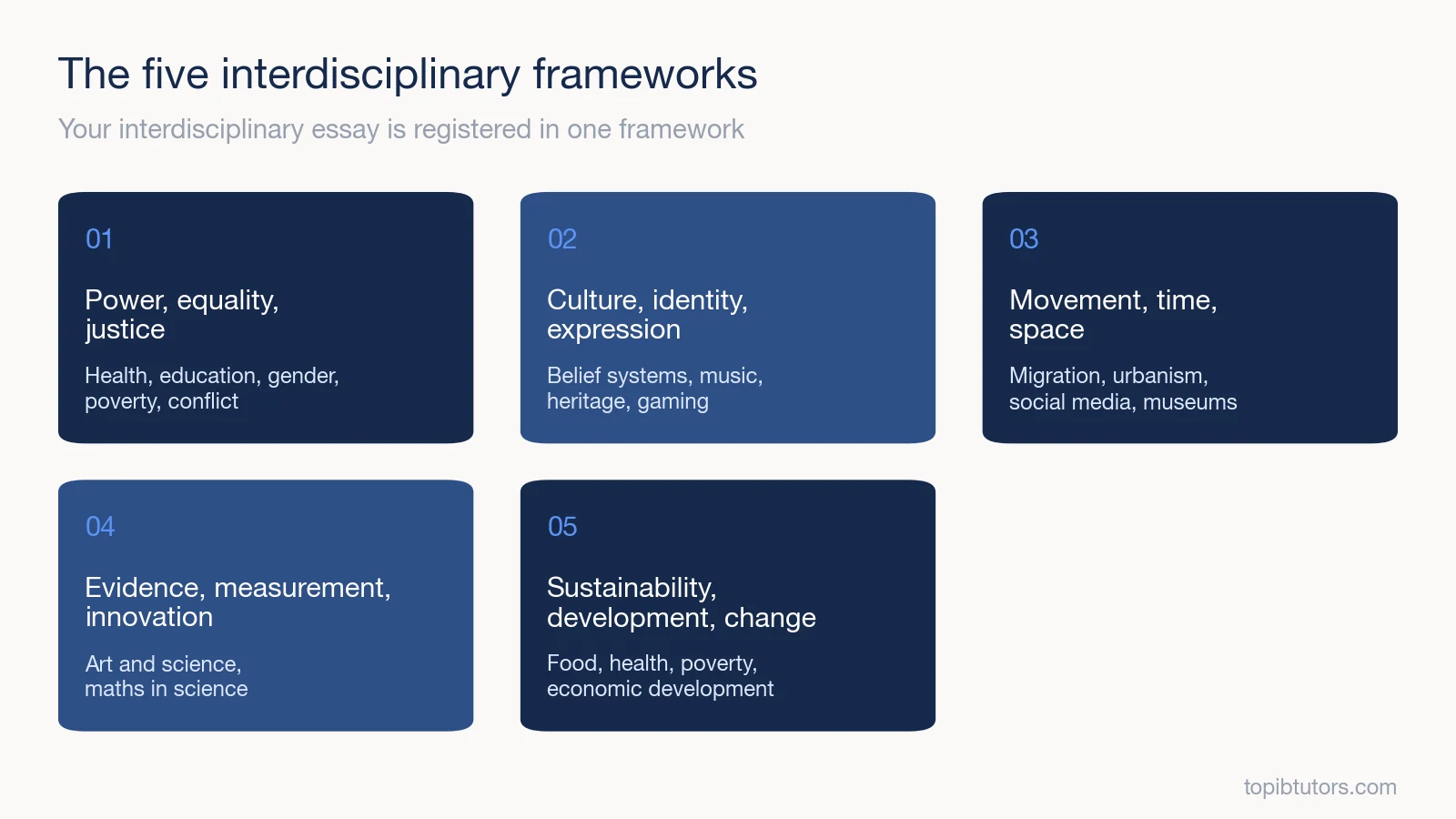
The frameworks are a starting point, not a test. The guide says the connection to your framework isn't directly assessed, your topic needn't connect with all three words, and the same topic could fit more than one framework depending on your research question. Use the framework to sharpen your idea, then move on.
Choosing Your Two Subjects
The IB's guide includes many worked examples. Here's a selection, organised by framework, showing how students paired their subjects:
Notice that strong pairings often combine one subject that provides the content (the event, text or issue) with another that provides a tool (a method, theory or concept). The fairground example says this directly: physics gives the experimental method, and mathematics gives the language and models to describe it.
Four Ways to Integrate Two Subjects
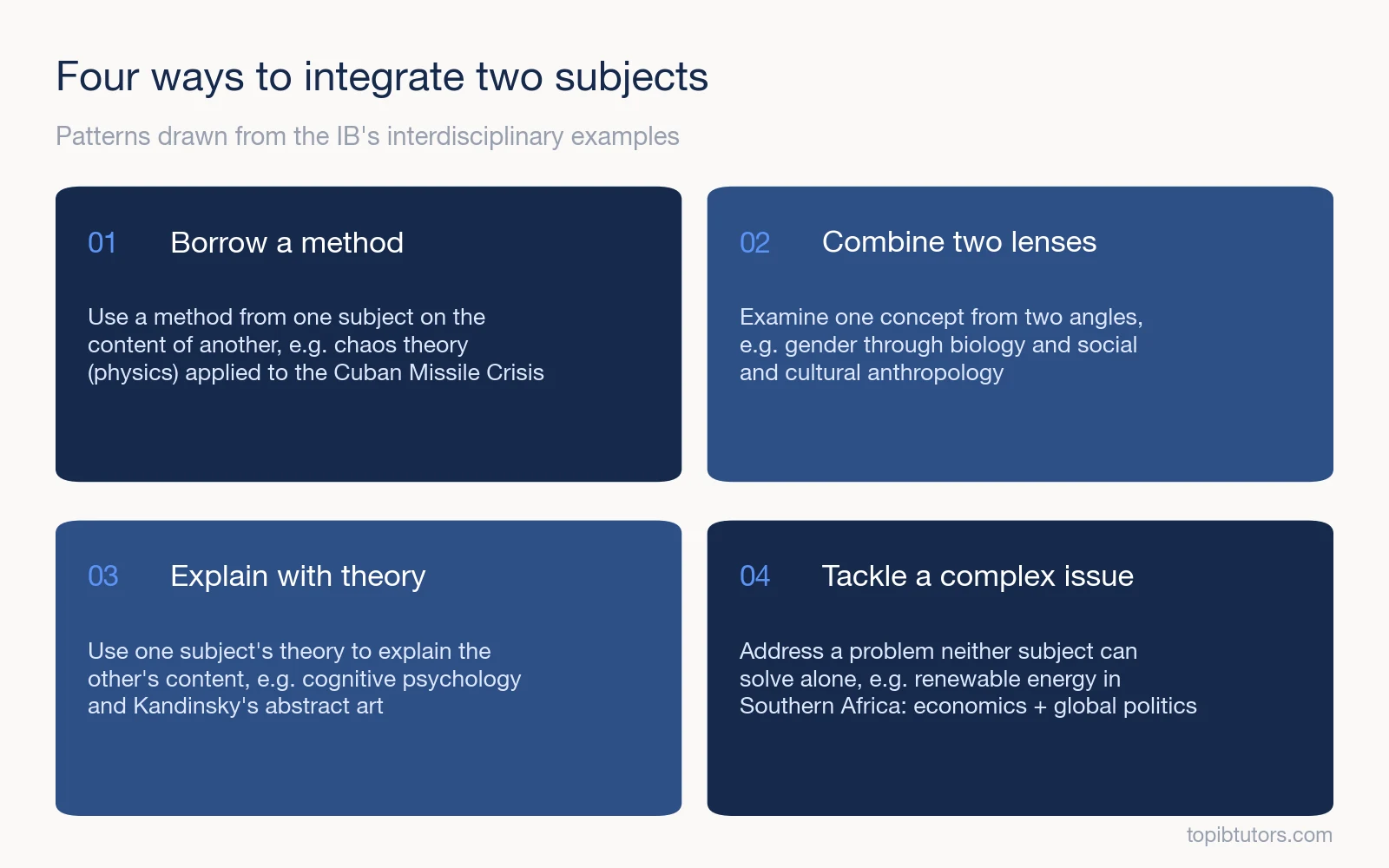
Looking across the IB's examples, integration usually takes one of four forms:
1. Borrow a method. Apply a method from one subject to the content of another. The guide's examples include applying chaos theory (physics) to the Cuban Missile Crisis (history), and design thinking (design technology) to gaming communities (digital society).
2. Combine two lenses. Examine one concept from two angles. The guide's gender example asks whether athletes should have to prove their gender, combining the genetic view (biology) with gender as a social construct (social and cultural anthropology).
3. Explain with theory. Use one subject's theory to explain the other's content. For example, applying cognitive psychology to understand how Kandinsky created his paintings.
4. Tackle a complex issue. Address a problem that neither subject can answer alone, such as how political and economic decisions shape renewable energy in Southern Africa.
You don't need to label your essay with one of these, but they're a useful test. If you can't say which one describes your essay, your integration may not be clear yet.
Integration Grows as You Write
The guide makes an important point: integration "develops and emerges" as your research progresses. It isn't something you need to have figured out on day one. A practical approach:
1. Start simply. Bring in some approaches from each subject and apply them to your question.
2. Make connections. Build an argument that links the two subjects' findings.
3. Synthesise. End with a conclusion that shows how combining the subjects answered your question.
Balance Doesn't Have to Be 50/50
The guide says the two subjects don't need to be evenly balanced. That depends on your question. What matters is that the essay "clearly" shows how integrating them enabled an effective answer.
Writing a Strong Research Question
The IB says an interdisciplinary research question should:
- be clearly stated and focused
- be open to change as your research develops
- invite critical examination by integrating elements from both subjects
- encourage analysis, evaluation and synthesis, not description or value judgements
- be answerable in 4,000 words.
A useful check: read your question and ask whether either subject could answer it alone. If one could, your question isn't truly interdisciplinary yet.
These are examples only, so check your own with your supervisor. Your question should come from your own interests.
Research Methods and Structure
The guide says the reader should be able to see that you've drawn on research methods from both subjects. For example:
- a physics experiment analysed with mathematical models
- historical sources interpreted with global politics concepts
- literary close reading combined with psychological research
- economic data combined with geographical mapping.
You should also follow the structural conventions of both subjects where relevant. A science-based essay needs labelled data and uncertainties. A history-based one needs evaluated sources. Read the subject guidance for both of your subjects. Our subject EE guides cover History, English, Biology, Economics, Psychology and Business Management.
A note on Psychology: a Psychology EE must use secondary sources only. Check with your supervisor how that applies if Psychology is one of your two subjects.
A Suggested Structure
1. Introduction: your research question, why it matters, and why it needs two subjects. 2. Approach: the concepts and methods you'll take from each subject, and how they'll work together. 3. Body sections: organised by argument, with each section drawing on both subjects wherever possible. Avoid a "Subject A half" and a "Subject B half". 4. Discussion: how the two perspectives together answer the question, including where they agree and where they pull in different directions. 5. Evaluation: how well your interdisciplinary approach worked, and the limits of your sources. 6. Conclusion: a clear answer, showing what the combination revealed that one subject couldn't.
How the Five Criteria Apply
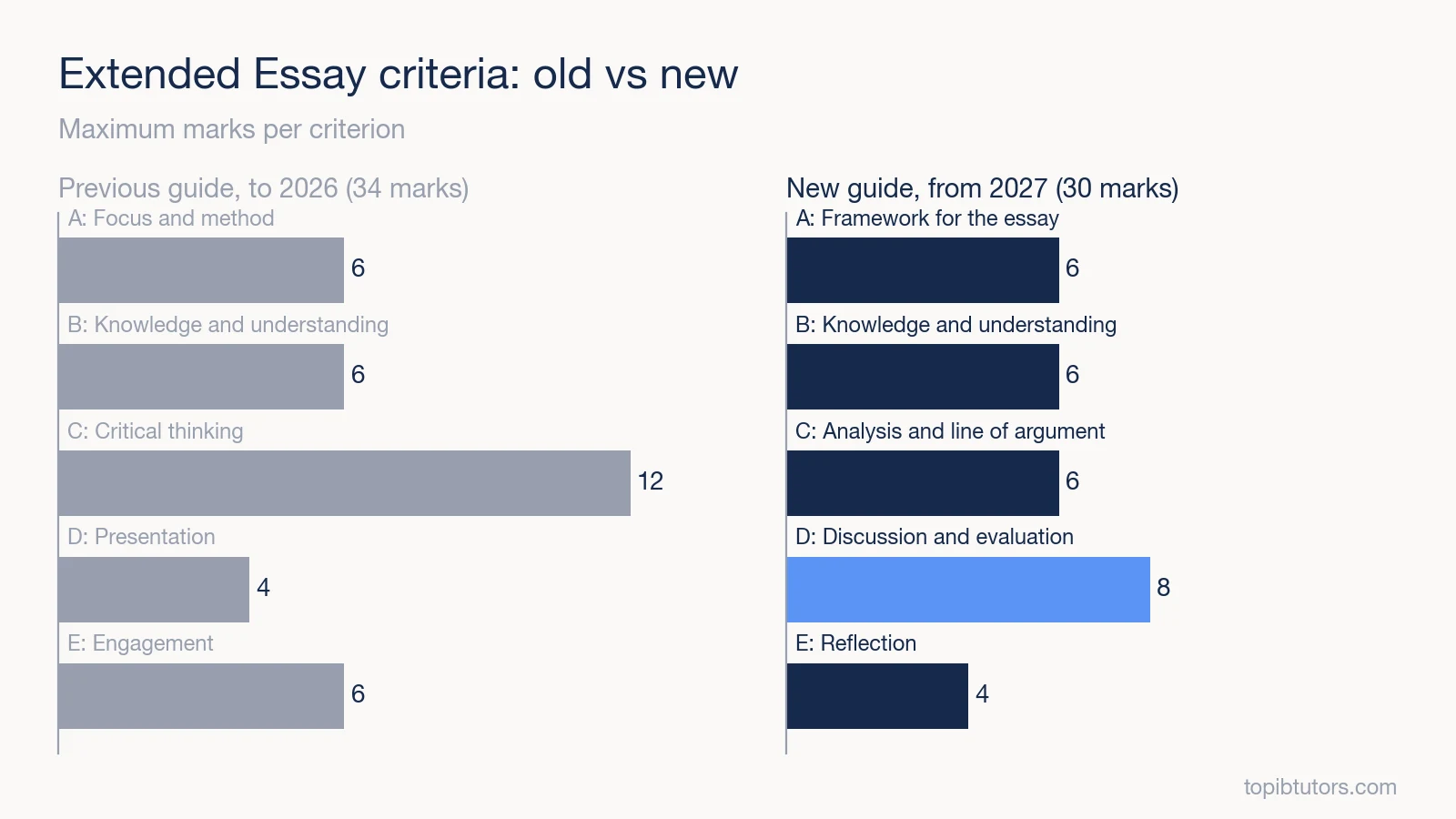
Criterion D is worth the most, and for interdisciplinary essays it's where integration matters most. Use your discussion to bring the two subjects together, not to repeat what each found separately.
Common Mistakes
- Two essays in one. Writing about one subject, then the other, with little connection.
- A "decorative" second subject. If one subject only provides background, a subject-focused EE is probably better.
- Not justifying the approach. Criterion A expects you to explain why two subjects are needed.
- Weak grounding in the unfamiliar subject. Learn its key concepts and methods properly, or choose a subject you study.
- Using ESS or Literature and Performance. These aren't allowed in this pathway.
- Writing in the wrong language. Use English, French or Spanish for now.
- Overloading the question. Two subjects already add complexity. Keep the question narrow.
A note on AI: the IB says using AI to write your essay and presenting it as your own is dishonest. If you use AI-generated material, you must acknowledge it and check it against other sources.
Frequently Asked Questions
What is an interdisciplinary Extended Essay?
An EE that integrates knowledge, concepts, theories, perspectives or methods from two DP subjects to answer one research question. It's one of two pathways for EEs from May 2027.
Is an interdisciplinary EE marked differently?
No. It uses the same five criteria, worth 30 marks, as every EE. Examiners apply the criteria in the context of your two subjects and your integration.
Do I have to study both subjects?
No, but the IB strongly recommends studying at least one of them, so you have the grounding you need.
Can I combine more than two subjects?
No. The interdisciplinary pathway uses exactly two DP subjects. The IB excludes ESS and Literature and Performance partly to avoid integrating more than two disciplinary perspectives.
Does my framework affect my grade?
No. You must register your essay in a framework, but the connection isn't directly assessed.
Is the interdisciplinary pathway harder?
It's different rather than harder. The IB says both pathways are equally valid. Choose the one that best fits your question.
Get Expert Support With Your Interdisciplinary EE
An interdisciplinary EE rewards careful planning: the right two subjects, a focused question and a clear plan for integrating them. Our Extended Essay tutoring gives you one-to-one support from experienced IB tutors across both of your subjects, always within the IB's rules on authentic work. For the full EE rules, see our complete Extended Essay guide.
Organise an Extended Essay tutor today →
Sources: IB, Extended essay guide (first assessment 2027, updated November 2025); IB, DP extended essay updates (updated 19 February 2026).


