



For years, the World Studies Extended Essay (EE) was the International Baccalaureate (IB) option for students who wanted to explore a global issue through more than one subject. In May 2026 it was still the sixth most popular EE choice. But from May 2027, World Studies no longer exists as a separate option.
The IB says the World Studies EE "has been absorbed into a broader, more flexible interdisciplinary pathway". This guide explains what that means: what World Studies was, what's changed, and how to write a strong interdisciplinary EE under the new rules.
All the rules and requirements come from the IB's official Extended essay guide (first assessment 2027, updated November 2025), the IB's Extended Essay updates page and its World Studies page, explained in our own words.
Key Takeaways
- World Studies has been replaced. From May 2027, students who want to combine subjects take the new interdisciplinary pathway.
- An interdisciplinary EE integrates two DP subjects to answer one research question.
- You place your essay in one of five frameworks, such as "power, equality, justice". The framework isn't directly assessed.
- Unlike World Studies, you don't have to link a global issue to a local example, although you still can.
- Interdisciplinary essays must currently be written in English, French or Spanish, and can't use ESS or Literature and Performance.
- The essay is up to 4,000 words, plus a 500-word reflective statement, marked out of 30.
What Was the World Studies Extended Essay?
According to the IB, World Studies began as a proposal from the United World College of Mahindra in 2001. It became a pilot EE option in 2005, developed with Harvard's Project Zero.
A World Studies EE had to:
- focus on a topic of global significance. The IB gave examples such as the global food crisis, climate change, terrorism, energy security, migration, global health, technology and cultural exchange
- show how that issue appeared in a local context, using specific, small-scale examples, linking "the local to the global"
- take an interdisciplinary approach, explaining the topic through more than one subject, with a clear reason for doing so.
It was also designed to build what the IB calls global consciousness: sensitivity to local experiences as part of global developments, flexible thinking about global issues, and a sense of yourself as a global actor.
Who Still Writes a World Studies EE?
Nobody starting an EE now. The new EE is first assessed in May 2027, so the November 2026 session was the last for the old EE, including World Studies. If you're in your first or second year of the Diploma Programme (DP) now, you'll follow the new guide.
What Changed: World Studies vs the Interdisciplinary Pathway
| World Studies EE (until 2026) | Interdisciplinary EE (from May 2027) | |
|---|---|---|
| Purpose | A global issue explored through more than one subject | Any topic that's best explored by integrating two DP subjects |
| Global/local link | Required | Not required |
| How it's organised | Around a topic of global significance | Placed in one of five frameworks |
| Subjects | Two subjects | Two DP subjects, integrated |
| Marks | 34, under the old criteria | 30, under the new criteria |
The biggest shift is in scope. The IB's updates page says the new EE "puts a stronger emphasis" on interdisciplinary research, to address complex issues and questions. World Studies was for global issues. The interdisciplinary pathway is for any question where combining two subjects gives you a better answer than one subject alone.
If you liked the World Studies approach, you can still do it. A global issue explored through a local case study fits well in the new frameworks, especially "sustainability, development, change" or "power, equality, justice". It's just no longer a requirement.
The Five Interdisciplinary Frameworks
When you register an interdisciplinary EE, you place it in one of five frameworks:
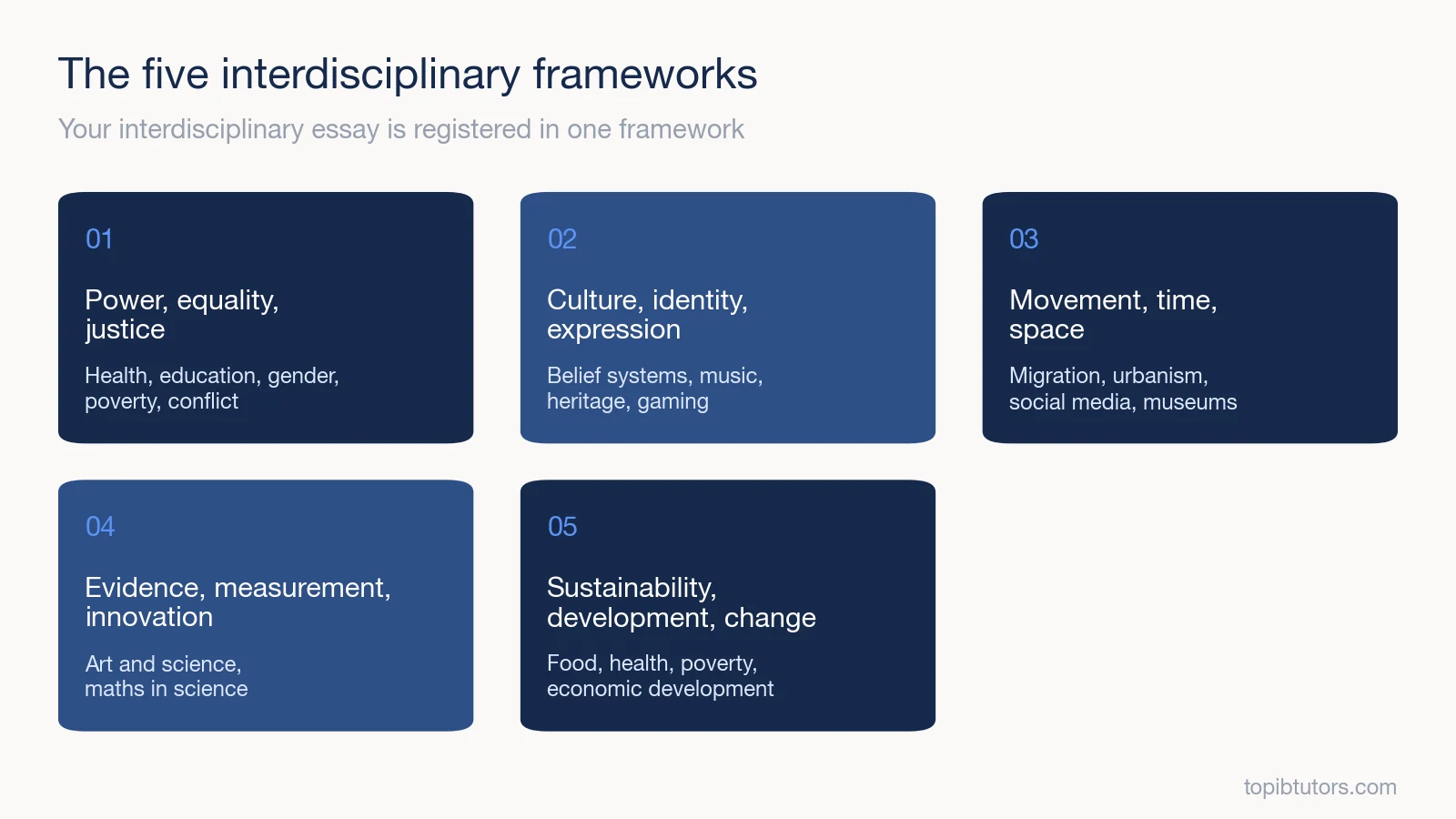
| Framework | Example topic areas from the IB |
|---|---|
| Power, equality, justice | Health, education, racism, gender, poverty, fairness, conflict |
| Culture, identity, expression | Belief systems, identity politics, political movements, cultural heritage, music, protests, gaming |
| Movement, time, space | Migration, refugees, virtual communities, urbanism, social media, globalisation, museums |
| Evidence, measurement, innovation | Art and science, literature and science, cross-scientific inquiry, mathematics in science |
| Sustainability, development, change | Environmental, social and economic sustainability Development Food Health Poverty |
Some important points from the guide:
- The framework isn't directly assessed. It helps you shape your idea and helps the IB organise marking.
- You don't need all three words. In "culture, identity, expression", your focus might be identity alone.
- Frameworks overlap. The same topic could fit more than one, depending on your research question.
The Rules You Need to Know
- Two DP subjects. You integrate knowledge, concepts, theories, perspectives or methods from two subjects.
- Study at least one of them. The IB strongly recommends that you're studying at least one of your two subjects in the DP.
- Language of submission. For now, interdisciplinary essays must be written in English, French or Spanish. You can still study a text or topic in another language, but the essay must be in one of these three.
- Two subjects you can't use. Environmental Systems and Societies (ESS) and Literature and Performance are classed as "cross-disciplinary" already, so they can only be used in the subject-focused pathway. If your idea combines geography and biology, consider a subject-focused ESS essay.
- No duplication. Your EE must not repeat work from your internal assessments (IAs).
- Balance doesn't have to be equal. The guide says the two subjects don't need to be evenly balanced. But the essay must show that combining them helped you answer your question.
Planning Your Interdisciplinary EE
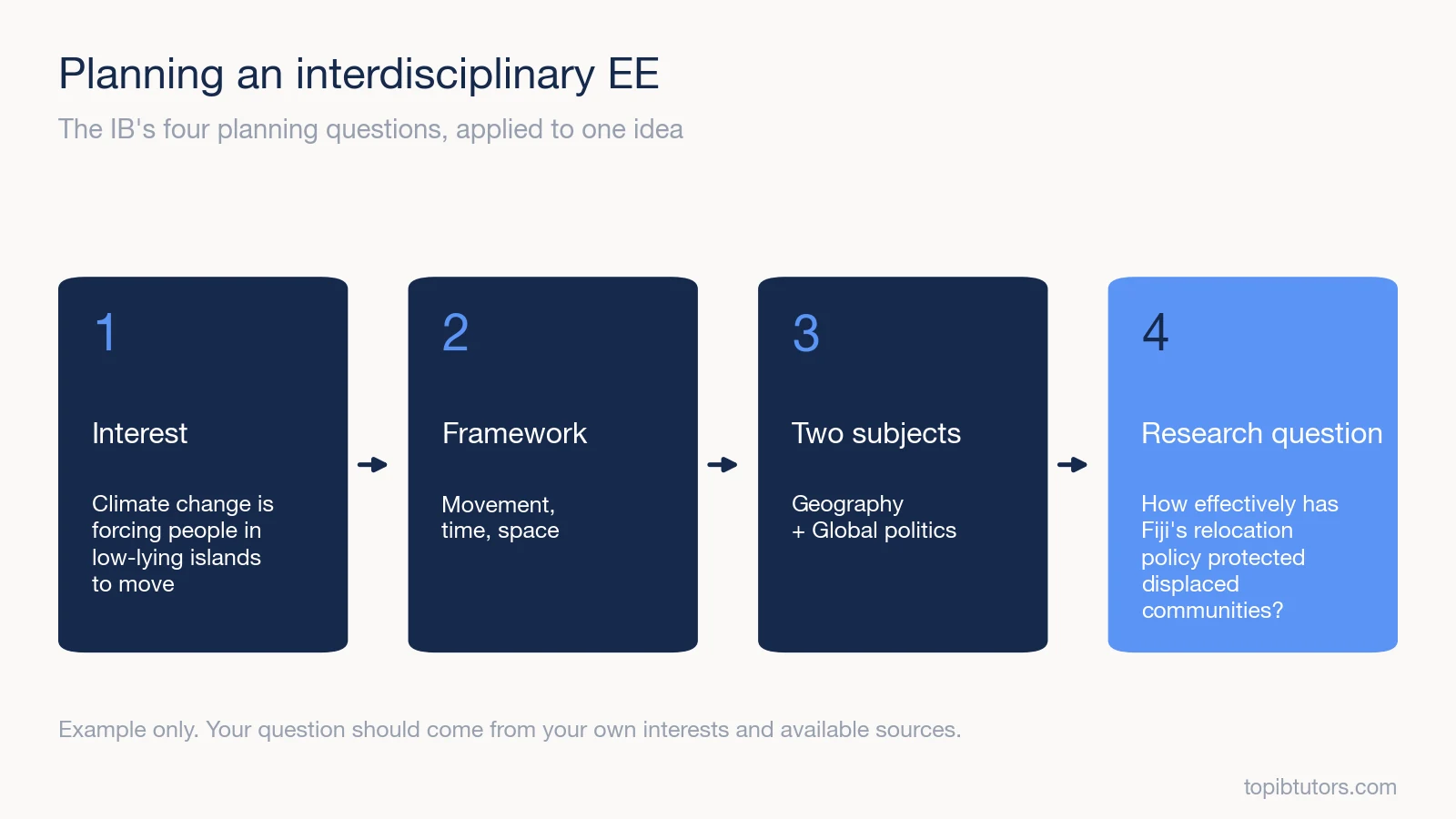
The guide suggests you "take your idea for a walk" by asking four questions:
1. What aspect or issue within this broad topic area really interests me? 2. Why is an interdisciplinary approach appropriate for my topic? 3. Which framework best suits my topic? 4. Which two DP subjects can I use to investigate my topic within that framework?
For a step-by-step walkthrough, including subject pairings and four practical ways to integrate two subjects, read our complete guide to the interdisciplinary EE.
Question 2 is the one students most often skip. If one subject could answer your question just as well, a subject-focused EE is the better choice. The IB says both pathways are equally valid.
Examples From the IB
The guide gives many examples of interdisciplinary topics, including:
- Gender in sport, inspired by the case of Caster Semenya: biology with social and cultural anthropology, or language and literature with global politics
- Disputes over property in East Jerusalem's Sheikh Jarrah area: history with global politics, under "power, equality, justice"
- Gentrification in Lisbon's historic centre: geography with economics, under "movement, time, space"
- Food security in Singapore since 2018: geography with economics, under "sustainability, development, change"
- Instagram influencers and marketing: digital society with business management, under "evidence, measurement, innovation"
- Dance therapy and dementia: dance with psychology.
Several of these, such as food security and gentrification, would once have been World Studies essays.
Writing a Strong Research Question
The IB says an interdisciplinary research question should be clear and focused, invite critical examination using both subjects, and encourage analysis, evaluation and synthesis rather than description. It should also be answerable in 4,000 words.
| Weak question | Why it's weak | Stronger version |
|---|---|---|
| What is climate migration? | Descriptive, one subject could answer it | How effectively has Fiji's relocation policy protected displaced communities? (geography and global politics) |
| How does social media affect teenagers? | Far too broad | To what extent do social media recommendation systems contribute to compulsive use among adolescents? (digital society and psychology) |
| Is fast fashion bad for the environment? | A value judgement, no clear subjects | How far can circular business models reduce the textile waste of a major fashion retailer? (business management and chemistry) |
| How did the Cold War affect art? | Too broad, unclear integration | How did Soviet state policy shape the style of socialist realist painting between 1934 and 1953? (history and visual arts) |
These are examples only. Your question should come from your own interests.
How the Five Criteria Apply to an Interdisciplinary EE
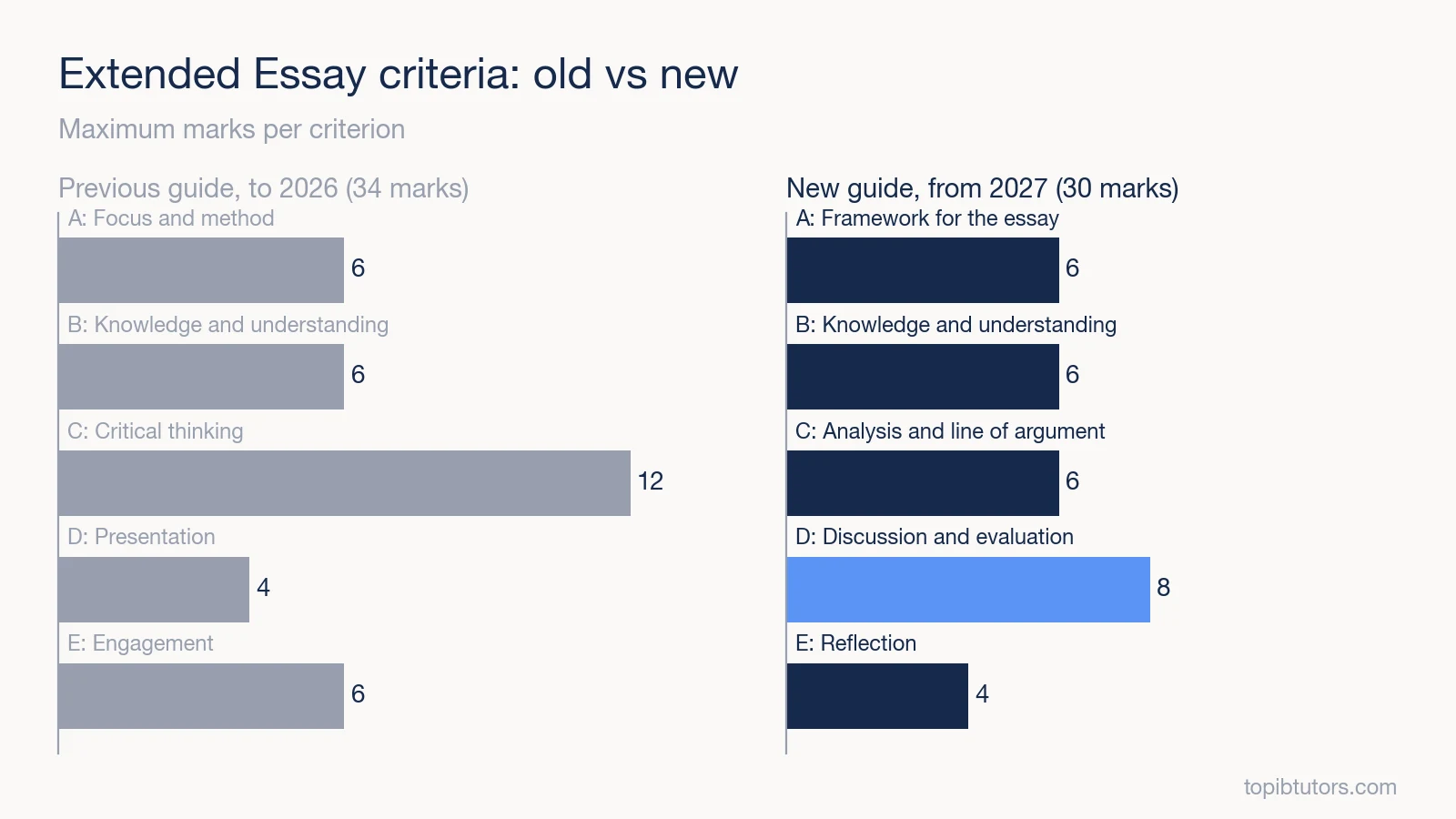
Every EE is marked against the same five criteria. The guide adds specific advice for interdisciplinary essays:
| Criterion | Marks | What it means for an interdisciplinary EE |
|---|---|---|
| A: Framework for the essay | 6 | Your research question should reflect your interdisciplinary approach, and you should explain and justify that approach. Use research methods from both subjects and follow each subject's structural conventions where relevant |
| B: Knowledge and understanding | 6 | Show grounding in both subjects through their terminology and concepts. The balance doesn't have to be even |
| C: Analysis and line of argument | 6 | Your findings should reflect both subject lenses, and your argument should show how the two perspectives come together |
| D: Discussion and evaluation | 8 | Discussion is "the key tool" for integrating the two subjects. Evaluate how well your interdisciplinary approach worked |
| E: Reflection | 4 | Your 500-word reflective statement. The guide notes that interdisciplinary research is itself a transferable skill |
Integration Is the Key
The most common weakness is an essay that discusses one subject, then the other, without bringing them together. The guide describes integration as something that grows as you research and write. You can start by using approaches from each subject, then build an argument that connects them, ending with a conclusion that shows how combining them answered your question.
Before you start, read the subject-specific guidance for both of your subjects too. Our subject EE guides cover History, English, Biology, Economics, Psychology and Business Management.
A Suggested Structure
The IB requires a title page, contents page, introduction, body, conclusion and bibliography. For an interdisciplinary essay, the title page must show both subjects and your framework. A typical structure:
1. Introduction: your research question, why it matters, and why two subjects are needed. 2. Approach: the concepts and methods you'll use from each subject. 3. Body sections: organised by argument, with each section drawing on both subjects where possible. 4. Discussion: how the two perspectives together answer the question, and where they differ. 5. Evaluation: strengths and limits of your interdisciplinary approach and your sources. 6. Conclusion: a clear answer, showing what the combination revealed.
For word count and formatting rules, see our complete Extended Essay guide.
Common Mistakes in Interdisciplinary EEs
- Choosing two subjects without a reason. Explain why your question needs both.
- Writing two mini-essays. Integrate the subjects throughout.
- Weak grounding in one subject. Choose at least one subject you study, and research the other's methods and concepts carefully.
- Writing in the wrong language. Interdisciplinary essays must currently be in English, French or Spanish.
- Using ESS or Literature and Performance. These are only allowed in the subject-focused pathway.
- Treating it like old World Studies advice. A global-local link is optional now. What matters is integration.
A note on AI: the IB says using AI to write your essay and presenting it as your own is dishonest. If you use AI-generated material, you must acknowledge it and check it against other sources.
Frequently Asked Questions
Can I still write a World Studies Extended Essay?
No. From May 2027, the IB has absorbed World Studies into the new interdisciplinary pathway. November 2026 was the last session under the old EE.
What replaced World Studies?
The interdisciplinary pathway. You integrate two DP subjects and place your essay in one of five frameworks.
Do I still need a global issue and a local example?
No. That was a World Studies requirement. You can still take a global-local approach, but any topic suited to two subjects is now allowed.
Is an interdisciplinary EE harder than a subject-focused one?
Not necessarily, but it needs good grounding in two subjects. The IB says both pathways are equally valid. Choose the one that best fits your question.
Is the framework assessed?
No. You must register your essay in a framework, but the connection to it isn't directly assessed.
Which subjects can I combine?
Any two DP subjects available for your exam session, except ESS and Literature and Performance, which can only be used in subject-focused essays. The IB strongly recommends that you study at least one of them.
Get Expert Support With Your Interdisciplinary EE
Combining two subjects well takes careful planning. Our Extended Essay tutoring gives you one-to-one support from experienced IB tutors, from choosing your subjects and framework to integrating them in your argument and preparing for your viva voce, always within the IB's rules on authentic work.
Organise an Extended Essay tutor today →
Sources: IB, Extended essay guide (first assessment 2027, updated November 2025); IB, DP extended essay updates (updated 19 February 2026); IB, World Studies Extended Essay.


